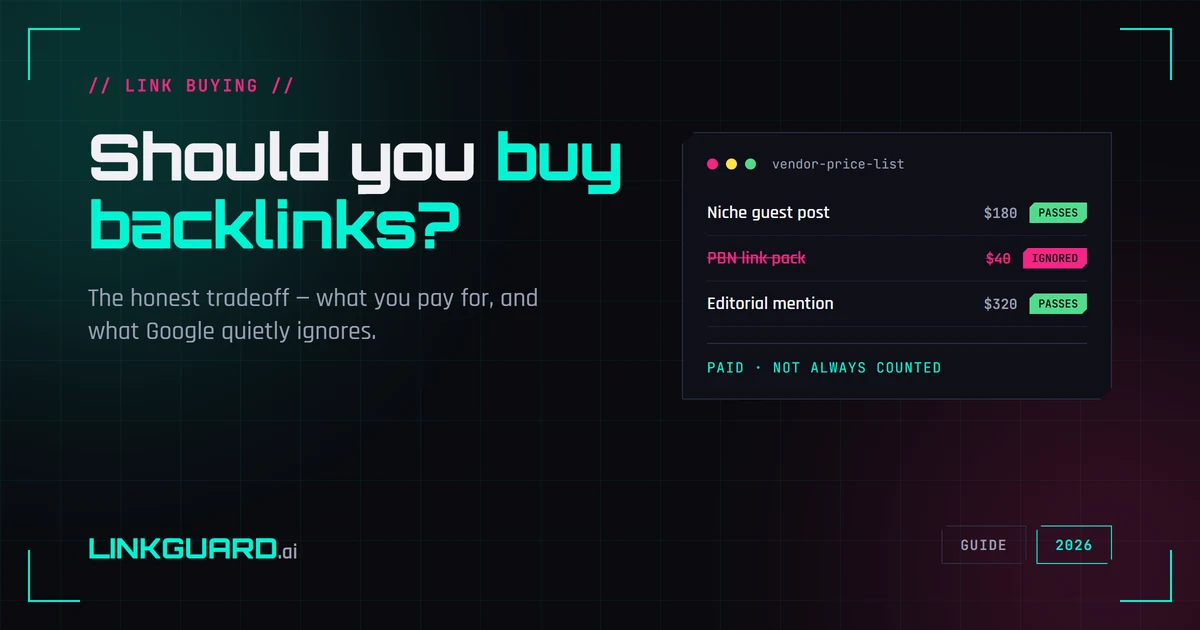
Somebody slides into your inbox with a price list. "DA 50+ sites, dofollow, niche-relevant, $40 a link, bulk discount over twenty." The screenshot looks legit, the sites have traffic graphs, and you have a page stuck on the second page of Google that one good link might nudge over the line. So you wonder whether you should just buy the backlinks. The math feels obvious: a few hundred dollars now, more traffic forever.
I have sat with that exact temptation, and I have watched plenty of people give in to it and then regret it quietly. Not because Google dropped a hammer on them, but because the money mostly vanished into links that did nothing, or worked for a month and then died. So here is the honest version of whether you should buy backlinks, with the boring parts left in: what happens when you pay for them, when it is a waste, when it is a real risk, and what tends to work better for the same budget.
The short answer
Buying backlinks that pass ranking credit breaks Google's spam policies. But the consequence most buyers meet is not a penalty. It is waste: Google's systems are good enough now that a large share of paid links get ignored, so you pay for ranking power you never receive. A paid directory listing is the same trade in a cheaper suit. A smaller number of buyers do get hit with a manual action. And nearly all paid links share a third problem that has nothing to do with Google: they decay. The page gets edited, the link gets nofollowed, the site moves, the placement disappears, and your rented authority leaves with it. If you want links that compound instead of evaporate, you earn them. If you are going to buy anyway, the rest of this is how to lose the least.
What Google really does when you pay for a link
Google's spam policies are not vague about this. Exchanging money for links, or for posts that contain links, that pass ranking signals is listed as link spam. The compliant escape hatch is to qualify the link: a paid or sponsored link is supposed to carry rel="sponsored" (or at least nofollow), which tells Google not to pass ranking credit. A link you pay for and leave as a plain followed link is exactly what the policy prohibits.
What happens next is where the fear and the reality drift apart. Since the December 2022 link spam update, Google leans on SpamBrain, its machine-learning spam system, to neutralize spammy links rather than always punish the site that received them. Neutralize means devalue: the link still sits on the page, but it passes no weight. You bought a number that rounds to zero. That is the common outcome, and it is why so many link-buying campaigns produce a beautiful backlink report and no movement in rankings.
The less common outcome is a manual action: an "unnatural links" notice in Search Console, applied by a human reviewer, that can suppress rankings until you clean up and file a reconsideration request. It is rarer than the panic suggests, and more likely when the pattern is obvious: a sudden pile of exact-match anchors, footprints across a network, links that all but shout "paid." It is the heavy-handed, high-volume buying that rolls that die.
The risk nobody puts on the invoice: the link just stops working
Set Google aside for a second, because there is a problem with bought links that exists even if every one of them is perfectly "safe." You do not own them. You are renting a spot on someone else's page, and that someone can change their mind.
This is the part our whole library keeps circling back to, because it is the part that bites quietly. A paid link's working lifespan is often measured in months, not years. The publisher switches it to nofollow during a template change and never tells you. They rewrite your anchor to something generic. The post gets pruned in a content cull, the domain changes hands, or the page just 404s. None of this trips an alarm. You find out, if you ever find out, when you go looking, or when the traffic you were counting on never shows.
So even the optimist's version of buying links, "I will only buy good, relevant, followed links from real sites," comes with a meter running. The authority you paid for is on loan, and the loan can be called at any time, without a word.
When buying is simply a waste of money
Most of the link-buying I see fails the cheapest test: relevance. A link from a site with nothing to do with your topic, dropped into a paragraph that was clearly built to hold links, is the kind of thing Google's systems are tuned to discount. You are not buying authority. You are buying a footprint.
A few patterns are close to dead money:
- Links on "write for us" farms that publish anyone, about anything, for a fee. This is the paid-article-with-optimized-anchors placement Google's spam policy flags directly.
- Private blog networks (PBNs). The pitch is "our own network of high-DA sites." The old giveaways for these — shared hosting, recycled templates, thin content — have largely stopped working, and the ones that replaced them are in our guide to PBN backlinks. What has not changed is the shape of the loss: the whole network tends to go at once, and so does everything you bought on it.
- Anything sold purely on a third-party score. An expired domain repurposed to sell links can carry a "DR 60" propped up by its own bought history. The number is not the audience.
If you want to sanity-check a profile you have already built this way, our backlink audit score and donor trust audit give you a fast read on how a linking site looks, and the AI backlink risk score flags the patterns that tend to age badly. They will not make a bad link good. Nothing does. But they will tell you what you are holding.
The narrow case where paying for a placement is defensible
There is a version of paying for a link that is not link spam, and it is worth naming so this does not sound absolutist. If you pay a relevant publication for a placement and treat it as advertising, disclosed and marked rel="sponsored" or nofollow, you are inside the rules. You will not get ranking credit from it, and you should not expect to. What you might get is real referral traffic and a brand mention in front of the right audience, which can be worth the spend on its own terms.
That is the honest frame. Pay for traffic and exposure, with the link correctly tagged, and it is a media buy. Pay for ranking with a followed link, and it is the thing that gets devalued or, occasionally, penalized. The trouble is that almost nobody selling "backlinks" means the first one.
If you are going to buy anyway, lose the least
People buy links regardless of what any guide says, so here is the harm-reduction version rather than a lecture. The goal shifts from "rank with this" to "do not get burned."
Vet the site like you are about to advertise on it, not link from it: real organic traffic, a topic that genuinely overlaps yours, an audience that exists, outbound links that are not already a graveyard of paid placements. The outbound links analyzer shows you that last part fast. Vet the seller separately. Our guide on how to vet a link seller and the one on what "permanent" and "replacement" guarantees actually promise exist because the words on the invoice rarely mean what you think. Keep the anchor boring and branded, not exact-match. Know which product you are buying, too — an insertion into somebody’s existing post fails differently from a new article, and what a niche edit really buys you is worth reading before you pay for one. Then do the part everyone skips: actually watch the link, because the day it breaks or goes nofollow is the day it stops earning, and nobody is going to email you about it. If it does go bad, our notes on recovering a lost paid link (or getting the refund) are the next step.
What works better for the same money
Here is the reframe that changed how I spend. The budget you would burn on ten rented links buys a lot of one earned link that nobody can take back. Links you earn, because you made something worth citing or did a real favor for a real publisher, pass weight precisely because they were not bought, and they do not carry the meter.
The most reliable of these is not glamorous. Guest posting, the real kind, an actual contribution to a relevant site rather than a mass-produced article-farm placement, earns links that sit in genuine editorial context. Broken-link building trades a small service (you found a dead link, here is a live replacement) for a placement that belongs. Both are slower than swiping a card. Both produce links you do not have to nervously monitor for the rest of their lives. One more thing worth checking on any link you earn or buy: that it is a followed link, because a nofollow placement, paid or earned, will not pass the ranking value you were after.
Questions people ask
Is buying backlinks illegal?
No. It is not against any law. It is against Google's spam policies, which is a different thing. The cost of breaking those policies is not legal trouble; it is Google devaluing the links so they do nothing, or, less often, a manual action that suppresses your rankings until you clean up. So "illegal" is the wrong word. "Against the rules of the game you are trying to win" is the right one.
Will I get penalized for buying links?
Usually not in the dramatic sense. The common outcome since Google's 2022 link spam update is neutralization: SpamBrain ignores the link, so you simply wasted the money. A manual "unnatural links" action is the rarer, harsher outcome, and it is most likely when the buying is obvious: exact-match anchors at volume, network footprints, unnatural spikes. Rare does not mean impossible, and a manual action is a genuinely bad week.
Do bought links still work in 2026?
Some slip through and pass value for a while. That is why the market still exists. But "works" is doing a lot of lifting. A link that passes credit today can be devalued in the next update, switched to nofollow by the publisher next quarter, or removed when the page is restructured. Betting your rankings on links you do not control, that Google is actively trying to discount, is a weak position even when it occasionally pays off.
How does Google detect paid links?
Mostly through patterns, not by catching a transaction. SpamBrain weighs signals like irrelevant linking sites, unnatural anchor-text distributions, link velocity that does not match a site's normal growth, and footprints across sites that share hosting, templates, or owners. It does not need to see your invoice; it needs to see that the links do not look like links people give freely.
What about "sponsored" or nofollow links — are those safe to buy?
Yes, in the sense that paying for a properly tagged rel="sponsored" or nofollow link is within Google's rules: that is just disclosed advertising. The catch is that those links are not meant to pass ranking credit, so buy them for referral traffic and brand exposure, not for SEO. If a seller offers you a "sponsored" tag and promises rankings, they are promising two things that contradict each other.
I already bought a bunch of links. Should I disavow them?
Probably not reflexively. Google's own guidance is that most sites never need the disavow tool, because the algorithm already ignores the junk. Disavow is mainly for when you have a manual action tied to links you cannot get removed, or a real pattern of paid links you control. If that is you, our disavow file generator builds the file in the right format. But treat it as a last resort, not a routine cleanup.
The honest summary
Buying backlinks is not illegal, and it is not an instant death sentence. It is a bad trade. Most of what you buy gets ignored, a little of it gets you in real trouble, and almost all of it decays on a timeline you do not control, so you pay for authority you rent, watch erode, and cannot bank. Spend the same budget and patience on a smaller number of links you earn, and you get the opposite: fewer links, but ones that pass weight and stay put.
So before you spend on links, spend on the thing that makes any link worth buying: knowing it still works. Start free with 1,000 tokens and point LinkGuard at the links you care about, so the day one breaks or goes nofollow is the day you find out, not the quarter after. And if you just want to see what your existing paid links are worth first, run a couple of the linking sites through the donor trust audit.
About the Author

Related Articles

Expired domain backlinks decay before the auction closes
Policy requires an expired .com to resolve to nothing for weeks before anyone can buy it. The links you're bidding on were counted before that, by a crawler that hasn't been back.

PBN backlinks don't fail one at a time
Google's spam documentation never uses the word. What a network link actually is in 2026, which footprints still identify one, and why four of them tend to go in the same week.
Directory submission in 2026: what a listing is actually worth
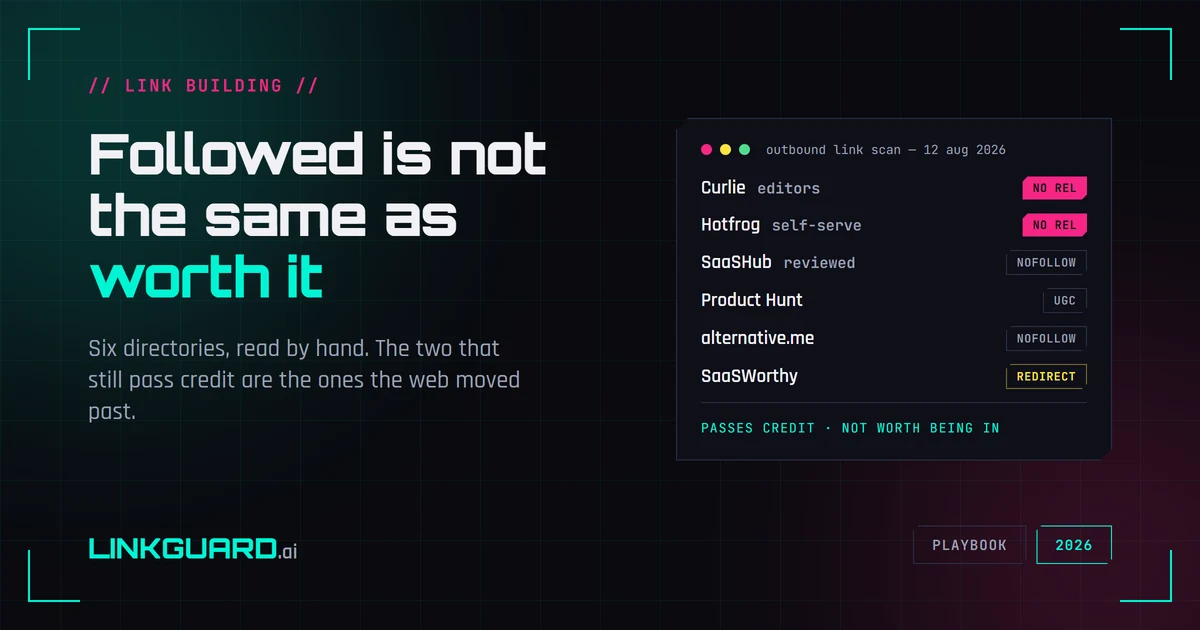
Google's spam policy names low-quality directory links as link spam. We opened six web directories and read the raw HTML: the two that still pass link credit are the general-directory survivors, while every vertical directory worth being listed in withholds it. What the tactic is still good for, and what to check once a listing is live.