Open any link marketplace and the listings compete on the same three words: permanent, replacement guarantee, money-back. They're the close. They turn a hesitant buyer into a paying one, because they make the purchase feel risk-free. Then a link drops, you go to claim the guarantee that sold you, and you find out what it was actually worth.
Most link guarantees are written to sell, not to pay out. That doesn't make them worthless, but it does mean you have to read them for what they obligate, not what they imply. Here's what each of the three obligates, the fine print that quietly voids it, and the one thing that decides whether you ever collect.
The three guarantee words, and what they actually promise
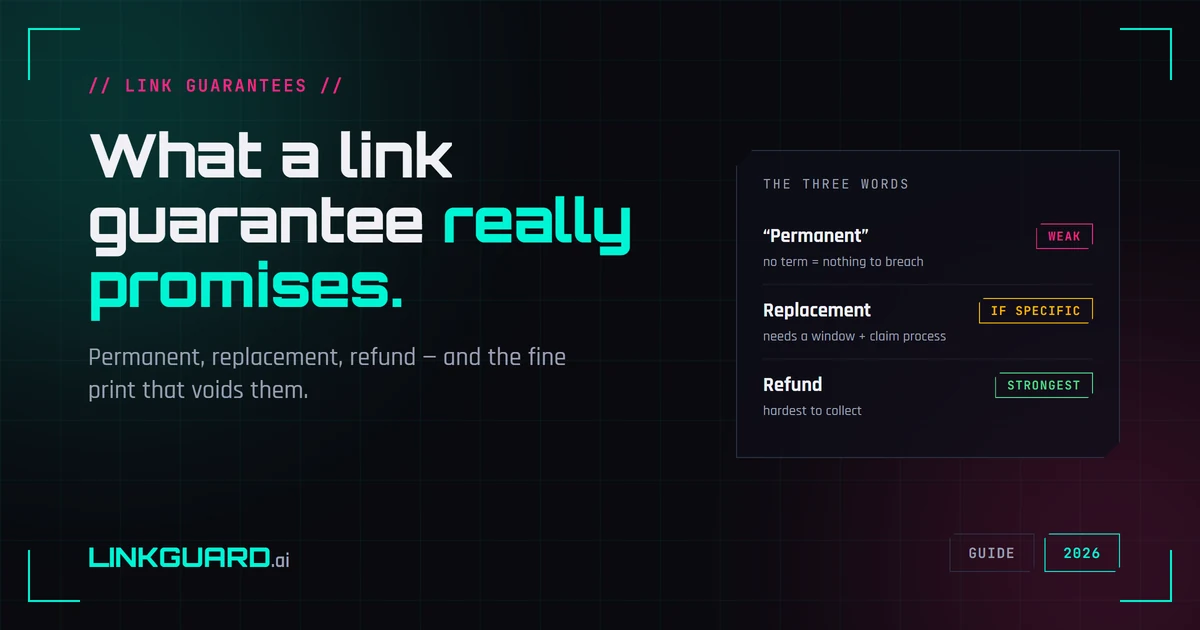
"Permanent." This is the weakest of the three, because it promises an outcome no seller controls. "Permanent" means "we don't plan to remove it", not "it cannot be removed". Site redesigns, page deletions, ownership changes, and plain neglect all kill permanent links, and none of them is a breach of anything, because there was no term to breach. A "permanent" link with no replacement or refund attached is a marketing word, not a guarantee. For why even genuine placements fade, see how long paid backlinks last.
"Replacement guarantee." Potentially the most useful of the three, but only if it's specific. A real replacement guarantee names two things: a window (how long the link is covered) and a claim process (what you do when it drops). "Lifetime replacement" with neither is a slogan. "We'll place an equivalent link on a comparable page within 14 days if it drops inside 12 months" is a guarantee you can actually hold someone to.
"Money-back" / refund guarantee. The strongest on paper and the hardest to collect. A refund means the seller gives back cash they've already booked, which is the outcome they least want, so refund guarantees tend to carry the most conditions. When they're honored, they're the cleanest remedy. When they're not, they're the one most likely to get buried in fine print.
The fine print that quietly voids a guarantee
A guarantee fails in the gap between what it implies and what it says. The clauses that do the damage:
- No window. "Lifetime" or no stated duration sounds generous and means the seller can argue the cover already lapsed whenever you claim.
- No claim process. If the listing doesn't say how to invoke the guarantee, invoking it is whatever the seller decides on the day, which is usually "not now".
- The proof burden is entirely on you. "Show us it's gone" is reasonable, but if you have no record of the original placement and terms, you can't meet it.
- "Natural link loss excluded." A common escape hatch: the seller calls any removal "natural" and the guarantee evaporates. The narrower the definition of a covered loss, the weaker the guarantee.
- No response commitment. A guarantee with no reply deadline can be honored by silence. Slow-walking a claim until you give up is the cheapest way to not pay it.
None of this means guarantees are a scam. Plenty of sellers honor them without a fight, because their reputation depends on it. It means a guarantee is a claim about future behavior, and you should weight it by the seller's track record, not the adjective in the listing.
A guarantee is only as good as your proof
Here's the part the listing never mentions: every guarantee, replacement or refund, puts the burden of proof on the buyer. To collect, you have to show the link was live, show it's now gone or changed, show it happened inside the covered window, and point to the terms you originally agreed. A seller acting in good faith still needs that to process a claim. A seller looking for an exit will use any missing piece as the reason to decline.
Which means the guarantee you can actually enforce isn't the one with the best wording. It's the one where you kept the receipt: the placement URL, the purchase date, the amount, the agreed terms, and the date it broke. Without that record, even an honest guarantee is hard to claim. With it, even a reluctant seller has little room to wriggle.
How to collect on a guarantee
Claiming a guarantee follows a predictable path once a link drops. Catch the loss early (a claim inside the window is worth far more than one after it), confirm the link is really gone rather than a false alert, then contact the seller with the placement details and the guarantee terms. From there it resolves one of a few ways:
- Replacement promised, then placed. The seller agrees to an equivalent link and delivers it. Confirm the new link is live and indexed before you consider it settled, and record the new URL against the old one.
- Refund requested, then received. If replacement isn't possible, you fall back to the refund the guarantee promised. This is where your written record earns its keep.
- Written off. The seller ghosts, the site is gone, or the guarantee turns out to be the worthless kind. You record the loss, learn the seller isn't worth buying from again, and move on.
For the exact wording that moves a seller from "promised" to "placed" or "refunded", we wrote the templates in backlink recovery email templates. And the bigger lesson, that the guarantee is a bet on the seller, is why vetting the seller beats trusting the adjective.
What tracking turns a guarantee into
A guarantee on its own is a promise in an email you'll struggle to find in six months. What makes it collectable is a record that ties the guarantee to the link, notices the day the link breaks, and tracks the claim to the end. That's the gap we built LinkGuard's recovery ledger to close. It holds the cost, seller, and agreed terms behind each link, and flags the day one drops while you're still inside the window. From there it runs the claim through its real stages: alerted, then outreach sent, then either a replacement (promised, then placed) or a refund (requested, then received), or an honest write-off if it comes to that. It tallies what you got back.
The honest boundary, because it matters: the ledger can't make a seller honor a guarantee. Nothing can, short of the seller deciding to. What it does is make sure you notice the loss in time to claim, you have the proof when you do, and no promised replacement or pending refund quietly falls off the list. The guarantee is still the seller's to honor. The record is what stops them from honoring it with silence.
Questions people ask
Are permanent backlinks real?
As a durability claim, no. As a guarantee, it obligates nothing. "Permanent" in a listing is a statement of intent, not a commitment you can enforce: there's no stated term, so there's nothing to breach when the link later disappears. Unless it comes paired with a written replacement or refund clause, treat "permanent" as a selling word with no remedy behind it. For how long bought links survive in practice, see how long do paid backlinks last.
What is a backlink replacement guarantee?
A promise that if your link drops, the seller will place an equivalent one elsewhere. It's only meaningful if it states a window (how long the link is covered) and a claim process (what you do to invoke it). "Lifetime replacement" with neither stated is a slogan; "equivalent link within 14 days if it drops inside 12 months" is something you can actually enforce. Always get the window and the process in writing before you pay.
Can you actually get a refund on a backlink?
Often yes, if the guarantee covers it and you can prove the claim. Refund guarantees are the strongest remedy on paper and the hardest to collect, because the seller is returning booked revenue. To succeed you need the original terms, proof the link went down inside the covered window, and ideally a seller whose track record says they pay out. Many sellers prefer to replace the link rather than refund, which is usually fine for you too.
What voids a backlink guarantee?
Five things, mostly. No stated window, so the seller can argue the cover already lapsed. No claim process, so invoking the guarantee is whatever they decide on the day. A proof burden you can't meet without your own records. A "natural link loss excluded" clause that lets them reclassify any removal. And no response deadline, so a claim can be honored by silence. The narrower the definition of a covered loss, the easier the guarantee is to void.
How long are backlink replacement guarantees usually?
It varies widely, from 30 days to 12 months to vague "lifetime" claims, and the number matters less than whether it's written down with a claim process. A short, specific window you can enforce beats a long, vague one you can't. Whatever the stated length, the practical guarantee only lasts as long as you'd actually notice a link going down inside it, which is why monitoring the covered links is what makes the window real.
Are link guarantees worth paying extra for?
Only if they're specific and the seller honors them, and you can't know the second part from the listing. A specific replacement or refund guarantee from a seller with a track record of paying out is worth a premium. A vague "lifetime" guarantee from an unknown seller is worth nothing, no matter the price. Judge the guarantee by its terms and the seller's history, not by its presence, and keep your own record of who honors theirs.
Buy the track record, not the adjective
The guarantee in a link listing is a promise about a day that hasn't happened yet, written by the person who'd have to pay it. The word doesn't protect you. What protects you is catching the loss inside the window, having the proof in hand, and knowing from experience whether this seller honors what they wrote. LinkGuard monitors your bought links, ties each to its cost, seller, and terms, flags the day one breaks, and runs the claim to a replacement, a refund, or an honest write-off, tracking what you get back. Not ready to set that up? The full recovery playbook walks a claim from a dropped link to a refund end to end. When you are, start free with 1,000 tokens and stop taking guarantees on faith.
About the Author

Related Articles

Expired domain backlinks decay before the auction closes
Policy requires an expired .com to resolve to nothing for weeks before anyone can buy it. The links you're bidding on were counted before that, by a crawler that hasn't been back.

PBN backlinks don't fail one at a time
Google's spam documentation never uses the word. What a network link actually is in 2026, which footprints still identify one, and why four of them tend to go in the same week.
Directory submission in 2026: what a listing is actually worth
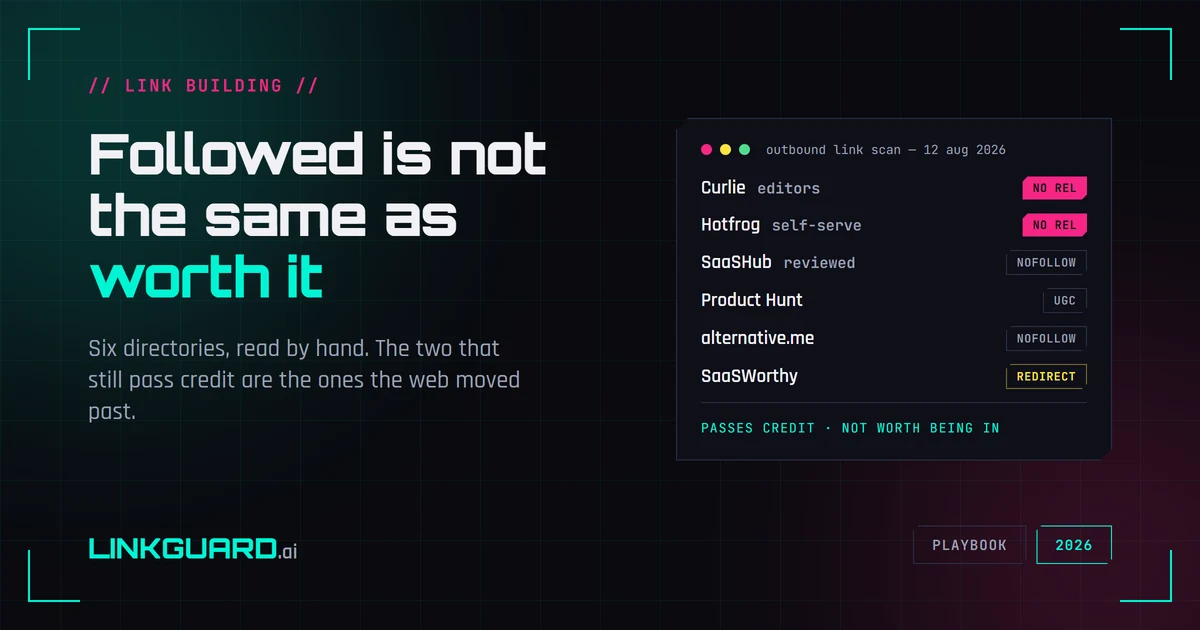
Google's spam policy names low-quality directory links as link spam. We opened six web directories and read the raw HTML: the two that still pass link credit are the general-directory survivors, while every vertical directory worth being listed in withholds it. What the tactic is still good for, and what to check once a listing is live.