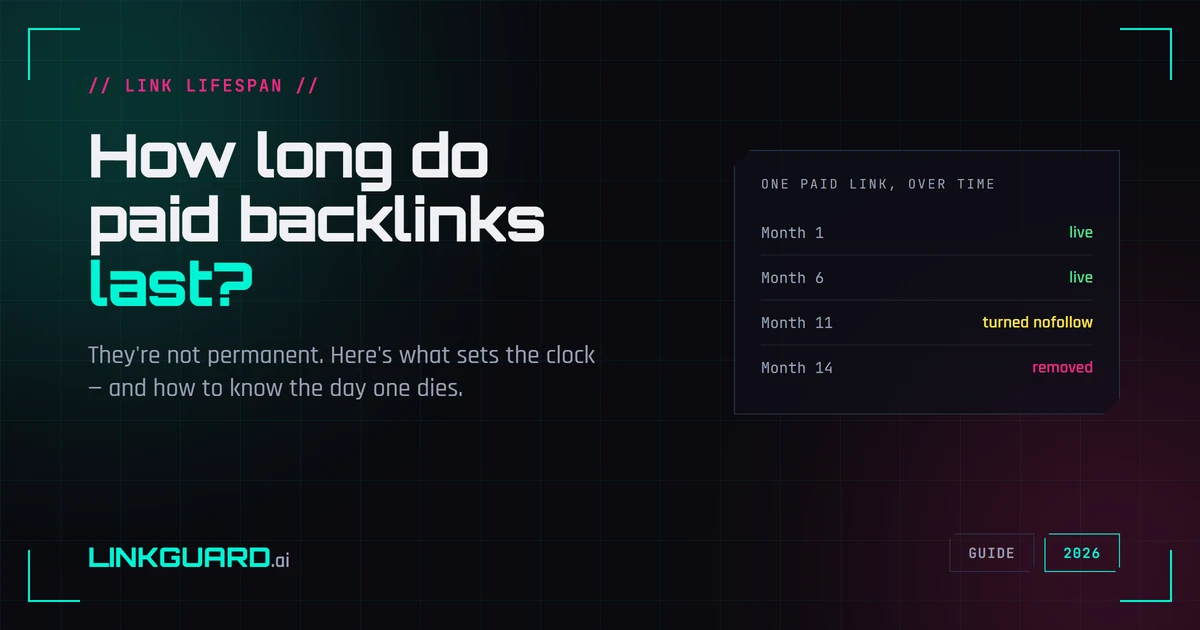
You bought a backlink. Maybe a guest post, maybe a link insertion on an established page. The natural assumption is that it stays put. You paid for it, so it's yours. It isn't. Backlinks are not permanent, and paid ones are no exception. The only question worth asking is how long yours will last, and how you'll know the day one doesn't.
This is the honest answer: there's no single number. A paid link can survive for years or vanish next month, and the difference comes down to a few things you can mostly see in advance. Here's what determines a link's lifespan, what the data says about decay, and how to stop guessing.
There is no fixed lifespan — here's what sets it
A backlink lives exactly as long as the page it sits on keeps it, and that depends on the site, not on what you paid. The factors that decide it:
- The agreed term. Many paid placements come with a stated duration — a fixed number of months, or "permanent" (which means "until we change our mind"). A link with no written term has no protection at all.
- The site's churn. Active publishers redesign, prune old posts, change CMS, and migrate domains. Each of those events can quietly drop your link. A sleepy site that never touches its archive is, ironically, the safer host.
- The seller's incentives. A reputable seller keeps your link up to protect their reputation. A churn-and-burn vendor takes your money, places the link, and has no reason to keep it once you've paid.
- The placement type. An in-content link inside a relevant, trafficked article tends to outlive a link dumped in a footer, a sidebar, or a thin "resources" page that gets pruned in the next cleanup.
- Plain decay. Even with none of the above, links fade. Pages get deleted, redirected, or set to noindex over time as the web turns over.
What the decay data says
Backlinks erode across any portfolio, free or paid. Ahrefs has written about link decay, and the picture the link-decay research consistently shows is the same: a meaningful share of any link profile disappears over the years, and the share grows the longer you look. Treat your bought links as a portfolio that loses members on a schedule, not a set of permanent assets. One category breaks that schedule: PBN backlinks do not fail independently of each other, because they all answer to one operator.
The practical takeaway isn't a percentage. It's a mindset shift: a paid link is a subscription you bought in one lump, and like any subscription it can lapse without telling you. The cost of assuming permanence is that you find out months late, after the ranking it supported has already slipped.
Paid links and free links age differently
An organically earned link and a bought one decay for the same mechanical reasons, but your relationship to the loss is different. When a free link dies — a quote you landed by answering a journalist's query, say — there's usually nothing to do but try to re-earn it. When a paid link dies before its term, you have a vendor, an agreement, and leverage — you can ask for a replacement or a refund. That's why the lifespan of a paid link matters more to track: every month of life you don't get is money you can sometimes claw back, but only if you notice in time.
The term you agreed to vs the term you get
Marketplaces and sellers advertise lifespans: "permanent", "12-month guarantee", "lifetime replacement". Read these as intentions, not guarantees. A 12-month guarantee is only worth something if you can prove the link went down inside those 12 months and the seller honors it. Plenty don't, and the only way you'll ever know is if you were watching. (For what each guarantee word actually promises and the fine print that voids it, see backlink guarantees, decoded.)
So the real lifespan of a paid link is two numbers: the one you were promised, and the one you can prove. Closing the gap between them is the entire game, and it starts with knowing the actual date a link dies.
How to know when a link dies
Nobody buys a link expecting to babysit it, and checking dozens of placements by hand is the chore that never gets done. Most people discover a dead paid link by accident — a quarterly audit, a ranking drop they go investigating, a manual spot-check months after the fact. By then the term may have lapsed and the seller has moved on. The fix is unglamorous: watch the specific links you paid for and get told the day one changes, rather than the next time you happen to look.
A caveat worth stating, because it trips people up: some monitors flag a link as "lost" on JavaScript-rendered pages where it's actually fine. Before you conclude a link is dead, or accuse a seller, confirm it on the live page. Accurate detection is the difference between a useful alert and a false alarm that wastes everyone's time.
This is the one step worth automating. LinkGuard watches your placements and flags a change the day it happens, with a real-browser check so JavaScript pages don't trigger false "lost" alerts. You can check one paid link's status free, no account needed, and see when it last changed.
What to do when a link's term ends (or it dies early)
When a paid link's agreed term runs out, you have a clean decision: renew it, replace it, or let it go and reinvest elsewhere. That's a budgeting choice, and having the dates in front of you makes it an easy one.
When a link dies early, before the term you paid for, that's a recovery situation, and you have leverage. Contact the seller with the placement details and the agreement, and ask for a restore, a replacement, or a refund. We wrote the full buyer-side playbook for that in how to recover a lost paid backlink. The short version: the sooner you catch it, the more leverage you keep.
Questions people ask
How long do backlinks last on average?
There's no reliable average, and any single figure oversimplifies. Backlinks decay continuously across any portfolio: a share dies within months, more within a year, and the total grows the longer you hold them. What matters for your links isn't an average; it's whether you'd notice the day a specific one you paid for goes down.
Do paid backlinks expire?
They can, in two ways. Some are sold with a fixed term and are meant to come down when it ends. Others are sold as "permanent" but still vanish when the site is redesigned, the page is deleted, or the seller stops honoring the placement. Either way, "paid" does not mean "forever" — treat a bought link as something to verify, not trust.
How long should a guest post link stay live?
If you bought a guest post placement, the link should stay live for at least the term you agreed to, and ideally as long as the article exists. If there was no written term, you have no agreed lifespan to enforce — which is why getting the duration in writing before you pay matters. If it comes down inside the agreed window, that's grounds for a replacement or refund.
Why did my paid backlink disappear so fast?
Common reasons: the seller never intended it to last (a churn-and-burn placement), the host site pruned or redesigned the page, the link was in a low-priority spot like a footer or resources list that got cleaned up, or the page was redirected or de-indexed. If it went down well inside an agreed term, treat it as a recovery case and go back to the seller.
How do I check if a paid backlink is still live?
For a one-off check, open the page and confirm the link is present, points to your URL, and carries the rel attribute you agreed to (a "live" page with a nofollow added isn't the placement you bought). It's worth confirming the page hasn't started redirecting elsewhere too, since a redirect chain can quietly strip the value you paid for before the link is removed outright. For an ongoing answer across many links, use a monitor that checks your specific placements on a schedule and alerts you on any change — that's the only way to catch an early death while you still have leverage.
Are permanent backlinks really permanent?
No. "Permanent" in a backlink listing means "we don't plan to remove it", not "it cannot be removed". Site redesigns, page deletions, ownership changes, and plain neglect all kill "permanent" links. The word raises your expectations without raising your protection, which is exactly why monitoring the link matters more than trusting the label.
Stop guessing at lifespans
Every paid link that dies unnoticed is a refund window closing and a ranking quietly sliding. You can't recover what you never saw die. So don't estimate a paid link's lifespan; measure it, link by link, and keep the ones worth renewing while you can still claw back the ones that fail early. LinkGuard monitors your bought placements, flags the day one changes, and gives you the ledger to chase a refund or replacement when a link dies before its term. Start free with 1,000 tokens and bring your paid links over.
About the Author

Related Articles

Expired domain backlinks decay before the auction closes
Policy requires an expired .com to resolve to nothing for weeks before anyone can buy it. The links you're bidding on were counted before that, by a crawler that hasn't been back.

PBN backlinks don't fail one at a time
Google's spam documentation never uses the word. What a network link actually is in 2026, which footprints still identify one, and why four of them tend to go in the same week.
Directory submission in 2026: what a listing is actually worth
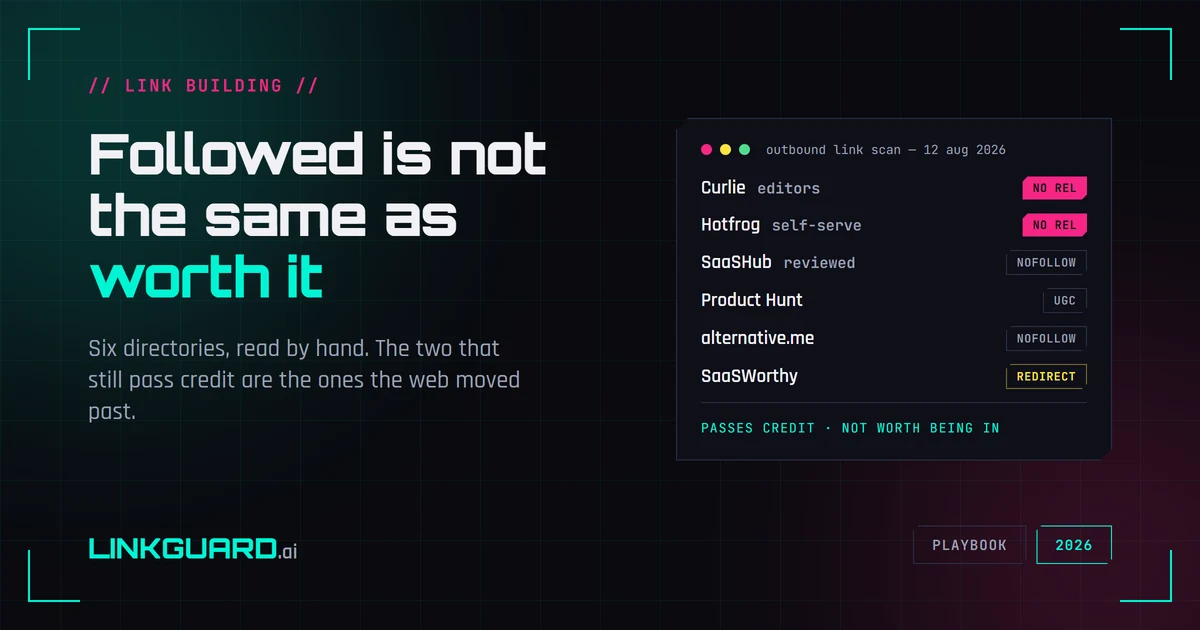
Google's spam policy names low-quality directory links as link spam. We opened six web directories and read the raw HTML: the two that still pass link credit are the general-directory survivors, while every vertical directory worth being listed in withholds it. What the tactic is still good for, and what to check once a listing is live.