Semrush vs LinkGuard: the Backlink Audit, or a dedicated monitor?
Semrush is a whole marketing platform (SEO, PPC, content, competitor research), and somewhere inside it sits a Backlink Audit module. LinkGuard is none of that breadth. It does one slice: continuously watch the links you already earned and tell you the moment one breaks. If you mostly open Semrush to check on your own links, here's the straight comparison.
The short version
Two different kinds of tool. The rows below show where the line is.
| LinkGuard | Semrush | |
|---|---|---|
| What it is | A dedicated backlink monitor | An all-in-one marketing suite |
| The backlink job it's built for | Continuously watch links you already have | Periodic audit + toxic-link / disavow (Backlink Audit module) |
| Backlink index | None — we don't crawl the web | 43T+ links, refreshed continuously |
| Pricing model | Prepaid tokens, spent per check | ~$139/mo, flat |
| Free starting point | 1,000 tokens (~83 full checks), no card | Free account, limited daily lookups |
| Checking a link's live state | On-demand, real-browser fallback (Browserbase) | Periodic crawl, not an on-demand live check |
| Keyword research, PPC, content tools | No | Yes — the rest of the platform |
| Cost while you pause | $0 — tokens wait, never expire | Monthly fee keeps running |
Backlink Audit and a monitor solve different problems
They sound interchangeable. They aren't, and knowing the difference is the whole decision.
Semrush's Backlink Audit is built for the disavow workflow: it crawls your profile, scores links for "toxicity," and helps you assemble a file telling Google which links to ignore. You run it now and then, usually when you suspect a negative-SEO problem or you're cleaning up a penalty. It's about finding bad links to cut loose.
A monitor does the opposite job, continuously: it watches the good links you paid for and tells you the moment one is removed, flipped to nofollow, or dropped from the index, the day it happens, not at the next audit. LinkGuard is that monitor. If your real question is "are the placements I bought still doing their job?", an occasional toxicity audit won't answer it; a monitor will.
Why I only ever used one tab
I had a Semrush seat for years. Keyword work, the odd competitor teardown, all useful. But the thing I checked most often was whether the links I'd bought for clients were still live, and for that I was logging into a full marketing platform to read one report that was never quite current.
Semrush is great at what it's for, and I'm not going to pretend otherwise. LinkGuard doesn't do keyword research, PPC, or content, and won't. It does the one thing I kept opening Semrush for: watch the links you already have, on demand, and charge per check instead of a flat platform fee. Keep Semrush for the marketing suite. Point this at the links you need watched.
— Andrii, founder of LinkGuard · LinkedIn
What the monitoring slice costs
Semrush's ~$139/mo buys the whole platform. If watching your links is mostly what you use it for, here's that slice on pay-as-you-go. (Use the rest of the suite and $139 is fair value; this isn't about Semrush being overpriced.)
Assumptions: balanced ≈ 130 tokens per link per month, economy ≈ 45, at the $25 package rate of $0.001 per token. Semrush shown at its ~$139/mo entry price for the full platform; the comparison is the monitoring slice only, not the index, keyword, PPC, or content tools. A planning estimate, not a quote.
Which one fits you
Different jobs, and plenty of people keep both. The split:
Stay on Semrush if…
- You use the platform for keyword research, PPC, content, or competitor intelligence.
- You need backlink discovery from a 43-trillion-link index.
- You periodically audit for toxic links and build disavow files.
- One all-in-one marketing tool is how your team prefers to work.
Add LinkGuard if…
- Your real question is "are the links I paid for still live and dofollow?", continuously, not at the next audit.
- You'd rather not pay platform prices for routine link monitoring.
- You want on-demand, JS-aware checks and pay-as-you-go billing.
- Your work is seasonal and you want $0 in the months you're not checking.
Plenty of teams keep both: Semrush for the marketing suite, LinkGuard for the day-to-day watching.
Where LinkGuard falls short (so you're not surprised)
- No backlink index and no discovery: we never find links you didn't import. Semrush's crawl does.
- No keyword research, PPC, content, or competitor tools. We're not a marketing suite and won't be.
- No toxic-link scoring or disavow-file builder. If your job is penalty cleanup, Semrush Backlink Audit is the right tool.
- We're newer and do one job well, not twenty.
There's nothing to rip out
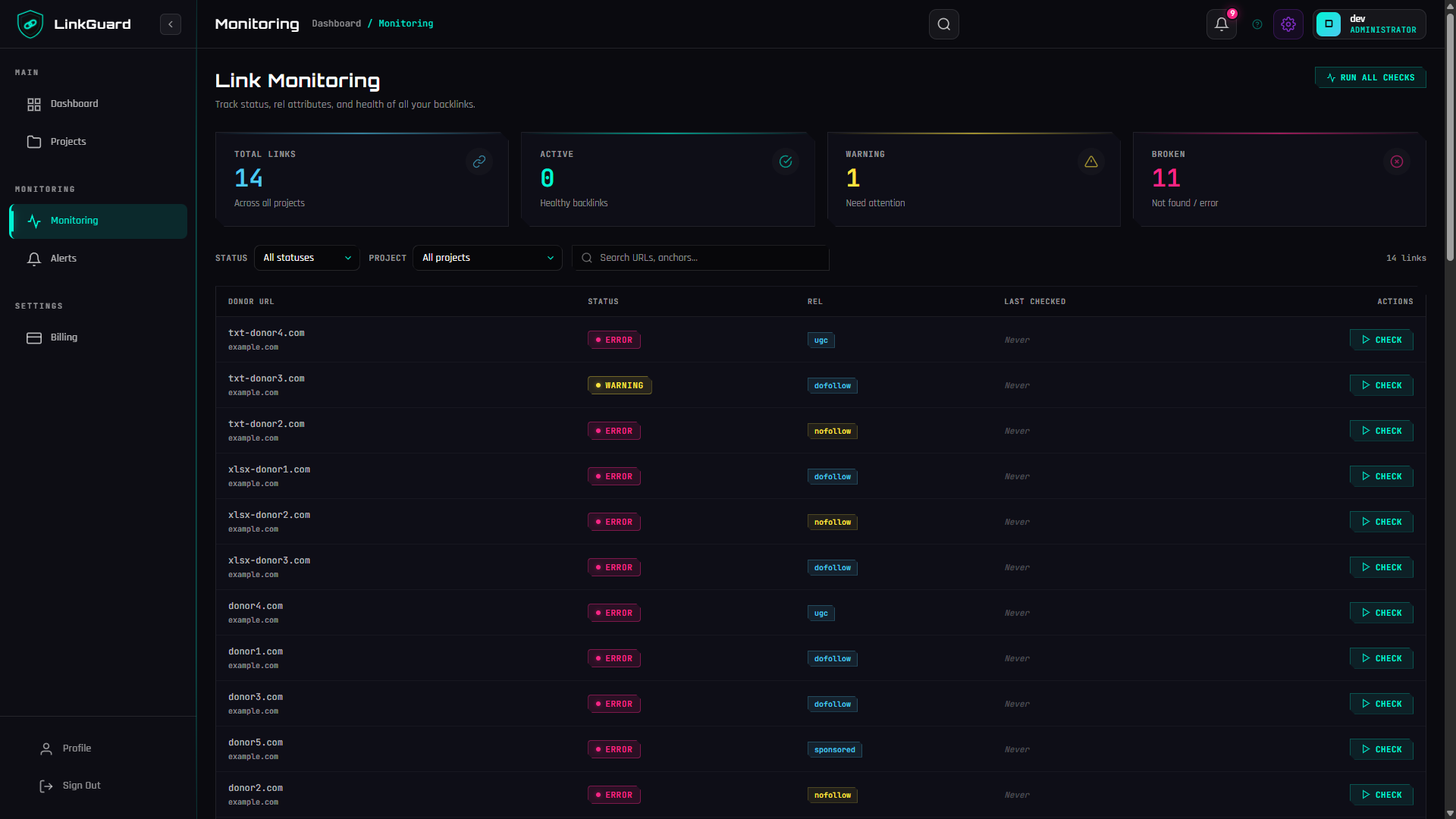
Keep Semrush for everything it's good at. Export the links you need watched (from Semrush, Google Search Console, or a spreadsheet) and upload them to LinkGuard. Monitoring starts on import, no API keys. Your 1,000 signup tokens cover a first full pass, so you can see how the checks read before moving any routine monitoring off the platform.
Questions people ask
Is LinkGuard a Semrush alternative?
Only for one slice. Semrush is a full marketing suite — SEO, PPC, content, research, plus Backlink Audit. LinkGuard replaces just the part where you watch the links you already have. If that's mostly what you use Semrush's Backlink Audit for, this does it for far less; if you need the platform, keep Semrush.
How is LinkGuard different from Semrush Backlink Audit?
Backlink Audit is built for periodic audits and disavow — it scores toxic links so you can tell Google to ignore them. LinkGuard continuously watches your good links and flags the day one is removed, goes nofollow, or drops from the index. One finds bad links to cut; the other keeps your good ones healthy.
Why is it so much cheaper than Semrush?
Because it does far less. Semrush's ~$139/mo buys a whole platform and a huge index; LinkGuard monitors links you already have and bills per check. Not "Semrush is overpriced." Paying suite prices to watch a list of links is more platform than the job needs.
Can I use both?
That's the usual setup: Semrush for research and audits, LinkGuard for routine monitoring. You stop spending the platform fee on day-to-day link checks and keep everything Semrush is great at.
Can I import my links from Semrush?
Yes — export the backlinks you want watched to CSV (from Semrush, GSC, or a spreadsheet) and upload. Monitoring starts on import.
Do unused tokens expire?
No expiry, refundable within 14 days. You owe nothing in the months you don't check, unlike a flat subscription.
Two Mondays
Same goal: keep your links healthy. Very different monthly cost.
Platform-as-monitor
You logged into Semrush twice all month, both times just to glance at your own backlinks. $139 for a marketing platform you barely used. A link had dropped three weeks earlier, and the client spotted it before you did. You spent the review explaining a drop you should have caught.
Right tool for the job
$0 the month you didn't need it. The month you did, an alert flagged the dropped link the day it happened, checked live in a real browser. You fixed it before the client ever saw it, and walked into the review with nothing to explain. Semrush is still there for keyword research and the next toxic-link audit. You just stopped paying platform prices to watch links.
Watch your links without the platform fee
Keep Semrush for research. Bring the links you need watched to LinkGuard, run a full check, and see how the alerts read. The signup tokens cover it, no card required.
Start free1,000 tokens on signup · no credit card · tokens never expire