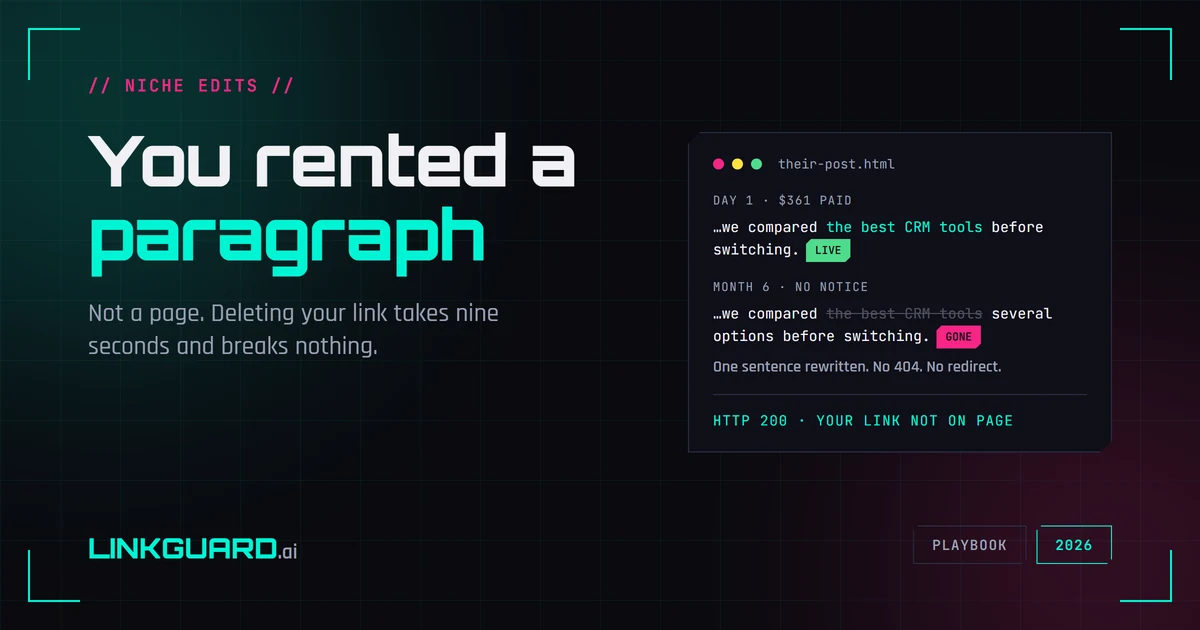
Six months ago you paid around $300 to get a link dropped into a three-year-old post that ranks for something you care about. Good page. Real traffic. It went live in a week and indexed almost immediately, which is the whole reason you bought that instead of a guest post.
Open it now. Still there, still ranking, still returning 200. Read the fourth paragraph. It says nearly what it said before — one sentence shorter, and your anchor isn't in it.
Nothing alerted you, because nothing broke. No 404. No removed page. No redirect. Somebody opened the post in WordPress, deleted eleven words, and hit update.
That's the trade you make with a niche edit, and it's the part the sales pages leave off the invoice. Below: what a niche edit is, why it costs several times what a guest post costs (there's one experiment that measured it properly), what Google's spam policy says in plain words, and what's worth checking after the link goes live. Disclosure before we start: we sell backlink monitoring, so the section on catching removals is where we have a stake. It's marked.
What is a niche edit?
A niche edit, also sold as a link insertion, is a backlink added to a page that already exists. You pay a site owner to open an old article and work your link into the body text, usually into a sentence they reword slightly to fit it. Nothing new gets published. The URL, the publish date, the page's existing rankings and traffic all stay exactly as they were. The same product also gets invoiced as a curated link or an authority link.
Contrast that with a guest post, where you supply an article and the site publishes it at a new URL. New page, no history, no traffic, no rankings. It starts from nothing and has to earn its way up, which takes months if it happens at all. The niche edit skips that entirely: you're buying a seat on a page that already has whatever the page has.
Which is the appeal. It's also the whole problem: everything that makes that page valuable belongs to somebody else, and they keep editing it.
Why niche edits cost several times what guest posts do
Most pricing you'll find on this comes from companies that sell niche edits, which makes it marketing rather than data. The one figure worth quoting came from an experiment instead of a price list.
Joshua Hardwick at Ahrefs contacted 450 sites across nine competitive niches and asked outright to buy a link on an existing page. Only 12.6% agreed. The ones who did charged $361.44 on average. In the same experiment, pitching guest posts to 180 sites in the same niches got a 25.5% response rate, and of the roughly half who wanted money, the average fee was $77.80. That's published on the Ahrefs blog, last updated July 18, 2024 — the most recent hard figure I've found, and I'd be surprised if this market has gotten cheaper since.
Roughly 4.6× the price, and only 12.6% of sites would sell an insertion at all. Don't read the two response rates against each other — they measure different things, and Ahrefs never published a comparable acceptance figure for guest posts. The price ratio is the part worth carrying; the dollar figures have moved since.
The premium isn't really about effort. Editing a paragraph is easier than publishing an article. It's scarcity: most site owners will run your free article before they'll touch their own published work, because one of those is content and the other is an admission. What you're paying for isn't a link. It's an exception to somebody's editorial policy. People price exceptions high.
What Google's spam policy actually says
No hedging needed: the policy is public and short. Google's spam policies list "exchanging money for links, or posts that contain links" under link spam. Buying a link that passes ranking credit is against the rules. A niche edit isn't a loophole in that sentence, and no amount of "editorially placed, contextually relevant" framing from a seller changes what the transaction is.
Google's own escape hatch sits in the same document: buying and selling links is a normal part of the economy, and the fix is to mark the link with rel="sponsored" or rel="nofollow". Which removes the reason you bought it. Nobody pays $361 for a nofollow. That's the honest shape of this market, and glossing over it is how articles like this usually go wrong.
What I won't tell you is your odds of getting caught, because I don't know them, and neither does anyone selling you a "100% safe, penalty-free" placement. Our full position is in should you buy backlinks. Short version: the outcome most buyers meet isn't a penalty, it's waste — a large share of paid links get quietly ignored, so you pay for ranking power that never arrives. The enforcement risk sits on top of that, real and unquantified. Make the call with both on the table instead of under them.
The cost nobody prices in: this is the easiest link in the world to remove
Work out what removal costs the publisher in each case.
Kill a guest post and you delete a whole article. The URL 404s or gets redirected. Anything that linked to it breaks. There's a visible hole where a page used to be, and every crawler that saw it before will notice.
Kill a niche edit and you open the post, delete a sentence, save. The page returns 200 the way it always has. The word count barely moves. No 404, no redirect, no trace anywhere except a diff nobody is running.
One of those has friction. The other takes about nine seconds and leaves the publisher with a clean page they can sell again next quarter — to someone else, at no cost, with no signal to you. Sellers write "permanent, no expiry" into their offers. Permanent is a word, not a term. It costs nothing to write and nothing to break, which is roughly what most backlink guarantees turn out to be worth once you read them closely, and why how long a paid link survives is worth knowing before you buy rather than after.
The same asymmetry runs through the quieter changes, and those are worse because they don't even feel like removals. A rel="nofollow" added to your anchor is invisible on the rendered page: the link still looks and clicks exactly the same. An anchor quietly rewritten from your commercial phrase to "this guide" leaves the link in place while dropping most of what you were buying, which is a whole separate mess covered in when a publisher changes your anchor text. And a page that gets deindexed keeps serving your link to nobody at all.
None of that shows up in an uptime check. All of it shows up in a diff.
How to buy a niche edit without getting burned
Vetting the seller is its own job and we've written it up separately in how to vet a link seller. What follows is specific to insertions, because a few of these questions only make sense for a page that already exists.
- Ask which page, before you pay. "A relevant article on a DR 60 site" is not an offer. If the seller won't name the URL until the money clears, you're buying a lottery ticket — and the page you get will be the one they couldn't sell at full price.
- Read the page's outbound links first. Open the article and count how many other paid-looking insertions are already sitting in it. Three commercial anchors to unrelated products in one post tell you exactly what the page is for, and it isn't readers. Our outbound links analyzer lists them in a few seconds if you'd rather not squint.
- Get the removal term in writing, with a number in it. Not "permanent" — a duration, and what happens if it goes early.
Then there's the one people skip: check whether the page gets crawled at all. A three-year-old post can rank, sit in a sitemap, look perfect, and still not have been recrawled in months, in which case your link will exist without ever having been seen. Run the URL through an index checker before you buy — if the page isn't indexed, stop there, because you'd be paying for a link Google can't see. After placement the question changes: now you're asking whether Google's copy of the page has caught up with your anchor. Weeks later and it still hasn't? The page isn't being recrawled, and your link isn't counting.
Last thing, and the cheapest: screenshot the placement the day it goes live, and save the sentence it sits in. Takes twenty seconds. It's the only version of that paragraph you'll ever be able to prove existed, and without it every later conversation with a publisher is your memory against their CMS.
What to check after your niche edit goes live
We have a stake here: we built LinkGuard to run these checks on a schedule. The checks are the same whether you run them by hand, script them, or pay somebody. Take the list and ignore us if you'd rather.
Start with what you already own. If you've been buying insertions for a while and never captured a baseline, capture one today. This week's version of the paragraph is worse evidence than day one's and far better than nothing, and it's the difference between "it changed" and "I think it changed."
Then four things move on a paid insertion, and people only watch for one:
- Is your anchor still on the page? Not "does the URL load" — does the anchor text still appear in the HTML. A status check never asks this, and it's the failure a niche edit is uniquely exposed to. Worth noting where on the page, too: a quiet demotion out of the article body into a footer or a sidebar isn't a removal, but it isn't what you paid for either.
- Is the
relattribute still what you bought? A free nofollow check answers that in one request. - Is the anchor text still word-for-word yours? A rewrite leaves the link in place while quietly dropping most of what you paid for.
- Is the page still indexed? A link on a deindexed page is decoration.
Cadence is a judgment call, not a rule. A $361 placement is worth looking at monthly; a $40 one is fine quarterly. Whatever you choose, the point is the diff against that baseline you screenshotted, not the individual check.
Where this stops being worth paying for. Under about 50 links, Google Search Console plus a spreadsheet does the job, and we'd rather you put the money into the links. What monitoring buys is timing, not protection. It can't stop a publisher deleting your sentence; it can only tell you while you still have something to push with: an unpaid invoice, a contract with a term in it, or a relationship the publisher still wants. That's the good version — you catch it in week two, reply with the sentence you saved, and it goes back in before anyone has reported it as live to a client. If instead your link vanished from a site you paid once, eighteen months ago, through a reseller who's stopped answering, a fast alert buys you little. That case is a recovery job, and the odds aren't great.
We're also not the only way to do this. Google Search Console plus a spreadsheet is the honest floor, LinkChecker.pro sits in the same category as us, and the big suites bundle link monitoring into a subscription you may already be paying for. Our argument is narrower than "we're better": you pay per check instead of per month, so a portfolio you check twice a year costs roughly what twice a year should cost.
On pricing: we charge per check rather than per month. 5 tokens for an HTML check, 7 for an indexation check, 12 for both. New accounts get 1,000 tokens free, no card. Check a link daily or twice a year; you pay for what you ran.
Questions people ask
What is a niche edit in SEO?
A niche edit is a paid link added to a page that's already published and already ranking. No new article: same URL, same publish date, same traffic. That inherited performance is why buyers pay a premium for it over a guest post. Sellers list the same product as a link insertion, a curated link, or an authority link — one thing, three invoices.
Are niche edits safe?
Not in the sense sellers mean when they say it. Paying for a link that passes ranking credit is explicitly against Google's link spam policies, whether the link goes into a new post or an old one. What honest people disagree about is the probability of enforcement, and anybody quoting you a number for that is guessing. What's specific to niche edits is a different risk: because the page belongs to somebody else and stays editable forever, the link can be silently removed or altered long after you've paid and stopped watching.
Niche edits vs guest posts — which is better?
They fail differently, which matters more than which is "better". A guest post gives you a page you effectively control the content of, but it starts with zero authority and traffic, and it can be deleted outright. A niche edit borrows a page that already performs, indexes faster, and costs several times more (4.6× more in the Ahrefs experiment) while being trivially easy to reverse without leaving a trace. If you can only monitor one of them properly, monitor the insertion.
How much do niche edits cost?
Public benchmarks are thin, because almost every published number comes from a company selling them. The most credible data point is Ahrefs' 2024 outreach test: of 450 sites across nine competitive niches, 12.6% agreed to sell a link on an existing page, at an average of $361.44. Treat that as a shape rather than a current quote — it's two years old, and price scales with the page's traffic and the niche's competition far more than with domain-level metrics.
How do I know if my niche edit was removed?
You won't from the status code, and that's the trap. The page keeps returning 200 after your link comes out of it, so uptime checks, broken-link crawls and most spreadsheet workflows show green. The only reliable method is to look at the page's own HTML for your anchor and compare what you find to what was there when the link went live — including which part of the page it sits in, since a move from the article body down into a footer costs you most of what you bought without ever registering as a removal. That's a diff, run on a schedule, by you or by a tool. Either way it needs a baseline, so capture one now even if the link has been live for a year.
You rented a paragraph, not a page
That's the whole thing. A niche edit is a lease on a few words inside somebody else's article, on terms they can revise at any moment without telling you. Worth buying, sometimes. Worth checking, always. And the check that matters isn't whether the page loads — it's whether your anchor is still on it.
Take the insertion you paid the most for and check it now: confirm the rel attribute, or confirm the page is still indexed. Both are free, neither needs an account.
About the Author

Related Articles

Expired domain backlinks decay before the auction closes
Policy requires an expired .com to resolve to nothing for weeks before anyone can buy it. The links you're bidding on were counted before that, by a crawler that hasn't been back.

PBN backlinks don't fail one at a time
Google's spam documentation never uses the word. What a network link actually is in 2026, which footprints still identify one, and why four of them tend to go in the same week.
Directory submission in 2026: what a listing is actually worth
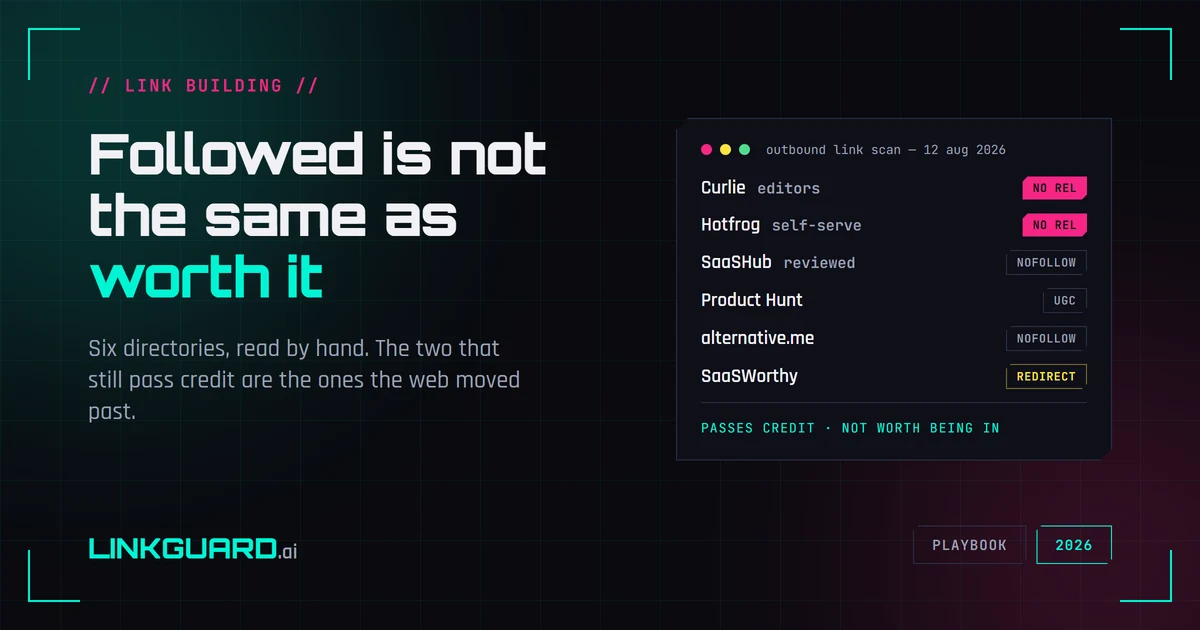
Google's spam policy names low-quality directory links as link spam. We opened six web directories and read the raw HTML: the two that still pass link credit are the general-directory survivors, while every vertical directory worth being listed in withholds it. What the tactic is still good for, and what to check once a listing is live.