You send a polite note to a site in your niche, and you get the reply that tells you everything: "Yes, we accept guest contributions. $120 per post, up to three dofollow links, 48-hour turnaround, send your article and anchors." No questions about the topic. No editor. Just a menu. What they are selling is not a guest post. It is a link with a word count attached, and you can almost feel Google's spam systems warming up.
Real guest posting still works in 2026. I have earned links from it that are years old and still passing value, because they sit in articles people actually read. But the version that works looks almost nothing like the menu above, and the gap between them is where the money goes. Get it wrong and you can write the whole article, place the link, and watch Google ignore it anyway. Get it right and you earn a link that compounds for years. Here is how to land on the right side of that line: where Google draws it, how to find sites worth writing for, how to pitch and write, and what to do after the post is live so the link does not quietly stop working.
The short version, before the how-to
Guest posting earns real, followed backlinks when it is a genuine editorial contribution to a relevant site with a real audience. It becomes link spam, and gets devalued, when it is done at scale on sites that publish anything for a fee, with keyword-rich anchors engineered for ranking. Google draws the line by intent and pattern, not by the words "guest post." So the job is not to find sites that accept guest posts; it is to find sites worth contributing to, then write something good enough that the link is the least interesting part.
Where guest posting crosses into link spam
Google's spam policies are specific about the paid version. The current policy (last updated May 2026) flags "links with optimized anchor text in articles, guest posts, or press releases distributed on other sites," alongside advertorials and native advertising where payment buys links that pass ranking credit. Read that slowly, because each piece is a tripwire. Optimized anchor text means links engineered to read "best project management software" instead of your brand or a plain phrase. Distributed on other sites means the same placement pushed out at scale. Payment that passes ranking credit means the link was bought to move rankings, not to serve a reader.
What Google does not object to is a person with relevant expertise writing a real article for a relevant publication that happens to include a link back to their work. The mechanics look identical from a distance: words on someone else's site, with a link in them. The difference is whether a reader is being served or a ranking is being gamed, and Google's systems have gotten uncomfortably good at telling those apart. So the safe path and the effective path turn out to be the same one: contribute for real.
Find sites people actually read
The instinct is to chase the highest Domain Rating you can get a byline on. Resist it. A high score on a site nobody reads, or a site that has drifted into a guest-post farm, is the metric propping up the very thing Google discounts.
What you actually want is topical overlap with what you do, real organic traffic, and an audience that would plausibly click. A link from a mid-DR site that is squarely about your subject and gets real readers beats a link from a bigger, vaguer site every time, for ranking and for the traffic that shows up the same week. Our donor trust audit gives you a quick read on whether a site looks like a real publication or a link shop, and the outbound links analyzer shows you a page's existing outbound links. If every post is already stuffed with paid-looking links to unrelated niches, you have found a farm, not a home.
Qualify before you spend a single hour writing
Writing a good guest article is real work, so qualify hard before you do any of it. A few questions save you most of the wasted effort:
- Is the site relevant, or just willing? Willingness is cheap. Relevance is what makes the link pass weight and the readers worth having.
- Do their existing guest posts get read and indexed? Search a few of their past contributor articles. If they are nowhere in Google, the whole guest section may be deindexed, a sign Google already decided what it is.
- How many outbound links does a typical post carry? One or two natural links per article is editorial. Five exact-match links to unrelated businesses is a footprint you do not want to join.
- Is there an actual editor? A site that pushes back on your draft, asks for changes, and has standards is a site whose links Google trusts. A site that publishes anything within 48 hours is the opposite.
This is the same muscle as vetting a link seller, just pointed at a publisher instead of a vendor. If the honest answer is "they will take anything for a fee," you are not guest posting anymore. You are buying a link, with all the decay and devaluation that comes with it.
The pitch: lead with the article, not the ask
Most guest-post pitches fail because they are transparently about the link. "I would love to contribute a high-quality article in exchange for a dofollow link" tells an editor exactly what you want and exactly how little you care about their readers. Flip it. Pitch a specific idea that fits their site, show you have read it (reference a real article, not "I love your blog"), and make the topic something their audience needs that they have not covered.
Keep it short and specific, the same discipline that makes any outreach work. If you want a first draft that does not read like a mail-merge, our outreach email generator gets you started from the specifics. But the personalization has to be yours. An editor can smell a template from the subject line.
Write something that earns the link, not something built around it
Here is the inversion that separates guest posting that works from guest posting that gets ignored: the article has to be good on its own, with the link as a footnote rather than the point. If you would be a little proud to have your name on it even with no link at all, you are in the right territory. If the whole thing was reverse-engineered from a keyword and an anchor, so is its value to Google.
When the link goes in, keep the anchor natural: your brand, your name, or a plain descriptive phrase. The exact-match commercial anchor ("cheap SEO tools") is the single loudest signal that a link was placed for ranking, and it is the thing that turns a fine guest post into a flagged one. A branded or natural anchor passes value without waving a flag. If you are not sure how your anchors are distributed across the links you have already built, the anchor text checker shows you the spread.
After it is live, the job is not done
You earned the link. Now make sure it is doing its job, because a published guest post can fail you in three quiet ways, and none of them announce themselves.
First: is it followed? Some sites nofollow every outbound link by policy, and you will not know unless you check. A nofollow link still brings referral traffic and a brand mention, but it will not pass the ranking value you wrote a whole article for. The nofollow checker answers that in a second. Second: did it get indexed? A guest post sitting on a page Google never indexes passes nothing. Our piece on whether a linked page is indexed walks through it, and the backlink index checker does the lookup. Third: does it stay the way you left it? Editors rewrite anchors, switch links to nofollow during template changes, and prune old posts, often months later and without a word.
When guest posting is not worth it
Let me argue against the tactic for a second, because it is not always the right move. If the only sites that will have you are low-traffic farms charging a fee, you are buying links in a guest-post costume, and you would do better earning one real link than ten of those. If your niche is tiny and the few relevant publications do not take contributions, your time is probably better spent on broken-link building or making something worth citing. And if you cannot write something an editor would want, honestly, if that is the bottleneck, guest posting will be a grind, and something like answering journalist queries, where the ask is a few sentences of expertise rather than a whole article, will suit you better.
Guest posting rewards patience and a real point of view. It punishes scale and shortcuts. That is a feature, not a bug, and it is exactly why the links it produces hold up.
Questions people ask
Is guest posting still effective for SEO in 2026?
Yes, when it is done as real contribution rather than at scale. A real article on a relevant site with actual readers earns a link that passes value and brings referral traffic, and those links tend to last because they sit in content people use. What is no longer effective is mass guest posting: the same spun article across dozens of low-quality sites with keyword-rich anchors. Google devalues that pattern on purpose, so it is effort spent earning links that do nothing.
Is guest posting against Google's guidelines?
Real, editorial guest posting is fine. What Google's spam policies flag is the paid, scaled version: "links with optimized anchor text in articles, guest posts, or press releases distributed on other sites." A relevant expert writing a real article for a relevant publication, with a natural link back, is not what that targets. The line is intent and scale, not the format.
Should guest post links be dofollow?
For ranking value, a followed link is the point. That is what passes credit. But do not demand dofollow as a condition; an editor who hands out followed links on request to anyone who asks is running the kind of site whose links get discounted anyway. Earn the placement on a real site, then check what you got with a nofollow checker. If it came back nofollow, you still earned a brand mention and traffic, just not the SEO value.
How many guest posts do I need?
Wrong question, and asking it is how people end up spamming. A handful of links from relevant, well-read sites will do more than fifty from farms. Chase quality and relevance, not a count. The moment you set yourself a monthly guest-post quota, you have slipped from earning links to manufacturing them, which is the pattern Google is built to catch.
Do I have to pay to guest post?
You should not have to, and being asked to is a yellow flag. A site charging a flat fee for a contributor slot with dofollow links is selling links, not accepting guest posts, which puts you back in buy-a-link territory: against Google's policies and subject to the same devaluation. Real editorial contributions are exchanged for the content's value to readers, not a payment for the link.
How do I find guest posting opportunities?
Start from relevance, not from "write for us" lists, which are picked over and skew toward farms. Look at where the people in your space already publish, who is writing for the publications you read, and which relevant sites have real audiences. Then qualify each one (traffic, indexed past contributions, outbound-link hygiene) before you pitch. It is slower than buying a list, and the links are worth more for exactly that reason.
The honest summary
Guest posting is not dead and it is not a loophole. It is just real now: the link counts when the article is a real contribution to a site people actually read, and it gets ignored when it is a scaled, link-first placement on a site that will publish anyone. Find relevant publications with real audiences, qualify them hard, pitch a specific idea, write something you would be glad to sign, keep the anchor natural, and the link mostly takes care of itself.
The one piece that is easy to forget is what happens after publication. Start free with 1,000 tokens and add the guest-post links you earn to LinkGuard, so if one gets nofollowed, deindexed, or quietly edited months later, you hear about it instead of finding out when the ranking you earned slips away.
About the Author

Related Articles

Expired domain backlinks decay before the auction closes
Policy requires an expired .com to resolve to nothing for weeks before anyone can buy it. The links you're bidding on were counted before that, by a crawler that hasn't been back.

PBN backlinks don't fail one at a time
Google's spam documentation never uses the word. What a network link actually is in 2026, which footprints still identify one, and why four of them tend to go in the same week.
Directory submission in 2026: what a listing is actually worth
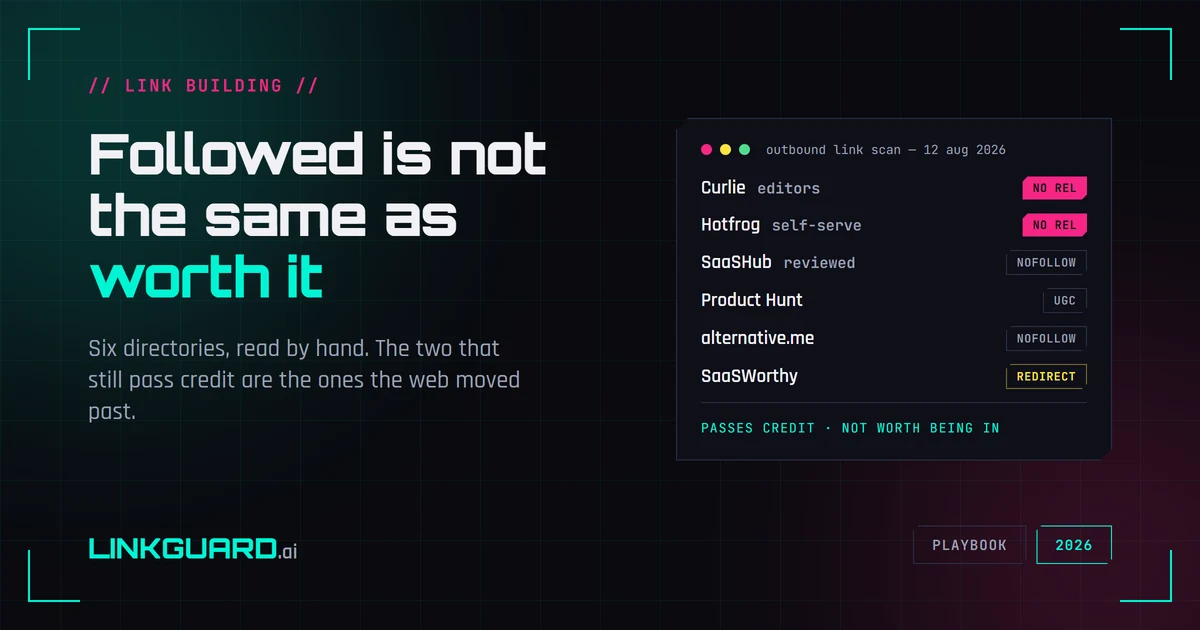
Google's spam policy names low-quality directory links as link spam. We opened six web directories and read the raw HTML: the two that still pass link credit are the general-directory survivors, while every vertical directory worth being listed in withholds it. What the tactic is still good for, and what to check once a listing is live.