You closed a guest post on a site you've been chasing for two months. The article goes live, your link is in the second paragraph with the anchor you wanted, and for about an hour you feel good about it. Then you view the page source, find your link, and there it is: rel="nofollow". Your client emails before you do: "Is that one of the good ones?"
Here's the short version most "dofollow vs nofollow" posts bury under 2,000 words of preamble: a nofollow link won't pass ranking credit the way a regular link does, but calling it worthless is wrong, and panicking about it is a waste of a Tuesday. The longer version is worth your time, because the link attributes changed in 2019, most of the advice online still describes the pre-2019 rules, and the part everyone gets wrong is what "dofollow" even means. This guide covers what each attribute does, when to use which, whether nofollow links have any value, and how to check any link in a few seconds with a free nofollow checker.
There is no such thing as a dofollow tag
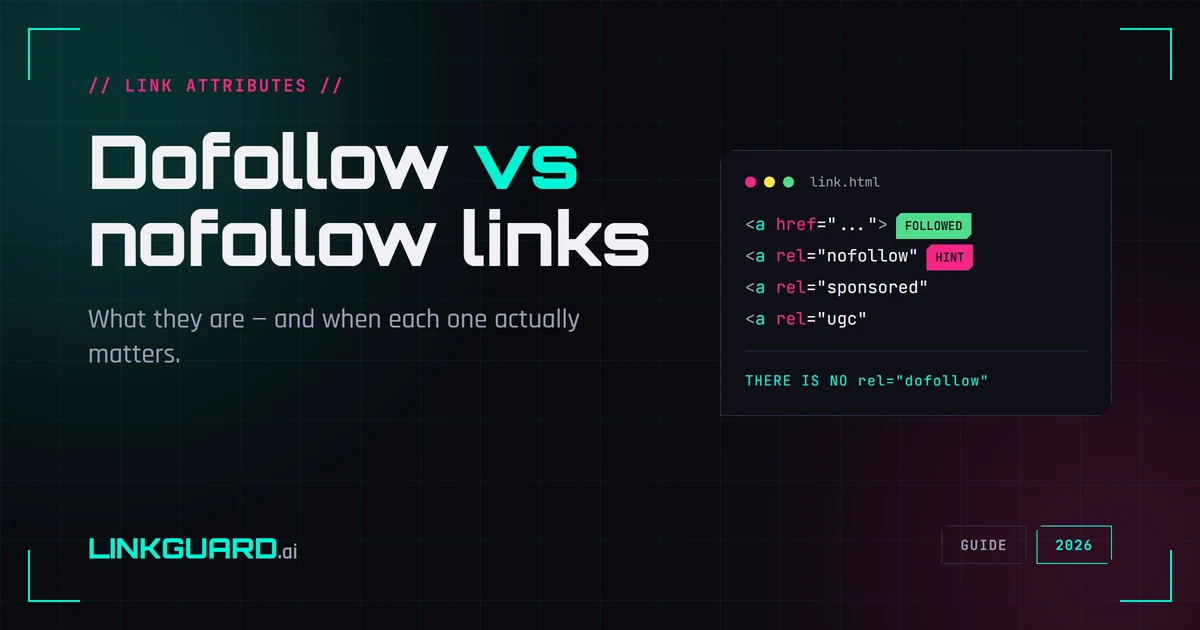
Start here, because it clears up half the confusion: rel="dofollow" is not real. There's no such attribute. Google has never read it. If you've seen it in someone's SEO checklist, that checklist is wrong.
A "dofollow" link is just a normal link — an <a> tag with nothing special added:
<a href="https://example.com">anchor text</a>That's it. By default, every link you write is followed. It passes ranking signals unless you explicitly tell search engines not to count it. "Dofollow" is a word the SEO community invented to describe the absence of nofollow, the way "non-decaf" isn't a thing you order. A link becomes nofollow only when you add an attribute. Leave the attribute off, and it counts.
(One side note that trips people up: rel="noopener" and rel="noreferrer" are security and privacy attributes. They do not make a link nofollow. If your CMS adds them automatically to external links, your links are still followed.)
What nofollow is, and why it exists
rel="nofollow" is the attribute you add when you want to link to a page without vouching for it:
<a href="https://example.com" rel="nofollow">anchor text</a>It dates to 2005. Google, Yahoo, and Microsoft introduced it together to fight blog-comment spam. Back then, anyone could drop a link to their payday-loan site in your comments section and steal a little of your ranking power. Nofollow gave site owners a way to say "this link exists, but I'm not endorsing it, and search engines shouldn't pass credit through it." Comment systems, forums, and Wikipedia adopted it widely, which is why so many links from those places are nofollow to this day.
For about 14 years, that was the whole story: a link was either followed or nofollow, and nofollow meant "ignore this for ranking." Then Google changed the rules.
The 2019 change most articles missed
On September 10, 2019, Google announced two new link attributes and quietly downgraded nofollow itself. This is the update that makes most older "dofollow vs nofollow" advice out of date, so it's worth getting the details right.
Three attributes now exist for qualifying a link:
rel="sponsored"— for paid links and affiliate links. Anything where money changed hands.rel="ugc"— for user-generated content. Comments, forum posts, anything your visitors wrote rather than you.rel="nofollow"— the catch-all, for when the other two don't fit and you'd rather not endorse or have Google crawl the linked page.
The second change is the one people miss: nofollow became a hint, not a strict order. Before, Google treated nofollow as an absolute "do not count this." Now Google says it may still consider a nofollow link for ranking, crawling, and indexing if its systems decide the link is relevant. The ranking part took effect immediately in September 2019; the crawling-and-indexing part on March 1, 2020.
"Hint" is the right word to sit with. It doesn't mean nofollow links now pass credit — Google still says they generally don't. It means Google reserves the right to use one if it wants to, rather than ignoring it on principle. You've given a suggestion, not an instruction.
You can also combine values. Google's own example is a comment link that's both user-generated and untrusted:
<a href="https://example.com" rel="ugc nofollow">anchor text</a>For most situations, one value is enough. The combination mainly helps if you're running an older system that doesn't recognize ugc yet and you want a fallback.
Which attribute to use when
If you publish links and you're deciding what to tag them with, the rule is short:
- You got paid to place it, or it's an affiliate link →
rel="sponsored". This is not optional. Undisclosed paid links that pass credit are exactly what Google penalizes sites for. - Your users wrote it (a blog comment, a forum reply, a profile bio) →
rel="ugc". - You're linking to something you don't trust or don't want to endorse, and it's not paid or user-generated →
rel="nofollow". - You're citing a source you stand behind → add nothing. Let it be a normal followed link.
Most site owners over-nofollow out of fear. You don't need to nofollow every external link. Linking out to good sources is normal, and Google expects to see it on real content.
Do nofollow links have any SEO value?
This is the question that started the whole client email, so let's answer it honestly. I've sent the panicked version of that reply before I understood the mechanics, and it helped no one. Let's make sure you send the calm, correct one your client respects.
By Google's own statement, a nofollow link does not pass PageRank or anchor text. So if you're buying or earning links purely for ranking power, a nofollow link is not what you're buying. Anyone selling "high-DR nofollow links" as a ranking play is selling you the wrong thing.
But "doesn't pass PageRank" is not the same as "worthless," and treating those as identical is the most common mistake people make here. A nofollow link still does real work:
- Referral traffic. A nofollow link from a busy, relevant page sends humans to your site. Those people convert. PageRank doesn't pay your invoices; customers do.
- Brand exposure. Being mentioned and linked on a respected site builds recognition, even when the link is technically nofollow.
- Profile diversity. A backlink profile that's 100% followed links looks engineered, because no natural profile looks like that. Real sites accumulate a messy mix of followed, nofollow, ugc, and sponsored links. The mix is the natural signal.
- The hint. Since 2019, Google may still factor a nofollow link in. Not reliably, not something to count on, but not zero either.
So the honest answer to your client: no, that guest-post link won't move rankings the way a followed link would. Yes, it can still send traffic and build the brand, and a profile with some nofollow in it looks healthier than one without. If the whole point of the placement was ranking power and you only found out it was nofollow after publishing, that's a qualification step to add to your outreach — not a disaster. (Paid for a followed link and had it switched to nofollow after the deal closed? That's a broken agreement, not a qualification gap — here's what to do when a paid backlink is switched to nofollow.)
Three myths worth killing
"You need a specific nofollow-to-dofollow ratio." There is no Google-published target ratio. Nobody at Google has said "aim for 20% nofollow." A natural profile contains a mix because the web is messy, not because you hit a number. Chasing a ratio is reverse-engineering a symptom. Earn links from real places and the mix takes care of itself. If you want to see your own distribution, our anchor text checker and the anchor text portfolio checklist cover how to read a profile without inventing rules that don't exist.
"Nofollow links are a waste of time." Covered above. They don't pass PageRank; they do pass traffic, brand, and diversity. A nofollow link from a site your buyers read beats a followed link from a directory nobody visits.
"Wikipedia links boost your rankings." Every external link on Wikipedia is nofollow. So a Wikipedia citation passes no direct ranking credit. Its value is the referral traffic and the visibility, which can lead to earned followed links elsewhere when other writers find you through it. That's a real benefit. It's just an indirect one, and it's worth understanding the difference before you spend a week trying to get cited.
Does nofollow matter for AI search?
There's an emerging wrinkle worth flagging, with the caveat that it's a trend, not a Google ruling. In AI search — ChatGPT, Perplexity, Gemini, Google's AI Overviews — whether a link is followed or nofollow seems to matter less than it does in classic ranking. These systems seem to lean on a source's overall authority and how often a brand is mentioned, rather than on the technical rel attribute of any single link. A nofollow link from a respected publication can still feed your visibility in AI answers, and even an unlinked brand mention can count.
I'd hold that loosely. There's no official Google statement on how LLMs weigh nofollow, and the specific studies floating around haven't been published with methodology I'd stake a strategy on. The directionally safe takeaway: don't dismiss a nofollow placement on a strong site just because it won't pass PageRank. In 2026, getting named on the right sites is worth more than the attribute on the link.
How to check whether a link is nofollow
You can do this by hand: open the page, view source, find your link, and read the rel attribute. rel="nofollow", rel="ugc", or rel="sponsored" means it's qualified; no rel (or only noopener/noreferrer) means it's followed. That works for one link.
For more than a few, or for a whole donor's outbound links, it gets tedious and error-prone fast — a single page can have dozens of links and the attributes are easy to misread. That's what our free nofollow checker is for. Paste a URL, and it reads every outbound link on the page, shows you which are followed and which carry nofollow, ugc, or sponsored, and tells you the exact attribute on each. One honest caveat: it reads the raw HTML, so a rel that a page injects with JavaScript won't show up — that case needs a check that renders the page in a real browser. No login, nothing saved.
It pairs naturally with the qualification step in our backlink donor evaluation checklist: before you spend on a placement, check whether the site's existing outbound links are followed at all. A donor that nofollows every external link is telling you what your link will be too.
Frequently asked questions
Is there a rel="dofollow" attribute?
No. There's no such thing. A "dofollow" link is simply a normal link with no rel="nofollow", rel="ugc", or rel="sponsored" attribute. Followed is the default state of any link; you only change it by adding an attribute.
Do nofollow links pass PageRank?
By Google's own statement, no — nofollow links don't pass PageRank or anchor-text signals by default. Since 2019, Google treats nofollow as a hint and may consider the link, but you shouldn't count on a nofollow link for ranking power.
What's the difference between rel="sponsored", rel="ugc", and rel="nofollow"?
sponsored is for paid and affiliate links. ugc is for user-generated content like comments and forum posts. nofollow is the catch-all for any other link you don't want to endorse or have crawled. You can combine them, for example rel="ugc nofollow", though one value usually suffices.
Are nofollow links worth getting?
They won't move rankings the way followed links do, but they still drive referral traffic, build brand visibility, and keep your backlink profile looking natural. A nofollow link from a site your audience reads can be more valuable than a followed link from a low-quality directory.
Is there an ideal nofollow-to-dofollow ratio?
No. Google has never published a target ratio. Natural backlink profiles contain a mix of both because the web is messy, not because there's a number to hit. Earn links from real sources and the mix sorts itself out.
Do nofollow links matter for AI search?
The technical attribute appears to matter less in AI search than in classic ranking — LLM-based tools seem to weigh overall authority and brand mentions more than the rel value. This is an emerging trend rather than a confirmed Google position, so treat it as a reason not to dismiss good nofollow placements, not as a rule.
Check before you celebrate, and before you pay
The fastest way to avoid that client email is to check the link attribute before you report a placement as a win — and to check a donor's outbound links before you pay for one. Both take seconds.
Run any page through the free LinkGuard nofollow checker. It reads every link on the page, labels each as followed, nofollow, ugc, or sponsored, and shows you the exact rel attribute that decided it. Paste, run, read.
Do that, and the client email at the top of this article never happens. You reply in two minutes with the exact attribute, your call holds up, and you move on to the next placement, instead of finding out what you bought from the person who's paying you.
Last updated: 2026-06-05. We re-check the link-attribute rules against Google's current documentation roughly every quarter; if Google changes how nofollow, sponsored, or ugc are treated, this guide gets updated.
About the Author

Related Articles
Guest posting for backlinks, done right: earn links Google counts
Guest posting still earns real backlinks in 2026, but only the genuine kind. How to find sites worth writing for, qualify them, pitch, write, and keep the link working after it is published, without crossing into the spam Google devalues.
Should you buy backlinks? An honest answer for 2026
Buying backlinks is not illegal, but it is mostly a bad trade. What Google actually does when you pay for links, when it is wasted money, when it is a real risk, and what earns links that last instead.
Broken-link building, the honest version: find dead links, earn the replacement
Broken-link building works, but not the way most guides sell it. How to find dead links on the right pages, qualify them before they go on your list, and pitch a replacement that actually gets accepted, with realistic numbers, not hype.