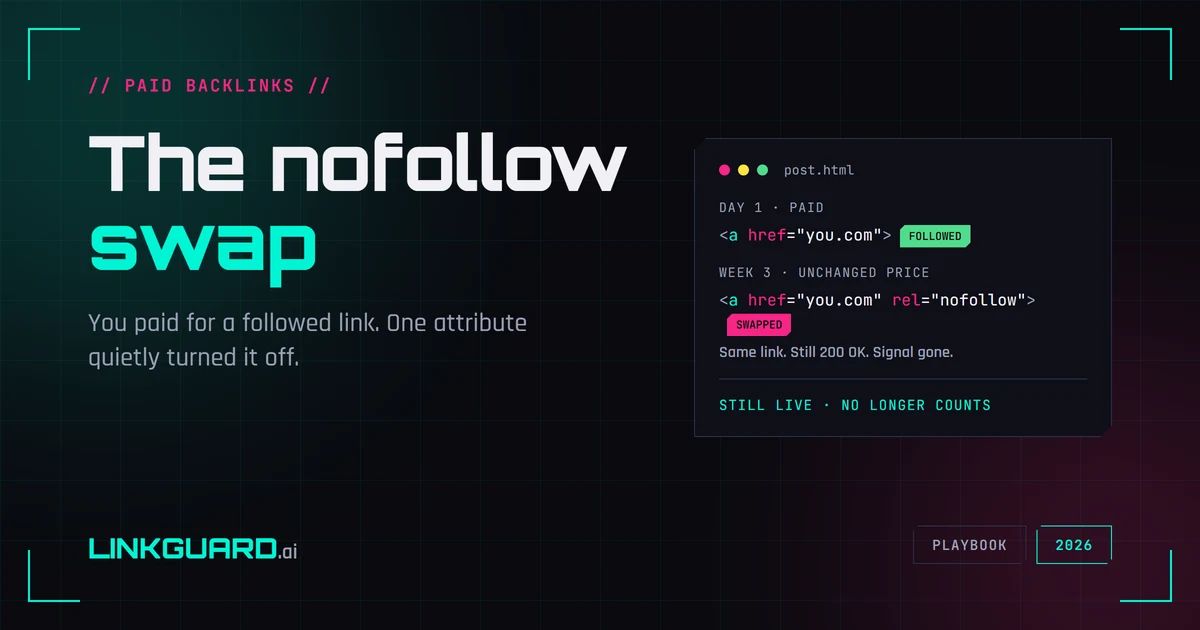
You paid for a dofollow link on a site that gets real traffic. You read the article, checked the placement, watched your anchor go live. Money well spent. Then a few weeks after the payment cleared, the publisher opened the post and added one word to your link: rel="nofollow". The link is still there. The anchor still reads exactly as agreed. The page still ranks. And the one thing you were paying for is gone.
This is the quiet failure. A removed link at least announces itself: the URL 404s, your checker screams, you know to act. A nofollow swap makes no sound at all. The link stays live, so every "is it still up?" check comes back green. You can lose the follow signal you bought and keep staring at a dashboard that says everything's fine. Months later you wonder why that placement never did a thing for you. It did nothing because, somewhere along the way, it was quietly told to do nothing.
I've watched this happen to bought links over and over, and it's the failure people are least ready for, because most monitoring asks one question only: is the link alive? This piece covers the rest. What a nofollow swap is, why publishers do it after they've been paid, how to check whether it's happened to one of your links, and how to get the followed link you paid for back, or your money.
A removed link screams. A nofollow swap whispers.
Start with the plumbing, because the whole problem hides in it. A "dofollow" link isn't a special tag — there is no rel="dofollow". A normal link passes ranking signals by default. To switch it off, a publisher adds an attribute: rel="nofollow", or its paid-link cousin rel="sponsored". One small edit flips your placement from "counts for SEO" to "doesn't."
Here's why that's worse than an outright removal. When a link disappears, you find out fast and you act fast. That's what the whole paid-link recovery playbook exists for. A nofollow swap evades all of it. The page is up. The HTTP status is 200. The anchor text is untouched. To a link checker that only verifies the URL responds, nothing is wrong. So the damage runs for months while your tooling reports a clean bill of health. You're not blind because you're careless. You're blind because you're watching the wrong signal.
Why publishers flip your link after you've paid
It's tempting to assume bad faith, and sometimes that's exactly it. But not always, and the reason matters for how you respond. A few of the patterns I see most:
- New owner, new rules. The site changed hands. The new team ran a site-wide audit, found a pile of old paid placements, and nofollowed all of them in one pass. Your link was collateral, not a target.
- A nervous editor. Someone got spooked by a Google update or a manual-action horror story and decided every external link to a commercial site should be nofollowed "to be safe." Overcautious, not malicious.
- Policy cleanup. The site is tidying its sponsored content properly and adding
rel="sponsored"to anything it was paid for. Technically the correct move on their end. Still kills your follow signal. - They simply can. And then there's the seller who took your money, placed the link, and figures you'll never check the source. Once the payment's cleared, there's nothing stopping a quiet edit. This is the one that should make you angry.
The first three are recoverable with a polite, well-aimed email. The last one tells you something permanent about that seller. It's exactly the kind of thing worth remembering before you buy from them again. More on that below.
How to tell if your paid link went nofollow
One thing that will not tell you: a Google search. No operator returns the rel attribute on a link, and the retired link: operator returns no links at all — we ran the four usual workarounds and logged what each one actually returns in how to check a backlink in Google search.
Checking one link by hand takes a minute. Open the page, view source (or right-click the link and inspect it), find your anchor, and read the rel attribute on that exact <a> tag. If you see nofollow, sponsored, or ugc in there, your link isn't passing ranking credit anymore. If there's no rel at all, you're still followed.
A few traps. This is where people get a false read:
- It's per-link, not per-page. The publisher can nofollow your link and leave every other link on the page followed. Check your tag, not a random one.
- Sitewide nofollow. A
nofollowcan be applied across a whole section via a meta robots tag or anX-Robots-TagHTTP header, which won't show up on the link itself. Rarer, but it happens. - JavaScript edits. Some sites inject the
relattribute after the page loads, so the raw HTML and the rendered DOM disagree. The rendered version is the one Google sees.
For a single link, a free check does the job. Our nofollow checker reads the rel on any URL so you don't have to squint at source code. One honest caveat, given the trap right above: the free tool reads the raw HTML, so a rel that's injected by JavaScript won't show up in it, and catching that case takes a check that renders the page in a real browser. The anchor text checker covers the other silent edit publishers make: changing your anchor. The real limit of doing this by hand is scale. It works for ten links. It does not work for two hundred, on a schedule, forever. That's a different shape of problem than a one-off lookup.
What a nofollow link costs you (no scare tactics)
Now the unglamorous truth. Overselling this would be its own dishonesty. A nofollow link is not worthless. It still sends real referral traffic if people click it, still puts your brand in front of that site's audience, and still looks natural in your profile. A nofollow mention from a site your buyers read can beat a followed link from some directory nobody visits.
But you didn't buy a brand mention. You bought a followed link, at followed-link prices, for its ranking value — and by Google's own long-standing position, nofollow links aren't counted on for that. So the loss isn't "the link is now useless." The loss is "you paid for X and silently received Y." If you'd wanted a nofollow placement you'd have negotiated a nofollow price. The gap between what you paid for and what you're now getting is the thing to recover.
What to do the moment you catch one
Treat a nofollow swap the same way you'd treat a removal: as a broken agreement, because that's what it is. The link you contracted for was a followed one. The steps, roughly in order:
First, confirm it's really nofollowed and grab a screenshot of the source. You want evidence before you write to anyone, so the conversation is about a fact, not a feeling.
Then ask, plainly and without heat. Most of the time the first three causes above apply and a short note fixes it: "Hi — noticed the link in [article] now has rel=nofollow. We'd agreed on a standard followed link. Could you restore it?" Our recovery email templates include wording for exactly this, restore-vs-refund and all. The tone that works is calm and specific, not accusatory.
If they restore it, you're done. If they refuse or go silent, you're in refund territory. Whether you have a leg to stand on depends on what was promised — a vague "permanent dofollow" pitch falls apart here; a written term holds up. That's the whole argument of our guide to what backlink guarantees promise. And it's a sharp reminder to vet the seller before the next purchase, because a vendor who quietly nofollows paid links has shown you who they are.
Catching the swap before it costs you months
Everything above assumes you noticed. The hard part is noticing at all, on time, across more links than you can eyeball. A swap that you catch in week one is an email. A swap you find six months later is six months of a placement that did nothing while you assumed it was working.
This is the gap we built LinkGuard to close. It doesn't just check whether your links are alive. It records the rel attribute on each monitored link and flags the day a followed link turns nofollow or sponsored, the same way it flags a removal or an anchor change. Tie each link to what it cost and who sold it, and a swap doesn't just raise an alert; it lands in the recovery ledger as money at risk, attached to the seller responsible, so your refund conversation starts with a record instead of a vague memory.
Picture the version where you caught it. A Tuesday alert: the link in that guest post went from followed to rel="sponsored", attached to the seller you bought it from and the $180 it cost. You forward a two-line restore request from a saved template before lunch. By Friday it's followed again. And if it hadn't been, you'd have the dated record to ask for the $180 back. That's the whole difference. A swap you find this week is an email; one you find next quarter is a write-off.
The limits, plainly. Monitoring catches the swap after it happens, not before. Nothing can stop a publisher from editing their own page. It only watches the links you've added. And it can flag the problem and arm your outreach, but it can't force anyone to flip your link back. What it does do is make sure you find out in days instead of quarters, and that you never again discover a dead-weight link by accident.
Questions people ask
Is a nofollow swap as bad as the link being removed?
For ranking value, it's effectively the same loss: a nofollow link isn't counted on to pass PageRank or anchor signals, so a followed link turned nofollow has lost the thing you paid for. In one way it's worse — a removed link is obvious and triggers your alerts, while a nofollow swap leaves the link live and looking healthy, so it can drain value for months before anyone notices. The link still has referral and brand value, but that's not what you bought.
How do I check if a backlink is dofollow or nofollow?
Open the page, inspect your link, and read the rel attribute on that exact <a> tag. If it contains nofollow, sponsored, or ugc, the link isn't passing ranking credit; if there's no rel, it's followed. For a quick read without digging through source, our free nofollow checker reports the rel it finds in a page's HTML. One caveat: it reads the raw HTML, so a link whose rel is injected by JavaScript needs a browser-rendered check to see the truth. And check your own link specifically — publishers can nofollow one link and leave the rest of the page followed. New to the attributes themselves? Our dofollow vs nofollow guide breaks down what each one does.
Can a publisher switch my paid link to nofollow after I've paid?
Technically, yes — it's their page, and one attribute edit is all it takes. Whether they're allowed to is a contract question, not a technical one. If you agreed on a standard followed link, switching it to nofollow is a broken deal, and your recourse depends on what was put in writing. A clear written term (link type, duration, page) gives you grounds to ask for a restore or a refund. A handshake "don't worry, it's permanent dofollow" gives you almost nothing.
Why didn't my backlink monitoring tool catch the nofollow swap?
Because most tools check whether the URL is reachable and the link is present, not what the rel attribute says. A nofollowed link is still present and the page still returns 200, so a presence-only check reports it as healthy. This isn't a knock on any one tool; plenty of solid monitors exist. But presence is the cheap, fast signal, while catching a swap means storing the rel attribute and comparing it across checks. That comparison is the thing to look for in whatever tool you use. LinkGuard tracks the rel value on each monitored link and fires an alert when a followed link turns nofollow or sponsored.
Should I ask for a restore or a refund?
Ask for the restore first — it's the cleaner outcome and most accidental swaps get reversed with one polite email. Go to refund only if the seller refuses or stops responding, or if you no longer trust the placement to stay followed. Whether a refund is realistic comes down to the guarantee you were given and, ideally, the written terms behind it. Either way, log what happened against that seller so the next purchase decision is an informed one.
Does rel="sponsored" hurt me the same way nofollow does?
For ranking purposes, treat sponsored and ugc like nofollow: by default they don't pass ranking credit. So if a publisher swaps your followed link for rel="sponsored", the SEO effect is the same loss as a nofollow swap. sponsored is the "correct" tag for a paid link by Google's guidelines — which is small comfort when it's the exact ranking value you were paying for that just evaporated.
Watch the right signal
The links that quietly went nofollow look identical to the ones still working — that's the whole trap. The page loads, the anchor's intact, the checker's green, and the value's been gone for a quarter. The only way out is to watch the attribute, not just the URL, and to do it on every paid link without relying on yourself to remember.
If you've got a handful of links, the nofollow checker and a recurring calendar reminder will get you most of the way. When that stops scaling, start free with 1,000 tokens (about 80 full link checks to start) and LinkGuard reads the rel on every link you add, flags the day one flips, and ties it to what you paid and who sold it, so a silent swap becomes a refund you can pursue.
About the Author

Related Articles

Expired domain backlinks decay before the auction closes
Policy requires an expired .com to resolve to nothing for weeks before anyone can buy it. The links you're bidding on were counted before that, by a crawler that hasn't been back.

PBN backlinks don't fail one at a time
Google's spam documentation never uses the word. What a network link actually is in 2026, which footprints still identify one, and why four of them tend to go in the same week.
Directory submission in 2026: what a listing is actually worth
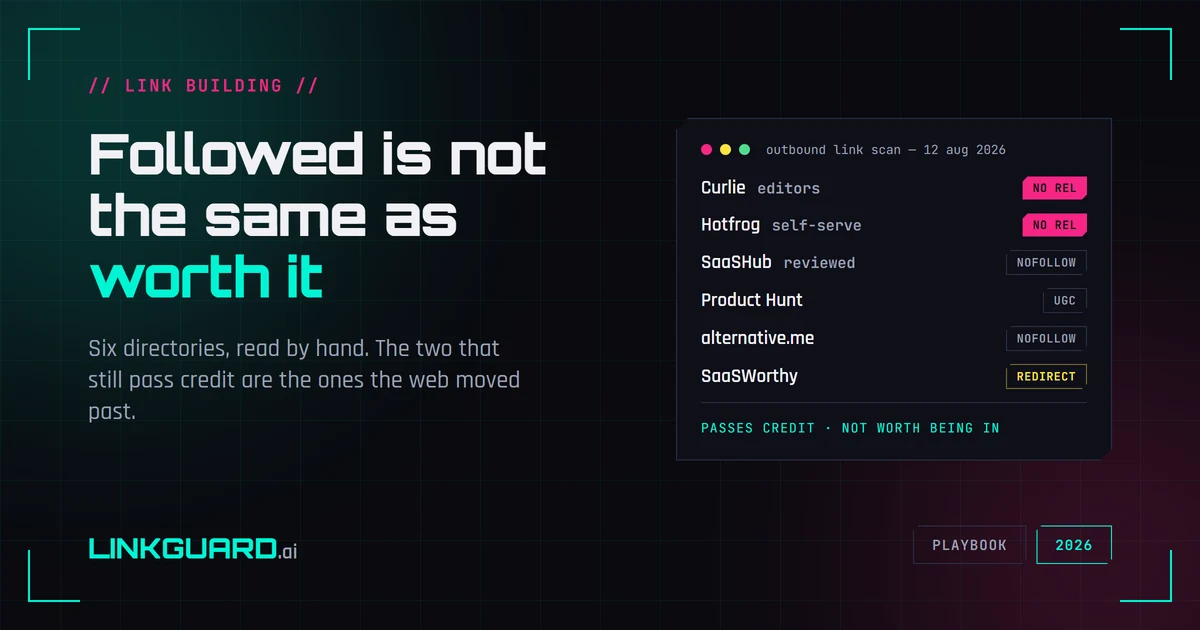
Google's spam policy names low-quality directory links as link spam. We opened six web directories and read the raw HTML: the two that still pass link credit are the general-directory survivors, while every vertical directory worth being listed in withholds it. What the tactic is still good for, and what to check once a listing is live.