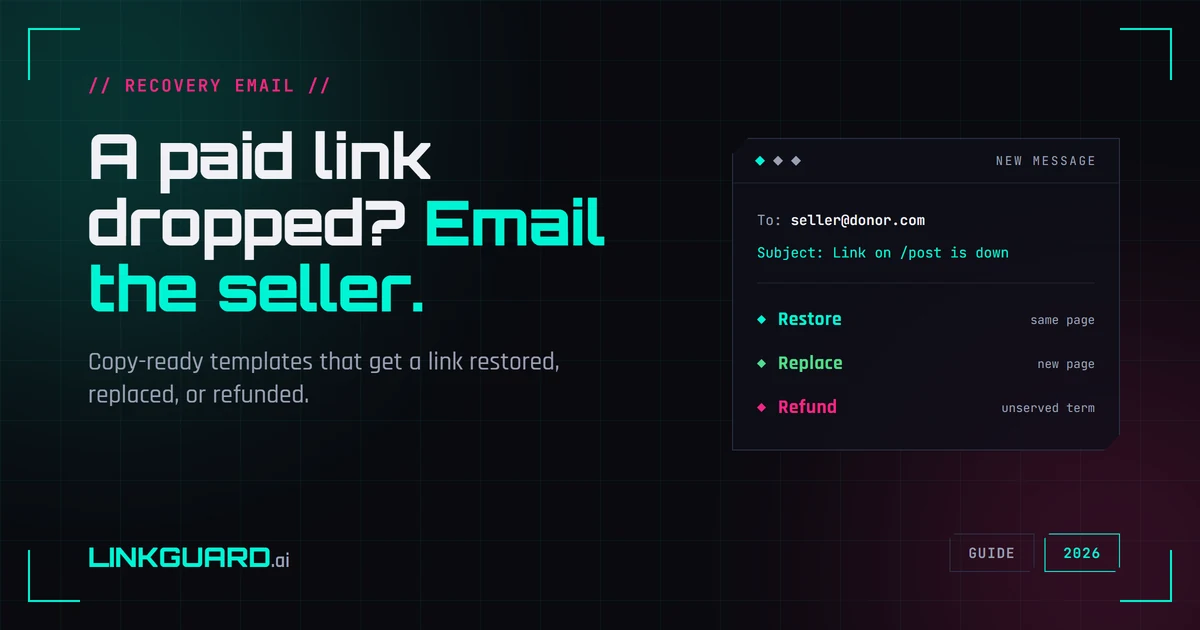
A backlink you paid for is gone, you've confirmed it on the live page, and now the only thing standing between you and your money is an email. This is the step people botch. They fire off something annoyed and vague, or they put it off until the seller has long forgotten the order, or they never send it at all and quietly eat the loss. The email is your entire leverage in a paid-link recovery. Get it right.
Here are the templates that move a seller to restore, replace, or refund, plus the small things about tone, timing, and evidence that decide which of those three you walk away with. If you haven't confirmed the link is gone yet, or you're not sure what your options are, start with the full paid-backlink recovery playbook and come back here for the wording.
The email is your leverage — don't waste it on anger
When a link you bought disappears, the instinct is to write like you've been wronged. Resist it. The seller is a vendor you may want to buy from again, and even if you don't, an angry email gives them a reason to stall instead of fix. The goal isn't to vent. It's to make restoring or refunding the link the easiest thing for them to do.
Every recovery email that works does the same three things: it states a fact (the link is gone), it proves you have standing (here's the order), and it offers an easy way out (restore, replace, or refund, your pick). Keep those three and you can write the whole thing in five lines.
Before you write: the four facts every recovery email needs
Open with specifics, not a complaint. A seller who placed dozens of links this quarter can't act on "my link is gone" — they need to find the order. Have these four facts in the message itself:
- The placement URL. The exact page the link was on, not your homepage. If the page is deleted, say so and give the URL it used to live at.
- The purchase date and amount. When you bought it and what you paid. This is what turns a request into a transaction.
- The agreed terms. Dofollow or nofollow, the anchor text, and how long it was meant to stay live. The gap between what you agreed and what happened is your case.
- What's wrong now. Removed entirely, page 404s, went nofollow, anchor rewritten, or redirected. Be precise — "the link is now nofollow" is a different ask than "the page is gone".
If you can't lay your hands on these in under a minute, that's the real lesson for next time: the cost and terms of a link have to live somewhere you can pull them, not scattered across email threads and a spreadsheet you update when you remember to.
The three asks, in the right order
Don't lead with a refund. Lead with the outcome that's cheapest for the seller and best for you, and fall back from there:
- Restore. Put the same link back on the same page. Easiest for both sides, and it's the link you wanted.
- Replace. If the page is gone for good, an equivalent link on another page of the same site. You keep the placement; they avoid a refund.
- Refund. If neither is possible, your money back for the unserved term. This is the fallback, and it's where your written order details — and what the guarantee wording actually promises — do the work.
Offering all three in order signals you're reasonable and gives the seller a path that doesn't cost them cash. Most legitimate sellers will take the replacement over the refund, which is usually the better result for you anyway.
The templates
Fill in the brackets and cut anything that doesn't apply. Shorter is better — every one of these fits in a phone screen.
1. Link removed before the agreed term
Subject: Link on [page URL] is down — restore, replace, or refund?
Hi [name],
The link you placed for me on [page URL] on [date] is no longer live. We agreed it would stay [term] as a [dofollow] link with the anchor "[anchor]", and we're inside that window.
Could you put it back, or place an equivalent link on another page on the site? If neither works, I'd like to arrange a refund for the remaining term. Happy to forward the original order. Thanks for sorting it out.
2. The page was deleted (404)
Subject: Page hosting my link is gone — [old URL]
Hi [name],
The article at [old URL] that carried my link (bought [date], [anchor], [dofollow]) now returns a 404, so the placement is gone with it. Since the page can't be restored, could you place an equivalent in-content link on another relevant page on the site? If there's nothing suitable, I'd like a refund for the remaining term. Order details attached.
3. The link went nofollow, or the anchor changed
Subject: Link on [page URL] changed — not the placement we agreed
Hi [name],
The link on [page URL] is still there, but it's now [nofollow / pointing to a different URL / using the anchor "[new anchor]"]. We agreed a [dofollow] link with the anchor "[anchor]" on [date]. Could you restore it to the agreed terms? Want to flag it early rather than let it sit. Thanks.
4. The refund ask (after restore and replace are off the table)
Subject: Refund for removed link — [page URL]
Hi [name],
Thanks for getting back to me. Since the link can't be restored or replaced, I'd like to go ahead with a refund for the unserved term. The placement was [page URL], bought [date] for [amount], agreed for [term], and it came down after [actual time live]. I've attached the order. Let me know what you need from my side to process it.
5. The follow-up (when they go quiet)
Subject: Re: Link on [page URL] is down
Hi [name],
Following up on the message below from [date]. The link is still down and we're still inside the agreed term. I'd rather sort this with you directly — a restore or replacement is fine, or a refund if not. Can you let me know which works this week?
One follow-up is fair. Two is the limit. If a seller ignores a clear, factual request twice, you've learned the most important thing about them, and the next step is to drop that source and write the link off, not send a third email.
What makes a recovery email work
The wording matters less than three things underneath it:
- Timing. The email you send the week a link drops lands very differently from the one you send three months later. Early, the seller still remembers the order and the term clearly hasn't lapsed. Late, you're arguing about ancient history with someone who's moved on. This is why catching the loss fast matters more than any phrase in the template.
- Evidence. "We agreed 12 months" is worth nothing without the order to back it. The sellers who honor guarantees still ask for proof, and the ones looking for an excuse will use a missing receipt as one. Attach the order; don't make them take your word.
- Tone. Factual and easy to act on beats forceful every time. You're not threatening a vendor into compliance; you're handing them a clean way to keep a customer. Save the firmness for the pattern ("this is the third link from you that's dropped"), which is far more persuasive than any amount of indignation about one.
Track the conversation, not just the send
Sending the email is half the job. The other half is remembering you sent it. A recovery isn't done when you hit send. It's done when the link is back up and indexed, or the refund has landed. In between, a request sits in one of a handful of states: alerted, outreach sent, replacement promised, replaced, refund requested, refund received, or written off. Lose track of which, and a "promised" replacement that never materializes slips through, or you forget to confirm a refund actually arrived.
This is where a spreadsheet quietly fails. It records what a link cost, but it doesn't know the link is down, it doesn't hold the back-and-forth with the seller, and it never reminds you that a promised replacement is two weeks overdue. The conversation outlives the spreadsheet's attention span.
Where a tool helps (and where it doesn't)
No tool writes the seller's reply, and none can force a refund. The recovery is still a human conversation. What software removes is the busywork around it — noticing the loss, drafting the first email, and keeping the thread from falling through the cracks.
Two pieces of LinkGuard cover exactly that. The free AI outreach email generator turns the facts of a placement into a first-draft recovery email you can edit and send — no account needed for a one-off. And the recovery ledger inside LinkGuard ties each broken link to what it cost and who sold it, runs the recovery through its stages so a promised replacement doesn't get forgotten, tallies what you've recovered, and over time scores each seller on how often their links survive and how often they refund. What neither does is pretend to do the seller's part for them. They detect, draft, and remember; the email is still yours to send.
If you're comparing monitors on the recovery angle specifically, our LinkGuard vs LinkChecker.pro page covers how the buyer-side workflow differs across tools.
Questions people ask
How do I ask for a backlink refund?
Lead with restore or replace, not the refund — it signals you're reasonable and gives the seller a cheaper way to make it right. Only after both are off the table, ask plainly for a refund of the unserved term, with the placement URL, purchase date, amount, agreed term, and how long the link was actually live, and attach the original order. The written terms are what turn a refund request into one a seller can't easily dismiss.
What should I say when a paid backlink is removed?
State the fact (the link on [URL] is down), show standing (bought [date], agreed [term] and [anchor]), and offer an easy out (restore it, replace it on another page, or refund the remaining term). Keep it factual and short. Skip the frustration — an annoyed email gives the seller a reason to stall, while a clean one gives them a reason to fix it fast.
Is it worth emailing the seller over one lost link?
Usually yes. You already paid for it, the relationship already exists, and a restore or replacement costs you a five-minute email versus the price of buying a new link. The exception is a dead domain, where there's nothing to restore — then it's a refund ask or a write-off. The bigger payoff is the record: emailing every loss builds the seller history that tells you who to keep buying from.
How many times should I follow up?
Once, maybe twice. A single factual follow-up a week after the first email is fair and often all it takes. If a seller ignores two clear, evidence-backed requests, a third won't change the outcome — it just costs you time. Treat the silence as the answer, write off the link, and stop buying from that source.
Should I threaten a chargeback or a bad review?
Not in the first email, and rarely at all. Leading with a threat turns a fixable vendor problem into a fight and makes a cooperative seller defensive. Give them a clean chance to restore, replace, or refund first. If a seller who clearly owes a refund stonewalls you across two factual follow-ups, your options (a chargeback, an honest public review) are still there — but most legitimate sellers never get you there, because the easy fix was cheaper for them too.
Can a tool write the recovery email for me?
It can write the first draft. A generator like our free AI outreach email tool turns the placement facts into a sendable draft you then edit in your own voice. What it can't do is have the conversation — read the seller's reply, judge whether a replacement offer is fair, or decide when to escalate. Use it to skip the blank page, not to outsource your judgment.
Catch the loss while the email still works
The best recovery email in the world is wasted if you send it three months late. Every template here depends on one thing happening first: knowing the day a paid link breaks, while the seller still remembers you and the agreed term hasn't run out. LinkGuard watches your bought placements, flags a change the day it happens, drafts the recovery email, and gives you the ledger to run the conversation to a restore, replacement, or refund. Start free with 1,000 tokens and bring your paid links over.
About the Author

Related Articles

Expired domain backlinks decay before the auction closes
Policy requires an expired .com to resolve to nothing for weeks before anyone can buy it. The links you're bidding on were counted before that, by a crawler that hasn't been back.

PBN backlinks don't fail one at a time
Google's spam documentation never uses the word. What a network link actually is in 2026, which footprints still identify one, and why four of them tend to go in the same week.
Directory submission in 2026: what a listing is actually worth
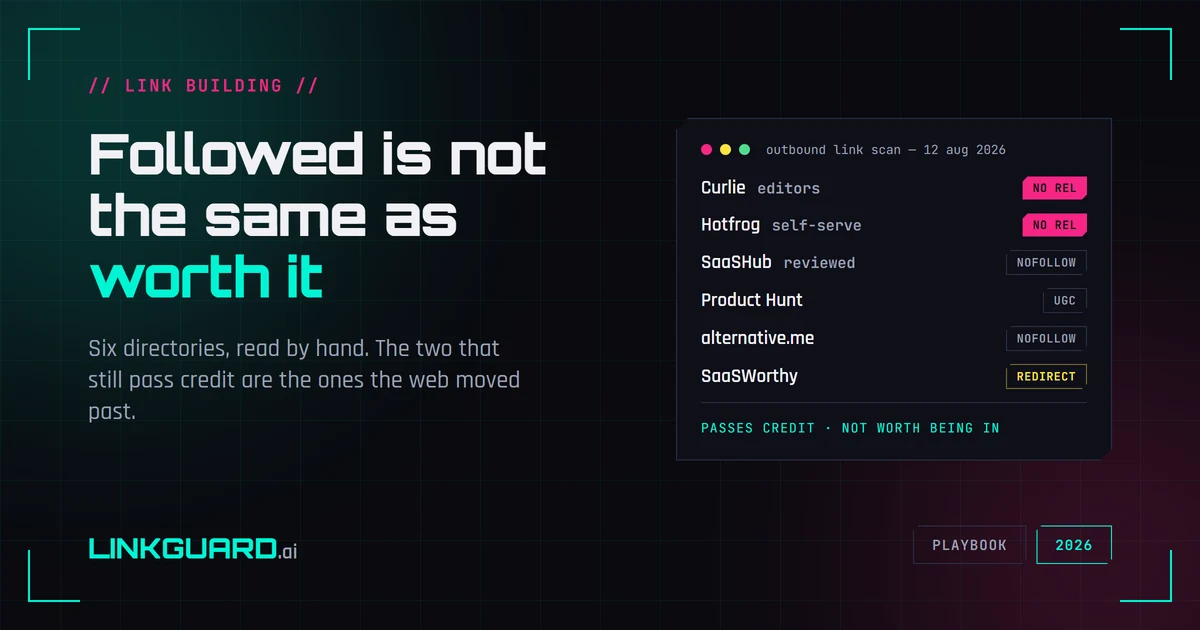
Google's spam policy names low-quality directory links as link spam. We opened six web directories and read the raw HTML: the two that still pass link credit are the general-directory survivors, while every vertical directory worth being listed in withholds it. What the tactic is still good for, and what to check once a listing is live.