Somewhere in the shared drive there's a spreadsheet called something like directories_final.xlsx. Two hundred rows. Site name, submission URL, date submitted, and a status column that's mostly the word "submitted". Someone spent a week building it, or paid somebody else to spend an afternoon.
Open ten of those rows at random today. Count how many still resolve, how many list your company with no link to your site anywhere on the page, how many land on a parking page. The ones that pass are exactly as promised: live, listing you, visited by nobody.
That spreadsheet wasn't a scam, and if you inherited it you didn't do anything wrong. It's just uncomfortable to look at, because you can't tell from the outside whether it was a week well spent or a week of filling in forms. And if a client ever asks what the directory line item bought them, you don't have an answer yet.
We opened six web directories on August 12, 2026 and read the raw HTML on each. Below: what Google's policy names, what we found, the three things a listing is still good for, and what to check once one is live. Disclosure first. We sell backlink monitoring, so the checking section is where we have a stake, and it's marked.
The short answer, before any of it: directory submission stopped being a link tactic and became a citation and referral tactic. The directories that still pass link credit are the two oldest business models on our list, and every directory where a listing might reach an actual buyer withholds it.
What is directory submission?
Directory submission is adding your site to someone else's categorized list of sites, usually through a form, sometimes for a fee. You supply a URL, a name, a category and a description. Then an editor, an algorithm, or nobody at all decides whether it goes live.
Treating three different products as one tactic is where most of the wasted effort comes from.
General web directories catalog the whole web by subject. Curlie is roughly what's left of that species.
Business and local directories hold name, address, phone and hours. Hotfrog, Yelp and the various Yellow Pages descendants live here, and their real job is local search rather than links.
Vertical directories cover one market. SaaSHub and G2 for software, Clutch for agencies. They're the only category where a listing puts a human in front of your product, which is also, as it turns out, why they're the ones that won't give you a followed link.
What Google's spam policy says
It's public, and it's one line. Google's spam policies give a bulleted list of link spam examples, and the seventh bullet reads, in full: "Low-quality directory or bookmark site links." It sits between advertorials and links stuffed into widgets distributed across other people's sites.
Read what it doesn't say. It doesn't say directories. It says low-quality ones, and Google has never published the line it draws. Two bullets up is the other half you need: "Exchanging money for links, or posts that contain links." A directory that takes a fee and hands back a followed link sits squarely inside that sentence, whatever the fee is called on the invoice.
Which directories still pass link credit?
The useful question about a directory isn't its Domain Rating. It's what the listing page does with your URL in the HTML, which anyone can check, for free, in about a minute.
| Directory | Getting listed | What the link gives you |
|---|---|---|
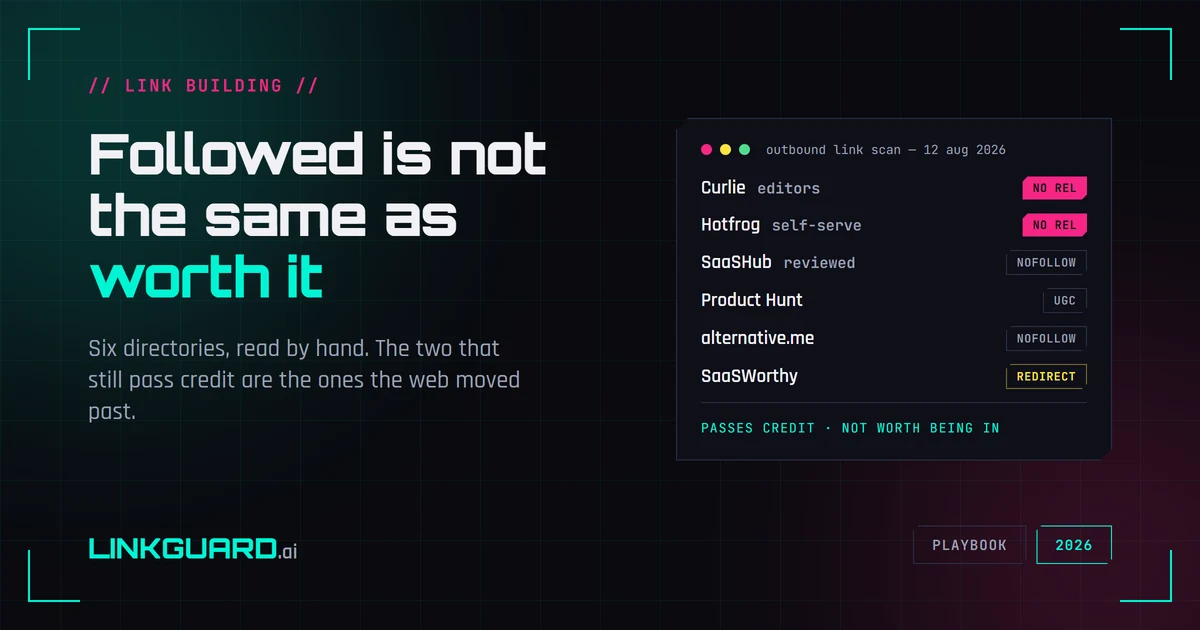
| Curlie general web | Free; volunteer editors, many categories closed | No rel attribute at all, so it passes credit |
| Hotfrog business listings | Self-serve | No rel on the claimed listing we checked, so it passes credit |
| SaaSHub software | Submitted, then reviewed | rel="nofollow" on every outbound link to the vendor |
| Product Hunt launches | Self-serve | rel="noreferrer noopener ugc" |
| alternative.me software | Self-serve | rel="nofollow", plus a JS handler that cancels the plain click |
| SaaSWorthy software | Self-serve | Not a link to the vendor. Points at saasworthy.com/redir.php with spons=1 |
Four distinct treatments across six sites: no rel at all, nofollow, ugc, and a redirect that isn't a link to the vendor. Two of them are worth a second look.
Product Hunt uses ugc, the value Google recommends for user-generated content like comments and forum posts. That's an honest label for a page a founder filled in themselves, and Google's documentation says links carrying these attributes "will generally not be followed." SaaSWorthy is the stranger case: the "visit website" link doesn't point at the vendor's domain. It points at SaaSWorthy's own redirect script, carrying tracking parameters including spons=1. We tried to follow it and got a 403 (their redirector doesn't answer scripts), so we can't tell you where it lands. Whatever it resolves to for a person clicking it, the anchor in the source is a link to SaaSWorthy.
Now put that last column next to what it took to get listed. Curlie's submission page says it plainly: volunteer editors, "we pride ourselves on being highly selective," "we don't accept all sites," and a category without a suggest icon isn't taking submissions at all. Hotfrog takes a form and an email. Those two sit at opposite ends of any quality measure you could name, and they are the two that pass credit.
Which inverts the usual selection rule, though not in the tidy way it first looks. The split isn't strict door against open door. It's old business model against new one. The two that pass credit are the survivors of the general-directory era, a volunteer-edited relic and a mass listings site, neither of which has revisited its outbound policy in years. All four of the software and launch directories, the ones where a listing can put you in front of a buyer, hand you a nofollow, a ugc tag, or a redirect. Selecting on link juice doesn't select for a gate, and it doesn't select for an audience. It selects for indifference.
Six is a small sample and we're not dressing it up as a study. Run the check yourself before you submit anywhere. Raw HTML doesn't negotiate.
Three things a listing is still worth
None of them is ranking credit.
Local citations. With a physical address or a service area, consistent name-address-phone data across the main business directories feeds local results. Directory people call it NAP consistency. It works whether the links are followed or not, because the value is in the data matching rather than the link, which means the format has to be identical everywhere, down to whether you write "Suite 4" or "#4".
Referral traffic, in exactly one category. Someone comparing project management tools really does browse a software directory. The two biggest general directories closed, which is its own section below, and nothing replaced the traffic. If you can't picture a specific person arriving at that listing page for a reason of their own, there's no traffic case to make.
Facts about your company that a machine can read. Directory pages are structured and consistent, which makes them easy material for the models now answering questions about your category. We can't draw a causal line from a directory listing to an AI citation, and nobody else can either. The defensible version is narrower. If a model is assembling a picture of your company, entries that agree with each other beat entries that contradict each other. Our fuller position is in how to get cited by ChatGPT, Perplexity and AI Overviews.
What isn't on the list: a followed link from a directory nobody reads. We've said the compressed version of this in the dofollow explainer, and it holds here too.
What happened to the two directories everyone remembers
Two closures explain this market better than any argument about link equity.
The Yahoo Directory charged a $299 non-refundable review fee, billed again every year a site stayed listed. Yahoo announced the closure on September 26, 2014, third item down in a post titled "Progress Report: Continued Product Focus," and the directory went dark on December 27, ahead of the December 31 date it had announced. DMOZ, the volunteer-edited Open Directory Project that every SEO of a certain age still name-checks, closed on March 17, 2017 when AOL stopped supporting it. Curlie is its continuation: same volunteers, same hierarchy, no fee.
The free one survived on volunteer labor. The one charging $299 a year didn't survive. Worth holding on to the next time a directory quotes you an annual review fee for a listing it promises to maintain forever.
Brownbook, still live, describes itself in its own <title> tag as "Free business listings for SEO and search engine marketing." Not for customers. For SEO. When a directory tells you what it's for, believe it.
How do you judge a directory before submitting?
Four checks, maybe five minutes. The first settles most cases on its own.
- Who decides what gets in? If the answer is "anyone with an email address," that's also the answer to what your listing is worth. A real gate (an editor, a review, a rejection rate) is the one quality signal in this exercise that's hard to fake. Approval speed is the tell: Curlie can take months or never get to you, while a self-serve directory publishes in seconds because nobody is reading. If the answer to this first check is no, stop, and you've saved yourself the other four minutes.
- Open a category page and read it as a person, not as a metric. Is this a list you'd use? Or is a third of it 404ing?
- Check the outbound treatment before you spend anything. View source on any existing listing, find the site link, read its
rel, and check whether the href points at the listed site or at the directory's own redirector. Our free nofollow checker answers the first half in one request if you'd rather not read markup. - Is the listing page indexed? A category page Google isn't holding in its index does nothing for you. An index check is a fifteen-second answer, and it disqualifies more candidates than any other check here. If you've never asked this about a page you're linked from, start with whether the linked page is indexed.
If there's a fee, ask the question that ends the conversation: is it refundable if you reject me? Yahoo's wasn't. Almost none of them are. You're buying a review, with the listing as a possible outcome. Fine, as long as you know that's the trade before you pay rather than after.
What to check after your listing goes live
Our stake, marked: we built LinkGuard to run these checks on a schedule. The checks are the same whether you run them by hand, script them, or pay somebody.
Directory listings decay differently from editorial links, and none of the failures announce themselves:
- The listing quietly loses its website field. Directories redesign, drop the outbound link from the free tier, or move it behind an upgrade. Your page still exists and still names you. It just doesn't link to you anymore, and it returns 200 through the whole thing. On the Hotfrog listings we opened, the claimed one carried a website link and an unclaimed one carried none: same template, different output.
- The link becomes a redirect. A directory that starts routing outbound clicks through its own tracker, the way SaaSWorthy does, has changed what you have without changing anything you'd notice. Tracing the chain is the only way to see it.
- The
relchanges. Directories add nofollow site-wide during cleanups, and it's invisible on the rendered page. - And whole directories get deindexed, which happens to this category more than any other. A listing on a deindexed page is a listing nowhere.
Cadence: quarterly, batched, and don't overthink it. These are low-value high-volume links where losing one barely registers, and our portfolio cadence files them alongside profile links for that reason. Put directory listings on a weekly watch and you'll spend more attention than the links are worth.
Don't buy monitoring for a directory list
Under about 50 links, Search Console and a spreadsheet cover you. Monitoring won't prevent anything either way. It tells you when, and for a free listing on a site that owes you nothing, knowing when buys you very little. Fix what you can fix in one sitting and let the rest go.
The real cost of getting this wrong isn't a penalty. It's that the same afternoon gets spent again next quarter, on the same list, by whoever inherits the spreadsheet.
5 tokens for an HTML check, 7 for an indexation check, 12 for both. Checking a hundred listings twice a year comes to 2,400 tokens; the smallest pack we sell is $25 for 25,000, so that year of checking uses under a tenth of it, and the rest doesn't expire while your account is open. New accounts get 1,000 free tokens, no card required, which covers a first pass on 83 listings. You pay when you check, and there's no month where you pay for not checking.
Questions people ask
Are directory submissions still good for SEO in 2026?
Not as a link tactic. Google's spam policies name "low-quality directory or bookmark site links" as an example of link spam, and the directories easiest to get into are the ones that description fits. Three uses survive: local citations, where consistent business data feeds local results whether the links are followed or not; referral traffic from vertical directories that buyers browse; and keeping consistent, machine-readable facts about your company in more than one place. The signal that predicts everything else is whether a human ever said no to anyone.
Do directory links pass link juice?
Some do in the markup, and that turns out to be the weakest signal available. Of six directories we at LinkGuard checked in August 2026, two linked out with no rel attribute at all: Curlie and Hotfrog. The other four used nofollow, a ugc tag, or routed the "visit website" link through their own redirect script. The two that passed credit were the two general-web survivors, not the two worth being listed in. Whether Google counts a followed directory link is a separate question from whether the markup is followed, and for a directory anyone can join, the honest answer is probably not much.
Are bulk directory submission services worth it?
A service promising 300 or 500 submissions is optimizing for the number in its own report, which is the one number nobody outside that report cares about. Every check that decides whether a directory deserves your time is a judgment call: does a person decide what gets in, would you use this list, does the listing page even stay indexed. None of that survives automation, and the directories that accept automated submissions accept them precisely because nobody is reading. Buy the volume if you want it, but know what you're buying: rows in a spreadsheet, not links that count.
How many directories should I submit to?
Far fewer than any list-of-500 article suggests. Every directory that shows up in local results for your industry and city, every vertical directory your buyers use, and nothing else. If you can't name a reason a specific person would land on that listing page, submitting is a rounding error at best.
Is paid directory submission against Google's guidelines?
If you pay for a link that passes ranking credit, yes. "Exchanging money for links" is listed as link spam, and the remedy Google offers is marking the link rel="sponsored" or rel="nofollow", which removes the reason to buy it. It gets murkier with the paid-review model: you're buying editorial consideration, non-refundable, with the listing as an outcome rather than the purchase. That's a real distinction, and also a convenient one for the seller. If the fee exists because the link is followed, you already know which side of the line you're on.
Will directory links hurt my rankings?
Mostly they'll do nothing, which is the outcome people underestimate. This is the corner of SEO people still attach the word Penguin to, and the fear is aimed at the wrong thing: the common case for low-quality links isn't a penalty. It's that Google ignores them, and the money and the afternoon are gone. Manual actions for unnatural links happen. Rarely, given how much of this gets built. Inherited a spreadsheet of a few hundred submissions from a previous agency? The useful response is to stop adding to it, not to panic-disavow, and the same caution applies to most links marketed to you as toxic.
Pick the ones with a door
The whole test fits into one question: did a person decide you belonged in this list? If yes, the listing is worth something and the rel attribute is nearly beside the point. If no, if the form auto-approves, if the fee is the only gate, if the category is a wall of dead links, then no amount of followed markup turns it into a link worth having.
Take the last directory you submitted to and check two things, thirty seconds each: what the site link's rel attribute is, then whether the listing page is still indexed. Both free, neither needs an account. If it fails the second one, it never counted.
That's one row. If the spreadsheet still has two hundred, the job isn't checking one. It's deciding which handful are worth keeping and putting those on a quarterly schedule. Start with the free tokens and check the first batch before you decide whether any of it is worth automating.
About the Author

Related Articles

Expired domain backlinks decay before the auction closes
Policy requires an expired .com to resolve to nothing for weeks before anyone can buy it. The links you're bidding on were counted before that, by a crawler that hasn't been back.

PBN backlinks don't fail one at a time
Google's spam documentation never uses the word. What a network link actually is in 2026, which footprints still identify one, and why four of them tend to go in the same week.
HARO link building in 2026: what's left after the shutdown
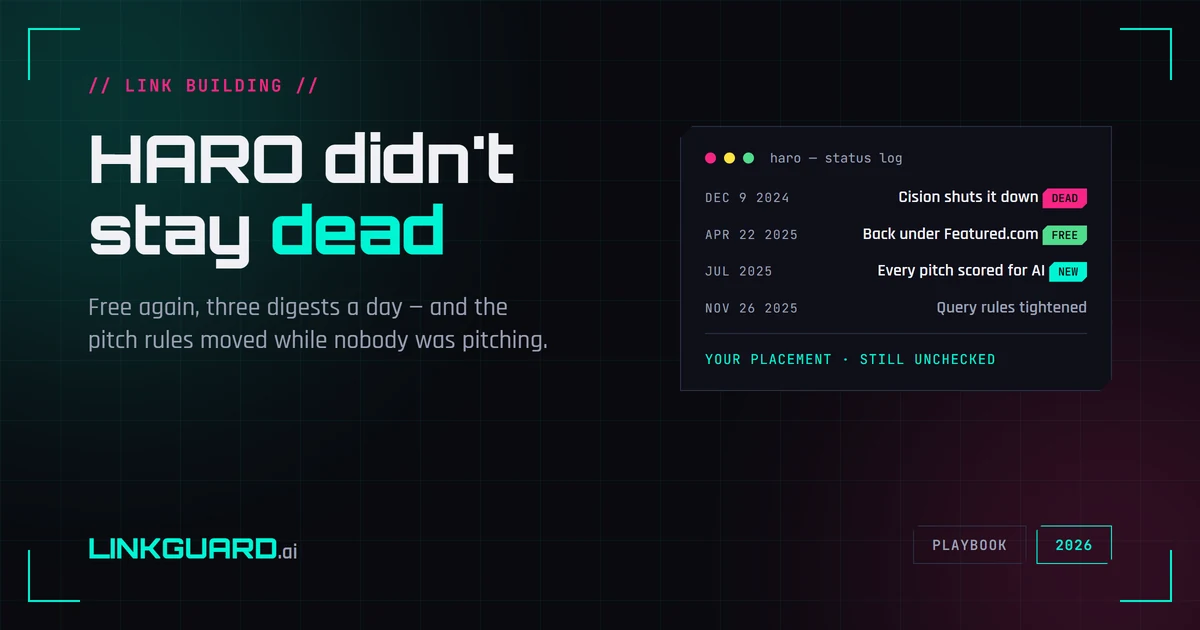
HARO shut down in December 2024, came back under new ownership four months later, and picked up rules on the way — including AI scoring on every pitch. What exists in 2026, what a placement actually gets you, and the four checks worth running once your coverage is live.