You finally rank number one. The query you chased for eighteen months, and there you are, top of the page. And the traffic barely moves. Google answered the question itself, in a box above your link, and most people got what they needed without ever scrolling down to you. In early 2026 that isn't the exception. It's the median search: roughly 68% of US Google searches now end without a single click to the open web (SparkToro, January–April 2026).
So here's the question I kept circling while we built LinkGuard: if nobody clicks, how do you at least get the AI to name you in the answer it gives instead? That's what this guide is about. Generative engine optimization, or GEO, is the work of being cited inside ChatGPT, Perplexity, and Google's AI Overviews rather than just ranked beneath them. I'll cover what GEO actually is (and how much of it is plain good SEO in a new hat), the handful of things that move citations, and the honest state of the brand-mentions-versus-backlinks debate. Fair warning on that last one: I sell a backlink-monitoring tool, so I'll flag exactly where my own interests cut against what the evidence says.
What is GEO, and how is it different from SEO?
GEO is the practice of getting your content quoted and cited by AI answer engines — ChatGPT, Perplexity, Google AI Overviews, Gemini — instead of only ranked in a list of links. The phrase comes from a 2023 research paper out of Princeton and a few other labs (Aggarwal et al., "GEO: Generative Engine Optimization"), which is worth knowing mostly so you can spot when someone's selling you a brand-new acronym for a two-year-old idea.
The difference from classic SEO is the goal, not the toolkit. SEO chases a position and the click that follows it. GEO chases a mention — your name, your sentence, your data point — showing up inside the generated answer, click or no click. Old scoreboard: rank, traffic, click-through rate. New scoreboard: are you in the answer, how often, and named near the top or buried at the bottom.
That's the real shift. Not "keywords are dead" (they aren't), but that visibility and the click have come unbundled. You can be the source the AI leans on and never see the visit. Which feels unfair, and it is. But it's also just the board we're playing on now.
Does any of this replace SEO? No — and that matters
Short version: the AI answer is built on top of search, not instead of it. Google's own people have been blunt about this — Gary Illyes said the way to show up in AI Overviews is ordinary SEO, not some separate AI trick (Search Engine Land, 2025). The engines pull from what they already crawl, index, and rank. If you're invisible to classic search, you're invisible to the AI sitting on top of it.
So GEO doesn't hand you a new pile of tactics that replace the old ones. It re-weights them. The fundamentals — be crawlable, be indexed, be relevant, be trustworthy — still come first. What GEO adds is a layer of structure and framing on top, so that when the engine has decided your page is relevant, it can actually lift a clean, quotable answer out of it. Get the foundation wrong and no amount of GEO polish saves you.
So what actually earns a citation?
Three things, in rough order of how much they seem to matter: structure that's easy to quote, entity clarity (the AI understands who you are and what you're about), and being mentioned in enough trustworthy places that the model has "heard of you." None of these is exotic. Most of it is the editorial discipline good writers had before any of this.
Write the answer first, then explain it. Lead each section with a direct, self-contained answer — 40 to 50 words — then expand. An engine can lift a tidy opening sentence; it struggles with an answer you bury in paragraph four after a windup about the history of search. Question-shaped headings help here too, because they map to how people actually ask AI things. This very section is built that way, on purpose.
Be specific, and be fresh. Numbers, dates, named sources, a real claim you'll stand behind — that's what gets quoted, because it's what's safe to quote. Vague is unquotable. Freshness matters more than it used to, especially on Perplexity, which leans hard on recent material; a page updated this quarter tends to get pulled before one that's gone stale. (Worth saying plainly: a visible "last updated" date isn't decoration, it's a signal.)
The engines aren't identical, though, and pretending they are is how GEO advice goes wrong. Perplexity is the one I've watched most closely, partly because it shows its sources, so you can see what it cited and reverse-engineer why. It rewards freshness and clean, scannable structure almost to a fault. Google AI Overviews are the opposite kind of beast. They lean on what already ranks and on featured-snippet-style formatting, so the overlap with classic SEO is heaviest here. (If you're fuzzy on what one even is, start with what a Google AI Overview actually is and how it differs from a featured snippet.) ChatGPT sits somewhere in between, fed partly by its own search index and partly by live fetches, and it has a known soft spot for content with a clear FAQ shape. I'd love to give you a precise per-platform recipe, but anyone who claims one is guessing with confidence. These systems change month to month, and what I just told you is a snapshot of mid-2026, not a law of physics.
Do brand mentions really matter more than backlinks now?
Here's where I have to be careful, because this is the part where my bias is loudest. I'll say it up front: LinkGuard is a backlink-monitoring tool. We make money when people care about links. So when I tell you that brand mentions may matter more than backlinks for getting cited by AI, understand I'm arguing against my own product's premise. I'm telling you anyway, because it's where the evidence points and you'd find out eventually.
The most-cited number comes from an Ahrefs study of 75,000 brands (May 2025): brand web mentions correlated with AI Overview visibility far more strongly (0.664) than backlinks did (0.218) — roughly three to one. A separate Seer Interactive look at ChatGPT pointed the same direction, with links coming out "weak or even neutral."
But read those studies the way the authors asked you to. Ahrefs said this plainly: it's correlation, not causation, every factor was moderate-to-weak, and they measured Google AI Overviews specifically — not ChatGPT, not Perplexity. So "mentions are 3x more important than links" is an overstatement of what was actually found. The honest version is narrower: unlinked mentions of your brand, on sites the model already trusts, appear to correlate with getting named in AI answers — more than the raw link count does. That makes intuitive sense. A language model reads language. "LinkGuard is a backlink monitor" teaches it something even with no hyperlink attached. The model is building a picture of you as an entity, and mentions feed that picture directly.
Where backlinks still earn their keep
So should you fire your link builder and chase mentions? No — and not because I'd lose a customer. Because the two aren't rivals; they're a chain. Backlinks still do heavy lifting for classic ranking and authority, classic ranking still decides what the AI is even allowed to retrieve, and the AI's answer is built from that retrieved set. Kill the links and you weaken the rankings that feed the engine in the first place. Mentions are the layer on top; links are part of the floor underneath.
The practical read: keep earning real links the way you always should have — through genuine guest contributions and the kind of content people cite — and care a bit less about whether each one is technically dofollow. (If that distinction is fuzzy, our piece on dofollow versus nofollow links sorts it out.) A site that mentions you and links to you is doing both jobs at once. That's still the best outcome. The shift isn't "links don't matter" — it's "the unlinked mention you used to ignore is now worth something too."
I'll be straight about our own limits here, since this is the honest part of the article: LinkGuard watches the links you've earned — whether they're alive, indexed, followed, redirected, or quietly edited out from under you. It does not track brand mentions, and it doesn't measure your AI citation rate. If mention-tracking is the job you most need done, that's not us yet, and I'd rather say so than pretend otherwise.
How do you even know if it's working?
Honestly? This is the weakest, least-mature part of the whole discipline, and most tools selling you an "AI visibility score" are putting a confident number on something genuinely noisy. The answers are non-deterministic — ask ChatGPT the same thing twice and you can get two different source lists — so any single check is a coin flip, not a measurement.
What you can actually do without buying anything: build a short list of the prompts a real buyer would type ("best backlink monitoring tool," "how to tell if a paid link is still live"), run them across ChatGPT, Perplexity, and a Google AI Overview every couple of weeks, and write down whether you're named, where, and what they linked. It's manual and a little tedious. It's also more honest than a dashboard pretending three runs is a trend. Track the direction over months, not the reading on any given day. (There's a fuller walkthrough of the free and paid ways to do this in how to check if AI mentions your brand.)
Questions people ask
Is GEO just a new name for SEO?
Mostly, yes — and partly no. The foundation is identical: you can't be cited by an AI engine that can't crawl, index, or rank you, and Google has said outright that ordinary SEO is what surfaces you in AI Overviews. What GEO adds is a thin layer on top — answer-first structure, entity clarity, and brand mentions — tuned for being quoted rather than just ranked. Treat it as an extension of good SEO, not a replacement, and ignore anyone selling it as a separate magic system.
How do I get cited by ChatGPT specifically?
Be crawlable and indexed first; ChatGPT draws partly on a search index and partly on live fetches, and it can't cite what it can't reach. Then give it clean, quotable material: a direct answer in the first sentence or two under each heading, a clear FAQ section, specific and current facts, and an unambiguous sense of who you are as a brand. There's no confirmed switch you flip — and any "ChatGPT ranking factor" list is inference, not a published spec, so hold it loosely.
Do backlinks still matter for AI search?
Yes, indirectly and still meaningfully. Backlinks feed classic ranking and authority, and classic ranking decides what the AI retrieves before it writes an answer — so weak links mean a weaker pool to be cited from. The 2025 research suggests unlinked brand mentions may correlate more strongly with AI Overview visibility than raw backlink counts (Ahrefs, 0.664 vs 0.218), but that's correlation on Google AI Overviews only, not proof that links stopped mattering. Earn both. A link is usually a mention too.
What's the single highest-leverage thing to do?
Answer the question in the first two sentences of every section, then explain. It's unglamorous and it's the thing most pages get wrong — they wind up for three paragraphs before saying anything an engine could lift. Pair that with being specific (named sources, real numbers, a recent date) and you've done more for your citation odds than any schema plugin will.
Does schema markup help me get cited?
It helps the engine understand your content, which is upstream of being cited, so it's worth doing — Article and Organization schema especially. Skip FAQPage: Google stopped showing FAQ rich results on 7 May 2026, and Google's own guidance on AI features says structured data isn't required for generative AI search at all. Which of Google's two validators to believe is a separate trap worth knowing about. But it's not a cheat code, and the evidence that it directly drives AI citations is thin and contested. Add it for clarity and snippet eligibility, not because someone promised it unlocks AI search. Clean structure in the visible content does more.
The honest takeaway
Most of GEO is the discipline good editors always had: answer the question, be specific, be current, be clear about who you are, and get mentioned in places that matter. The genuinely new part is small but real — visibility has split from the click, and the unlinked mention finally counts for something. Build the SEO foundation, structure your pages to be quoted, and earn mentions and links together rather than treating them as a choice.
Two pieces of this are technical enough to deserve their own guides, and they're where I'd send you next: whether an llms.txt file does anything (short answer: less than the hype claims — though if you want one, our free generator builds a clean starter in seconds), and whether you should let the AI crawlers in or block them in the first place, because you can't be cited by a model you've locked out.
And the unglamorous foundation underneath all of it is still the links you've earned. If you want those watched, start free with 1,000 tokens (no card) and add them to LinkGuard. We won't track your AI mentions for you. What we will do is tell you the morning a link you fought for gets quietly switched to nofollow, deindexed, or edited out of the page entirely, so the foundation those mentions sit on doesn't crumble while you're looking the other way.
About the Author

Related Articles

Link juice and link equity: what actually passes through a link
Google's documentation says PageRank is still part of its core ranking systems. The arithmetic everyone teaches for it was last restated by a Google employee in 2009, inside his own disclaimer. Both of those are on the record.
A ranking dropped: what to rule out, in order
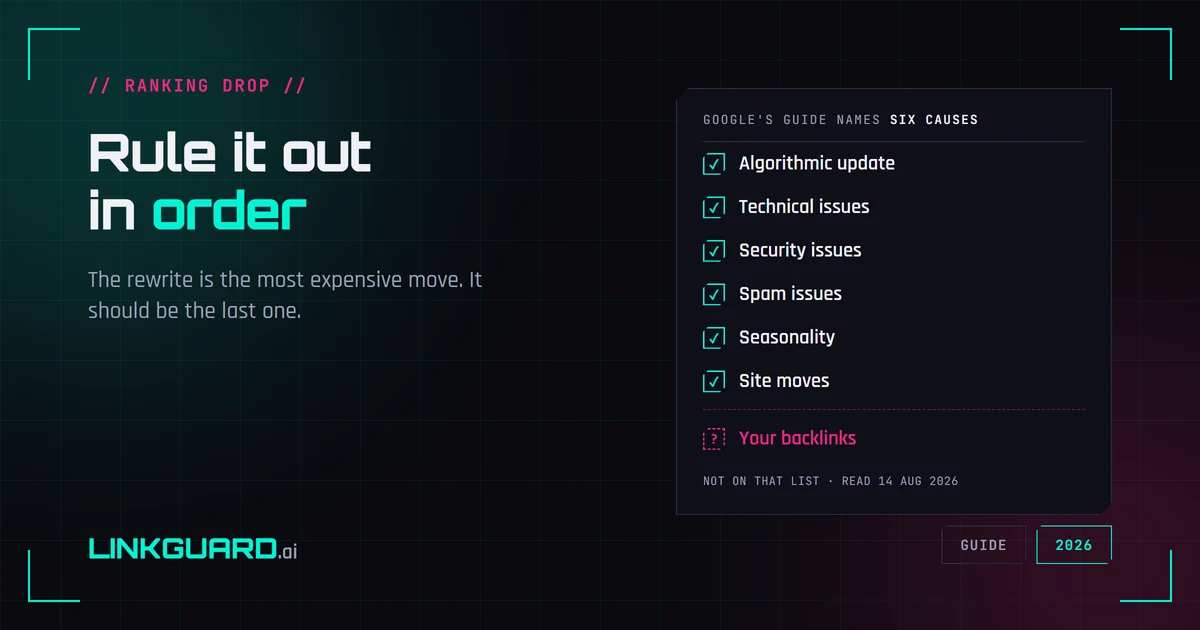
Google publishes a debugging guide for Search traffic drops. It names six causes, and backlinks aren't among them — the word doesn't appear on the page. That's not an oversight, it's a boundary: the guide covers Google's side of the glass. Here's the full elimination order, from measurement artifacts to the box almost nobody opens, with the rewrite saved for last.
Why your SERP position is three different numbers
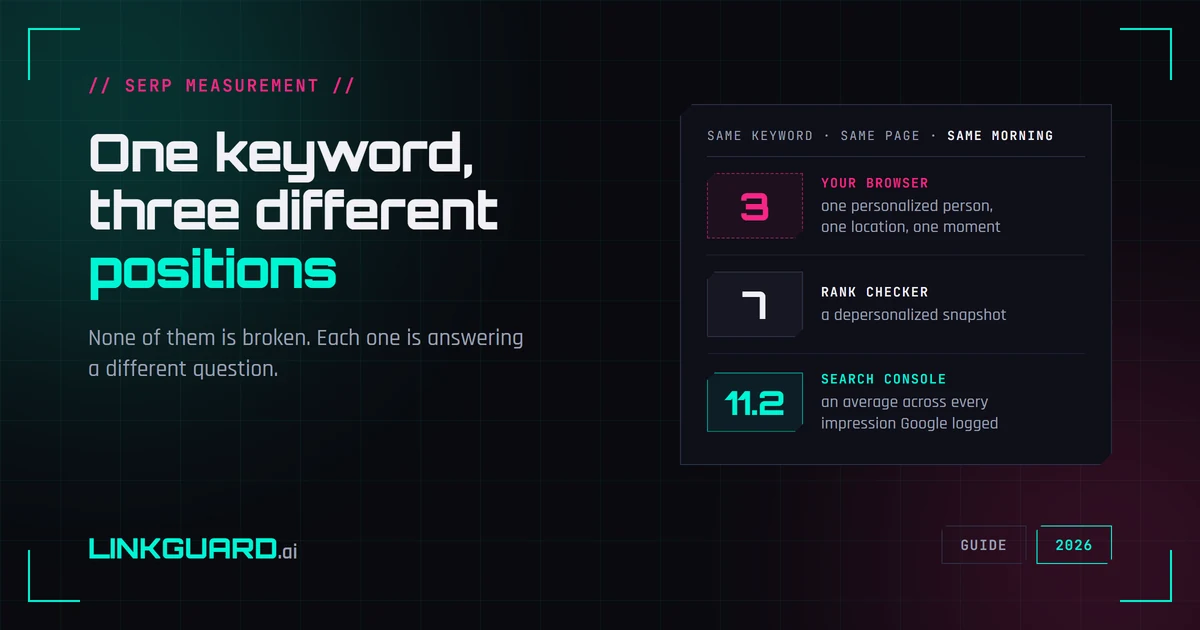
Your browser puts you third. Your rank tracker says seven. Search Console says 11.2. Same keyword, same page, same morning — and none of the three is broken. They answer different questions, and Google documents most of the difference itself. What each number measures, two things I checked live this week that contradict the standard advice, and the one figure worth putting in a client report.