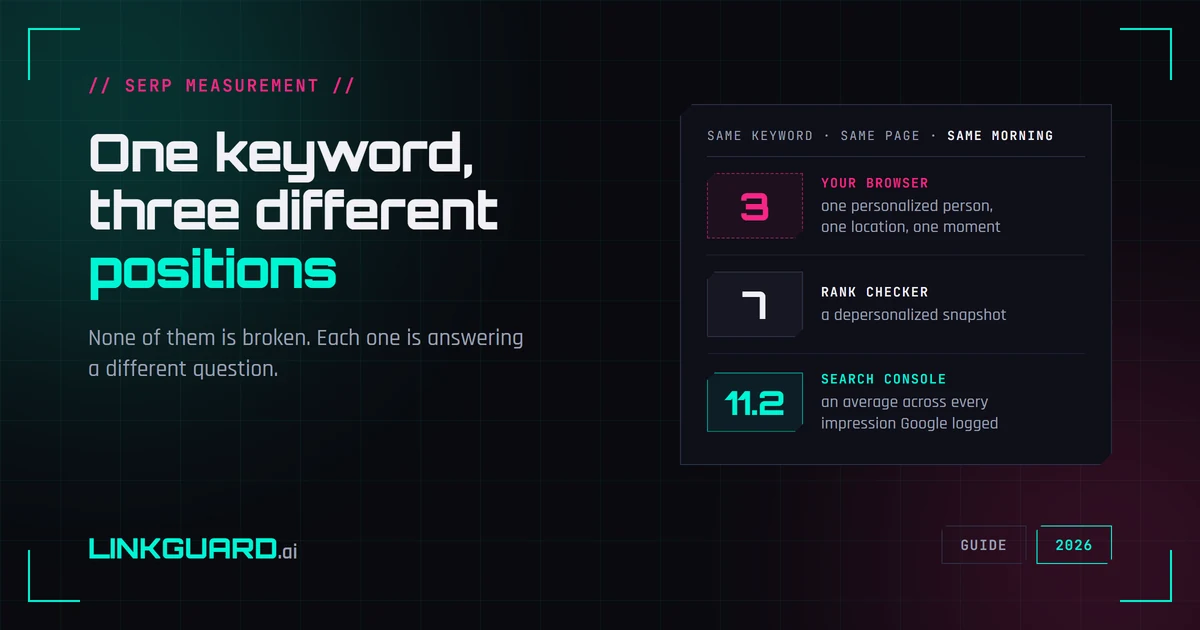
You check one keyword three ways inside ten minutes. Your own browser puts you third. The rank tracker you pay for says seven. Search Console, open in the next tab, says 11.2. Same keyword, same page, same morning.
The instinct is to work out which tool is lying. What usually happens instead is quieter: you pick the number that suits the report you're writing, and six weeks later a client asks why the position in your deck isn't the position on their screen. That conversation goes badly. You handed them a measurement you couldn't defend — not through carelessness, but because nobody mentions that the three numbers are answering three different questions.
None of the three is broken. Your browser shows what one personalized person saw once. A rank checker shows a depersonalized snapshot from one location at one moment. Search Console reports an average across every impression Google logged, with AI Overviews and every other block on the page counted as positions. Three instruments, three questions, three answers. The disagreement isn't noise once you know which question each one is answering.
Below: the three numbers side by side, what Google documents about each, two things I checked in a live browser this week that contradict advice still sitting in a lot of rank-tracking guides, and the one figure that belongs in a client report.
The three numbers, and what each is measuring
Start here, because almost every argument about SERP tracking dissolves once this table is on the screen.
| Where the number came from | What it is really telling you | What it can't tell you |
|---|---|---|
| Your browser | One result page, built for one signed-in person, in one place, on one device, at one moment | What anyone else sees. Google says outright that personalization "may affect the order that individual results would be ranked" |
| A rank checker | A depersonalized page fetched for one location and language, reachable only as deep as Google will paginate | Your customers' actual view, local-pack placement, or anything past the couple of hundred results Google will actually hand back |
| Search Console | The topmost position your link occupied, averaged across every impression Google recorded for that query | Any single person's experience. Google: "For your specific search your position might be different than the average" |
Notice that only one of the three is an average, and it's the one people quote as though it were a rank.
Your browser is not a measuring instrument
Google's own help page on personalization is blunt about it. Personalization "may affect the order that individual results would be ranked on the search results page", and sometimes "might affect the order in which certain content blocks appear". Results are shaped by your screen type, and by what's in your Google Account — Google names Search history explicitly.
Location is its own pile of signals. Google lists them: your device's location, your IP address, home and work addresses saved to your account, and past activity — "areas that you have searched for in the past may be used to estimate a relevant location".
Nobody has to switch anything on for this. It's the default.
When I ran the live checks for this article on 14 August 2026, Google printed the confession at the bottom of its own results page: a line saying results are personalized, with an offer to try again without personalization, next to a location it had inferred from my past activity. It named a district I had never typed into the search box.
So here's the part I should admit: every live number below came out of a signed-in browser in Ukraine. The evidence that your browser lies to you about rankings was collected in a browser that was lying about rankings. Your integers will differ. The shape won't.
What a SERP checker can see, and the two things that broke
A SERP checker's whole value is that it strips the personal layer off. It asks for a clean page, from a stated country, in a stated language, with nobody's history attached. That's a genuinely more useful reading than your own screen — it's repeatable, and two runs a week apart are comparable.
Then there's the depth question, and this is where a lot of tooling advice has gone stale.
The &num=100 parameter stopped working
No. Pasting a Google search URL with &num=100 used to return a hundred results in one request; it's how a large amount of rank-tracking infrastructure was built. On 14 August 2026 I requested google.com/search?q=backlink+monitoring&num=100 and counted nine organic results. Google ignores the parameter now. I couldn't find a Google announcement, changelog entry or help-page note about the change — the trade press covered it in September 2025, and Google is quoted secondhand as saying the parameter was never formally supported. So: the effect is verified, the announcement isn't. So be suspicious of any tool still promising a hundred positions per query.
How deep can you actually paginate?
Nothing like as deep as the result count suggests, because the result counts are for show. Page one for backlink monitoring announced about 6,380,000 results. I jumped to &start=300 on the same query and Google returned zero organic results and a new headline: page 31 of about 249 results. For backlink checker: about 6,300,000 on page one, 219 at depth. Google's footer explains it has omitted entries very similar to the ones already shown.
Six million to 249. That's the gap between the number that gets quoted in pitch decks and the number of pages you can actually reach. And note the two figures aren't the same — 249 and 219 for two adjacent queries — so there's no tidy constant to memorize. People repeat "Google caps results at 300" or "at 400". I measured two numbers, both under 250, and neither is a rule.
One more thing that surprises people: the parameters everyone passes around, gl for country and hl for interface language, are documented by Google only for the Custom Search JSON API, not for ordinary web search URLs. That API caps num at 10 and won't let start plus num exceed 100. The uule parameter that location-spoofing guides lean on isn't in Google's documentation at all — it's reverse-engineered, and I'm not going to pretend otherwise.
Read the policy line before you scale anything up. Google's spam policies, updated 15 May 2026, define machine-generated traffic as sending automated queries to Google, and then name the use case directly: "This includes scraping results for rank-checking purposes or other types of automated access to Google Search conducted without express permission." Such activity, the page says, violates the spam policies and the Terms of Service. Every rank tracker on the market operates in the space between that sentence and the fact that I can't find a case where Google has made an example of the category. It's worth knowing you're inside it.
"Average position" is not your position
Search Console's number is the one people misread most easily, partly because it's the one with a decimal point, which makes it look the most scientific.
Google's Performance report documentation defines it plainly. Position is "the topmost position occupied by a link to your property or page in search results, averaged across all queries". It's calculated top to bottom on the primary side of the page, then top to bottom on the secondary side. And the sentence that should end most arguments:
"Position value is the average position for all searches. For your specific search your position might be different than the average because of many variables, such as your search history, location, and so on."
So 11.2 doesn't mean you sit at 11. It can mean you're 4th for people in one country and 30th somewhere else. It can mean you were 8th for three weeks and 14th after a competitor shipped something. The average hides which, and the average is what you get.
Two more limits to carry around, and they're the same shape as the ones that make Search Console's link data a sample rather than a census. Google withholds rare queries entirely: anonymized queries are the ones "that aren't issued by more than a few dozen users over a two-to-three month period", and while they're missing from the tables they're still inside your chart totals — which is why the rows never quite add up to the total above them. And the interface export stops at 1,000 rows, though the Search Analytics API will go to 50,000 per day per site per search type.
The AI Overview took a position slot, and everything moved down
This one is documented, and it explains a specific flavor of panic that showed up in a lot of dashboards over the past year.
From the same Google page: "Each element in Search results occupies a single position, whether it contains a single link or many different links or child elements." And then, specifically: "An AI Overview occupies a single position in search results, and all links in the AI Overview are assigned that same position."
Read that twice. An AI Overview is one position. If it appears above you, you moved down a slot without losing anything, gaining anything, or doing anything. Your average position got worse because the page got a new element. Ten sites all cited inside one AI Overview share a single position number between them — which is also why what a Google AI Overview is and a blue-link ranking are not comparable numbers.
Which also means a position drop dated to the week an AI Overview started appearing for your query might be nothing at all. Check whether the keyword triggers one before you go looking for a cause.
The impression-logging error, 13 May 2025 to 27 April 2026
Worth knowing before you go trend-hunting in old data. Google's data anomalies page records that a logging error prevented accurate impression reporting from 13 May 2025 through 27 April 2026. Only impressions and the metrics derived from them were affected — which is to say CTR and average position.
Nearly a year of the exact metric this article is about. If you've been drawing conclusions from position trends across that window, that's the footnote.
Which number to act on
Depends entirely on what you're about to do with it.
For a client report or any decision about whether your work moved anything, use Search Console, and label it as an average rather than a rank. It's the only figure that comes from Google's own logs about real impressions to real people, and it's free. The decimal point is the tell that it's an average; keep the decimal in the report so nobody reads it as a position.
For a fast sanity check, use a depersonalized SERP checker. Ours reads Google's first page and tells you which of your URLs is on it, if any.
Your own browser is for looking at the page, not for reading a number off it. Use it to see what the SERP actually contains — an AI Overview, a local pack, four ads, a competitor's comparison table — because that's information neither of the other two sources gives you. And use it knowing what our own checker won't do: it won't tell you you're 14th, because reading positions 11 through 100 means several paid searches per check, and we'd rather say so than quietly guess.
What you shouldn't do is average them, or switch between them depending on which looks better, or put a browser screenshot in a deck. The payoff for getting this right is small and specific: the number in your report survives being questioned.
When a drop isn't a ranking problem at all
The scenario I keep meeting: a page slides, nobody can find a cause in the content, and the audit turns into a week of guessing at algorithm updates.
Then it turns out three of the links pointing at that page are gone — three you paid for, still sitting in the spreadsheet as though they were working. A publisher redesigned a category page and dropped the paragraph. Another donor page fell out of Google's index, which means it passes nothing while the page itself still loads perfectly well. Those are two of the four ways a link stops being the link you bought, and none of them announces itself.
None of that shows up in a rank checker. The rank checker only tells you the outcome — which is why the order you rule things out in matters more than the number you started from. Where you rank is the symptom; what's happened to the links pointing at the page is the cause, and it's the half nobody's watching. That's the job LinkGuard does — it checks the links you've acquired on a schedule, and it flags the ones that stopped being what you paid for.
Questions people ask
Why does my SERP checker show a different position than Google?
Because the tracker deliberately throws away everything that makes your view yours. It asks for a depersonalized page from a stated location; your browser serves a page shaped by your IP, your device, your account, your saved addresses and your search history. Google documents all of those as inputs. Neither is wrong — but only the tracker's number is repeatable, and only the tracker's number is comparable week to week.
Does &num=100 still work in Google?
No. On 14 August 2026 a request for google.com/search?q=backlink+monitoring&num=100 returned nine organic results; the parameter is ignored. Google published no announcement I could find, so the honest framing is that the behavior is observable rather than announced. The practical consequence: any tool whose depth was built on that parameter is either paginating far more requests than before, or quietly returning less than it used to.
Why is my Search Console average position a decimal?
Because it's an average, not a rank. A 7.4 could be a steady 7, or a mix of 3s and 12s across different countries and devices.
Do AI Overviews change my position in Search Console?
Yes, and Google documents it: an AI Overview occupies one position, and every link inside it is assigned that same position. If one appears above your result, everything below it shifts down a slot in the numbering. Your average position worsens without anything about your page changing. Before you investigate a drop, check whether the query started returning an AI Overview.
How many Google search results can you actually see?
Far fewer than the headline count suggests, and it varies by query. Two live checks on 14 August 2026: backlink monitoring claimed about 6,380,000 results on page one and reported about 249 at &start=300; backlink checker claimed about 6,300,000 and reported about 219. Google says it omits entries very similar to those already shown. There's no documented fixed ceiling — the widely repeated "300" and "400" figures aren't Google's.
Which number belongs in a client report?
Search Console's, labeled as an average rather than a rank — it's the only one of the three that comes from Google's own logs about real impressions to real people, and it's free. Keep the decimal point in the report. It's the thing that stops a reader mistaking an average for a position, and it's the difference between a number that survives being questioned and one that doesn't.
Is rank tracking against Google's terms of service?
Automated rank-check scraping is named in Google's spam policies as machine-generated traffic, and the page says such activity violates both the spam policies and the Terms of Service. Google also sells API access that doesn't return web-search rankings the way trackers need them. The whole rank-tracking industry runs in that gap. Use the tools; just don't be surprised by the terms.
The question to ask before you trust a position
Not "what's my rank" but "whose page is this number describing". One personalized visitor, one depersonalized SERP snapshot, or an average across everyone Google served. Three legitimate answers, and mixing them is where the client conversation goes wrong. It's a shape that repeats: two schema validators disagree the same way, and for the same reason.
Answer that before you quote a number to anyone. And if the number is real and it slipped, the next question isn't about the page at all — it's about what's pointing at it. That's a different investigation, and it has an order.
About the Author

Related Articles

Link juice and link equity: what actually passes through a link
Google's documentation says PageRank is still part of its core ranking systems. The arithmetic everyone teaches for it was last restated by a Google employee in 2009, inside his own disclaimer. Both of those are on the record.

A ranking dropped: what to rule out, in order
Google publishes a debugging guide for Search traffic drops. It names six causes, and backlinks aren't among them — the word doesn't appear on the page. That's not an oversight, it's a boundary: the guide covers Google's side of the glass. Here's the full elimination order, from measurement artifacts to the box almost nobody opens, with the rewrite saved for last.
How to read Ahrefs metrics: which numbers are counted, which are guessed
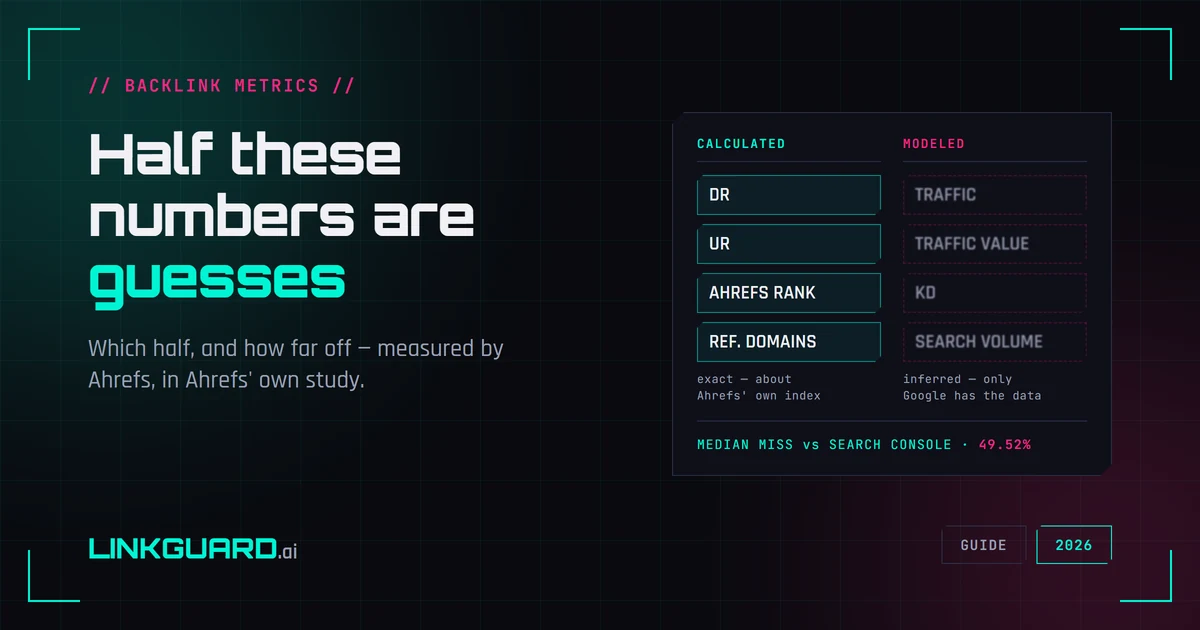
DR, UR, organic traffic, traffic value, KD. They sit in identical gray boxes and look equally authoritative, but half of them are calculations over Ahrefs' own index and half are models of data only Google has. Ahrefs published the error bar on the second half itself: a median deviation of 49.52% against Search Console.