You type a question into Google — something real, like whether you can deduct a home office or how long meat keeps in the freezer — and before the blue links there's a tidy paragraph that just answers it. A few site names sit off to the side as sources. You got what you needed and never clicked anything. If you run one of those sites, you might notice the flip side: an informational page that used to pull steady traffic quietly flattened, and you can't find a penalty or a lost ranking to blame.
That paragraph is a Google AI Overview, and it's reshaping who gets the click. We build backlink-monitoring software, and we just shipped a free AI Overview checker, so I've spent more time than is healthy staring at these boxes. Here's the honest version: what an AI Overview is, why it shows up for some searches and not others, how Google decides which sources to cite, and whether there's anything you can do to land your site in there. Spoiler on that last one, because I'd rather lose your click than your trust: there's no guaranteed way in, and anyone who sells you one is guessing.
What is a Google AI Overview?
A Google AI Overview is an AI-generated summary that appears at the very top of some search results, above the regular links. Google describes it as "an AI-generated snapshot with key information and links to dig deeper" (Google Search Help). Instead of sending you straight to a page, Google's model reads across several sources, writes a short answer in its own words, and shows a handful of links it leaned on.
The key word is generated. An AI Overview isn't a quote lifted from one winning page. It's new text the model assembles from many pages at once. That single fact explains almost everything strange about how these boxes behave, including why you can be a source feeding the answer and still not get named.
Why don't I see one on every search?
Because Google holds them back on purpose. By its own account, AI Overviews "are only shown when our systems determine that it is additive to classic Search, and as such, often don't trigger" (Google Search Central, 2025). Ask something broad or unfamiliar where a synthesized summary helps, and you'll likely get one. Search a single brand, a specific URL, or a transactional "buy" query, and often you won't. They now run in 200+ countries and 40+ languages, and that footprint keeps growing (Google, 2025).
They're not fixed in place either. The same query can show an Overview today and not next month, partly because Google keeps swapping the engine underneath. Gemini 3 became the default model behind AI Overviews globally in January 2026 (Google, Jan 2026), and the models keep changing. Google itself warns the answers "may include mistakes" and that the technology is "rapidly evolving." Treat any single look as a snapshot, not a fact you can build on.
How does Google choose which sources it cites?
Here's the part everyone wants a cheat code for, and the honest answer is that Google has mostly closed that door. To build an Overview, the system uses what Google calls a "query fan-out": it fires off multiple related searches across subtopics and pulls from a wider, more diverse set of pages than a single search would (Google Search Central, updated December 2025). To be eligible as a cited link, a page only needs to be "indexed and eligible to be shown in Google Search with a snippet." That's the whole bar.
And the door that's closed: Google states flatly that "there are no additional requirements to appear in AI Overviews" and "no special schema.org structured data that you need to add." Then the line that should end every "rank in AI Overviews" pitch: even a page that meets every requirement isn't guaranteed to be served, because "indexing and serving isn't guaranteed." No markup, no setting, no trick. Good ordinary SEO, being crawlable, indexed, and genuinely relevant, is the price of admission, not a fast pass.
One thing worth nailing down, because it trips people up: a citation in an AI Overview is not a backlink. It passes no link equity, it isn't a ranking signal, and Google doesn't count it as a vote for your site the way a real link is. It's visibility, not authority. Nice to have, but it won't move your rankings, and don't let anyone tell you it does.
Is an AI Overview the same as AI Mode?
No, and mixing them up sends people optimizing for the wrong thing. An AI Overview is the inline box stitched into normal search results. AI Mode is a separate, fuller experience: a dedicated conversational search you opt into, which Google says "expands what AI Overviews can do with more advanced reasoning" (Google, March 2025). Both run on Google's Gemini models. The Overview is the thing most of your visitors hit without trying; AI Mode is where they go on purpose. For most site owners, the Overview is what matters day to day.
So can you get your site cited?
You can improve your odds. You can't buy a ticket. Since the only stated requirement is ordinary search eligibility, the work is the work you already know: be crawlable and indexed, be the useful answer to the query, and structure your pages so a clean, quotable answer is easy to lift. That last bit is where most pages lose. They warm up for four paragraphs before saying anything an engine could quote. Lead with the answer, then explain. We go deeper on what actually earns AI citations in how to get cited by ChatGPT, Perplexity and Google AI Overviews.
What won't work: schema you bolt on hoping it's a switch, an llms.txt file (Google has said it doesn't use it, more in what is llms.txt), or any "AI Overview optimization" package that promises placement. None of those is a lever Google has confirmed. The uncomfortable truth is that you're influencing a probability, not flipping a setting.
Does being cited even bring you traffic?
Sometimes barely, and this is the part that stings. An Overview can answer the question so completely that nobody clicks, including on you. Pew Research watched the browsing of 900 US adults in March 2025. When an AI summary appeared, people clicked a result just 8% of the time, versus 15% when there was no summary. They clicked the summary's own cited links in only 1% of visits (Pew Research Center, July 2025). There's a reporting consequence too: an AI Overview occupies one position in Search Console, and every link inside it is assigned that same number. So being named is real visibility, your brand in front of someone mid-question, but it is not the same as a visit. Plan for the mention to be worth something on its own, because the click may never come.
How to check whether a keyword triggers an AI Overview
The manual way: open an incognito window to strip your own history, search the query, and look at whether a generated summary sits above the links and which sites it cites. Do it a few times across a day, because results shift. The faster way, if you want it depersonalized and don't feel like eyeballing it: our AI Overview checker runs one clean query, tells you whether an Overview appears, lists the cited sources, and flags whether your domain is among them. It's a snapshot, not a verdict, same caveat as everything else here, but it beats squinting at your own logged-in results.
Questions people ask
Is a Google AI Overview the same as a featured snippet?
No. A featured snippet quotes one page word-for-word and links to it; an AI Overview generates new text from several sources and links to a few. Both can sit at the top of the page, but they're built by different systems. We break the distinction down in AI Overviews vs featured snippets.
Can I pay or use schema to appear in an AI Overview?
No. Google states there are no additional requirements and no special structured data to appear, and that even a perfect page isn't guaranteed to be served. There's no paid placement and no markup switch. Markup is worth having for other reasons, but be clear-eyed about what a green tick means — what schema validators can and can't tell you is a separate question. The only real input is being a genuinely useful, indexable answer, and even that comes with no guarantee.
Why does the AI Overview cite my competitor and not me?
Most often because the model judged their page a cleaner, more relevant answer to that specific query, or because it's better known as a source on the topic. Citation isn't ranked the way blue links are, and it shifts between searches. Check whether your page answers the exact question in its first sentence, and whether you're even indexed and eligible. That's the floor.
Does an AI Overview citation help my SEO?
Not directly. A citation is visibility, not a backlink. It passes no link equity and isn't a ranking signal. It can build brand awareness and, occasionally, earn a click, but it won't lift your rankings, and treating it as if it does will send your effort to the wrong place.
Are AI Overviews going away?
There's no sign of it. Google has expanded them to 200+ countries and 40+ languages and keeps upgrading the models behind them. They change constantly, but the direction is more AI in search, not less. Building for them with clear, quotable content is the safe bet.
The honest takeaway
An AI Overview is Google answering the question itself, in generated text, from many sources, for some queries and not others, with no guaranteed way in and no promise of a click even when you're cited. That's not a problem you optimize away. It's the board we're all playing on now. Do the boring, durable things, be indexable, answer the question first, be the page worth quoting, and you've done about as much as anyone can.
The part you actually control is the foundation underneath all of it: the links and pages that make Google trust you enough to retrieve you in the first place. AI Overviews come and go; the backlinks holding up your visibility break, go nofollow, or get edited out without a word. That's the thing worth watching. Start free with 1,000 tokens (no card) and point LinkGuard at the links you've earned. We'll tell you the morning one of them quietly dies, which is the kind of problem you can still fix.
About the Author

Related Articles

Link juice and link equity: what actually passes through a link
Google's documentation says PageRank is still part of its core ranking systems. The arithmetic everyone teaches for it was last restated by a Google employee in 2009, inside his own disclaimer. Both of those are on the record.
A ranking dropped: what to rule out, in order
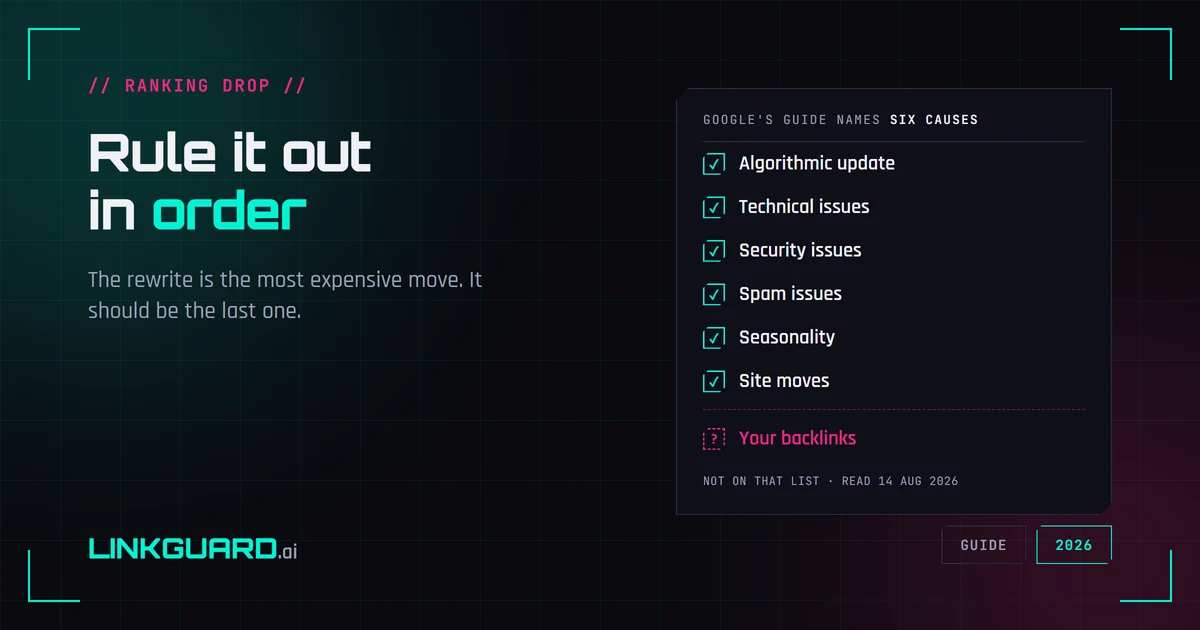
Google publishes a debugging guide for Search traffic drops. It names six causes, and backlinks aren't among them — the word doesn't appear on the page. That's not an oversight, it's a boundary: the guide covers Google's side of the glass. Here's the full elimination order, from measurement artifacts to the box almost nobody opens, with the rewrite saved for last.
Why your SERP position is three different numbers
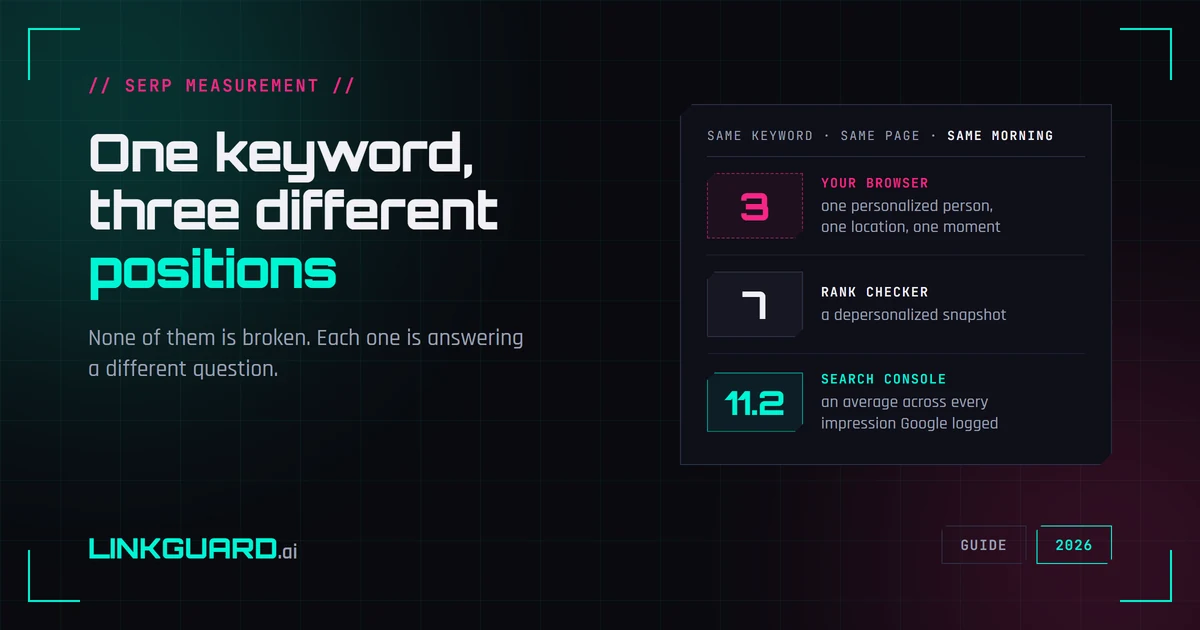
Your browser puts you third. Your rank tracker says seven. Search Console says 11.2. Same keyword, same page, same morning — and none of the three is broken. They answer different questions, and Google documents most of the difference itself. What each number measures, two things I checked live this week that contradict the standard advice, and the one figure worth putting in a client report.