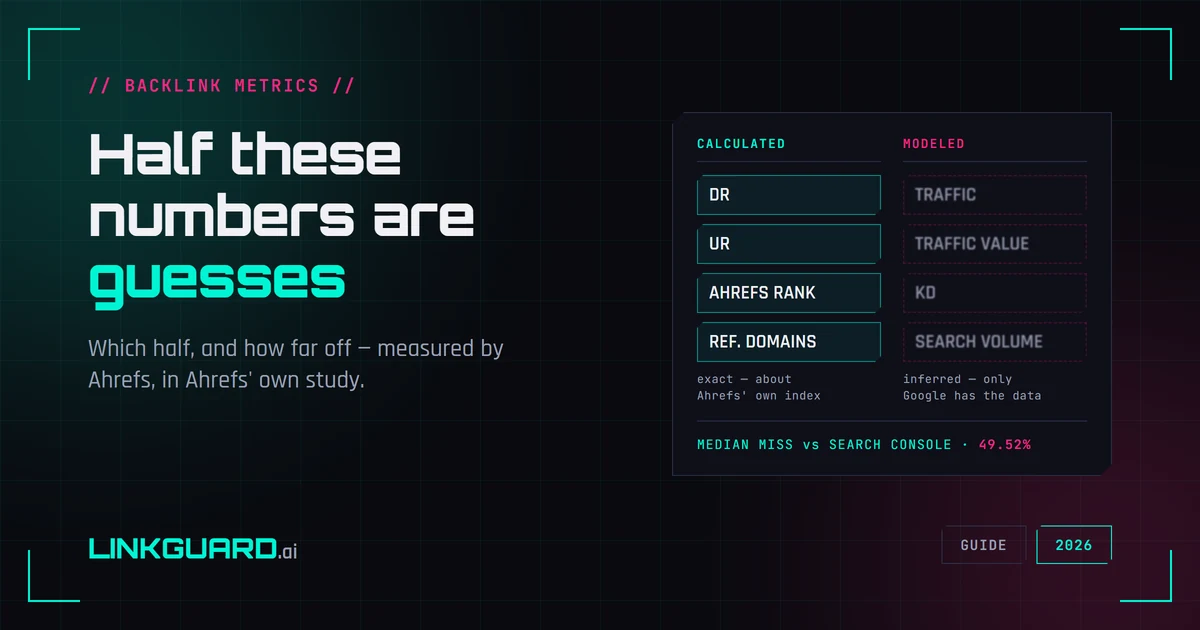
Open Site Explorer on any domain and count what comes back. A Domain Rating. A URL Rating. Referring domains. Organic traffic, and a dollar value attached to it. Keyword difficulty on the next screen over. You're about to paste three of those into a client report, or price a donor off one of them, and nothing on the screen tells you which ones are measurements.
Nothing in the interface marks the difference, which is how an estimate ends up in a deck as though it came off a meter. Nobody catches it there. It surfaces later, when the client opens their own Search Console and the figure is nowhere near what you showed them — and at that point it isn't the estimate that looks wrong. It's you.
The villain here isn't Ahrefs. They published their own error bar, which is more than most vendors ever do. It's the gray box that makes a model and a measurement look like siblings.
Some Ahrefs numbers are calculated from Ahrefs' own link index, and are exact about that index. The rest are estimates of things only Google can see, and they carry an error bar Ahrefs has published itself. That single split makes the whole dashboard readable. Below: what DR and UR compute, how far the traffic estimate drifts, why KD isn't the content metric people use it as, and what happened when we put one of these numbers into our own product.
That last part is the disclosure. There's an Ahrefs number sitting on our own dashboard, the DR badge beside your donor domains, and it's rented rather than built. Their formula, their crawl, our cache. This week the rent stopped being paid. That story is further down.
Two kinds of number, and only one is a measurement
Sort the dashboard into two groups before you read anything on it.
| Metric, and what Ahrefs says it is | Where the number comes from |
|---|---|
| Domain Rating (DR) "The overall strength of a website's backlink profile" | Calculated from links Ahrefs has crawled |
| URL Rating (UR) "The strength of a page's link profile on a 100-point scale" | Calculated, PageRank-style. Internal links included |
| Ahrefs Rank (AR) Every site in the database ranked by backlink profile, "basically, by their DR" | Calculated. A league-table position |
| Referring domains, backlinks Counts of linking sites and links | Counted, inside Ahrefs' index rather than the web |
| Organic traffic "An estimation of how much organic search traffic" a target gets monthly | Modeled: keyword volume × position × a CTR curve |
| Organic traffic value What that traffic would cost "if it were to be acquired via PPC in Google Ads" | The estimate above, multiplied by estimated CPC |
| Keyword Difficulty (KD) A 0–100 difficulty score | Calculated from the referring-domain counts of the current top 10 |
| Search volume Monthly searches for a keyword | Modeled from clickstream data and Google's own figures |
The first four are exact and narrow. The last four are useful and loose. Mixing them up is the mistake I see most often, including from people who've had a subscription for years.
What does DR mean in Ahrefs?
Domain Rating estimates the strength of a whole site's backlink profile on a 0–100 logarithmic scale, and the mechanism is closer to plumbing than to scoring. In Ahrefs' own description, a linking domain "splits its rating equally amongst the domains it links to", and the higher a domain's own DR, the more it passes along (Ahrefs Help Center). Run that across every domain, repeat, scale the result into 0–100.
Two consequences fall straight out of that sentence and neither is obvious from looking at the badge. A site that links out to thousands of other domains gives each of them a thin slice. And DR moves when other people's link profiles move, not only when yours does — your number can slip in a week when you did nothing at all.
What DR is not is a Google signal. Ahrefs is unusually straight about this in its own help center, saying only that DR "correlates with Google rankings pretty well" and, in the same breath, less well than UR does. Correlates. Not feeds. We covered the full argument, including Moz's DA and what Google's own staff have said on the record, in domain authority vs domain rating, so I won't relitigate it here.
UR vs DR: the number that counts your own internal links
URL Rating does the same job for a single page, built on PageRank principles: it counts links between pages, respects the nofollow attribute, applies a damping factor, and throws out link loops and links it judges inflated. Same 0–100, same logarithmic squeeze at the top.
Almost nobody uses the next line, and it's right there in the help doc: "Both internal and external links are taken into account." Weighted differently, but counted. Which means a page's UR is partly yours to move — link to it from your strongest existing pages and the number responds, no outreach involved. Ahrefs also says UR tracks rankings better than DR does, since Google ranks pages rather than domains. If you'd rather see that argument on the Moz side of the fence, it's in page authority vs domain authority.
The catch is the flip side of the same coin. Because internal links count, UR is the easiest of these metrics to inflate by accident. A site-wide footer link to one page will lift it. That's not a ranking win. That's your own template talking to itself.
How accurate is Ahrefs' organic traffic estimate?
Now the other group. Nobody outside Google knows how many clicks a page gets, so Ahrefs reconstructs it: find the keywords a page ranks for, estimate each keyword's monthly search volume, note the position, apply a click-through-rate curve built per keyword from clickstream data, add it up. Four estimates stacked into one number that displays like a fact.
Ahrefs went and measured the drift itself. Ahrefs' own test of 1,635 websites put its organic-traffic estimate a median of 49.52% away from the same sites' Google Search Console figures. On that same set, Semrush's median miss was 68.36%. Correlation with the real GSC numbers came out at 0.76 for Ahrefs and 0.74 for Semrush (Ahrefs, published 3 May 2022).
One caveat that cuts in the article's favor rather than against it: that benchmark is four years old, and Ahrefs rebuilt its keyword database twice in 2023, warning that March's update pushed traffic estimates down and June's would push them back up. The test has never been re-run. So the best-known error bar on this number was measured before two changes to the thing being measured, which is roughly the whole point.
Read those two findings together and the reading falls out. The ranking is trustworthy, the magnitude isn't. If Ahrefs says site A gets more traffic than site B, believe it; the correlation holds. If Ahrefs says site A gets 18,300 visits, treat that as somewhere in a wide neighborhood of the truth. Ahrefs' own help center lists the three reasons why, and they're all about what its crawl can't see.
Traffic value inherits all of that and multiplies it by an estimated cost-per-click. It's the estimate of an estimate, priced in dollars, which is exactly the format that makes people quote it in pitch decks.
Does Keyword Difficulty measure content difficulty?
No, and the gap between what it measures and what people use it for is the widest on the dashboard. KD is calculated from one input: the number of referring domains pointing at the pages currently in the organic top 10, weighted, outliers trimmed, plotted 0–100. In Ahrefs' words, KD "does not take into consideration any 'on-page SEO' factors" (Ahrefs Help Center).
So a keyword scores as hard when the top ten are thin, ancient, badly matched pages that happen to sit on heavily linked domains. A keyword where the top ten are excellent pages on modest domains scores as easy. Ahrefs itself tells you not to base decisions on KD alone and to use it as a first filter. Fair advice that gets ignored roughly every time somebody sorts a keyword export by that column and calls it a content plan.
Why two tools never show the same backlink count
Ahrefs' index is enormous. Its infrastructure page, read on 13 August 2026, claims 493.9 billion pages, 210.7 million domains, 35 trillion historical backlink records, five million pages crawled every minute, refreshed every 15 to 30 minutes.
Enormous, and still a sample. The web is bigger, and every crawler draws a different slice of it. So "referring domains" never means referring domains. It means referring domains this crawler has found and still considers live. That's why the same site gets one count in Ahrefs, another in Semrush, a third in Search Console, and why arguing about which is right is arguing about whose telescope is pointed where. Compare a number to other numbers from the same tool. Never across tools. The counts underneath these scores get their own treatment in referring domains vs backlinks.
One thing no crawler's sample can settle is whether a specific link of yours is on a page Google still has. That one you can check directly, in a few seconds, with our free backlink index checker.
What happened when we put DR into our own product
LinkGuard shows Ahrefs' Domain Rating next to donor domains, so you can eyeball who's linking to you without a second tab. Ahrefs publishes a free endpoint for exactly this. We call it on a nightly job, cache the value per domain, and print "Domain Rating by Ahrefs" under the trend popup because the license asks for attribution. It ran quietly for two months.
On 11 August it stopped. Every call came back 403 Forbidden, and after five of them Ahrefs answered 429, which tripped our own back-off and killed the run. Same the next night, and the next. The LinkGuard queue held 1,633 domains on the first night and 1,777 by the third; it fetched zero all three times. The task exited as a success each time, with the failure sitting right there in the same log line — nothing was hiding, nobody was watching. Meanwhile the badges kept showing what they'd shown on 9 August, because a failed fetch leaves the old value untouched. I found it while checking a fact for this article, which is a humbling way to find a bug in your own product.
The cause is mundane. Ahrefs' documentation now reads: "Requests to this endpoint are free, yet require an APIv3 key." Free keys, one header, ten minutes of work. Nothing was taken away and nothing was announced. The terms simply moved, the way vendor terms do.
That's the lesson, and it applies to every number above. These are one company's figures, computed by a private formula over a private crawl, delivered on terms that company controls and can revise on a Tuesday. Perfectly good to use. Just don't build anything load-bearing on the assumption that the number will be there, mean the same thing, and stay free.
So how do you read any of them?
Three questions, in order, and they take about a second each once the habit sets in.
- Is it a model of PageRank, or of something else? See the damping factor, and where it comes from.
- Which group is it in? Counted (DR, UR, AR, referring domains) or modeled (traffic, traffic value, KD, search volume)?
- If it's modeled, quote the comparison and never the absolute. "This donor outranks that one on traffic" is defensible. "This donor gets 18,300 visits" is a number with a coin-flip attached to it.
- If it's counted, keep it inside its own tool. Ahrefs DR against Ahrefs DR, never against a Moz or Semrush number. Different telescopes, different skies.
Everyone who has ever built a pitch on one of these numbers has skipped all three. The interface invites it.
The number Ahrefs can't give you
None of these metrics answers the question you have about a link you paid for: is it still there today, still followed, still on an indexed page?
Ahrefs does have a Lost backlinks report, and it does the decent thing: it tags each loss with a reason: the page 404s, redirects now, went noindex, changed its canonical, or the page is alive and the link is simply gone. Their own docs also admit the softer edge, that a crawl error can mark a link lost and the link reappears on the next successful crawl. Which is the real limit: a crawler visits when its schedule says so, not when your link disappears. For most link profiles, checking that report every so often is enough, and if you're sitting on twenty links you should stop reading here and go do that instead of buying anything.
It stops being enough when the links are bought, when a client asks what they got for the invoice, or when the gap between "the link came out" and "somebody noticed" costs more than watching would. That gap is the whole reason LinkGuard exists, and it's also the case for using Ahrefs and something else together. One tool finds and grades links. Another keeps watch over the ones you already own.
Questions people ask
Why did my DR drop when I didn't lose any links?
Because DR is relative. A linking domain splits its rating among everything it links to, and the whole scale is recomputed as Ahrefs recrawls the web, so your score moves when other sites gain links, when a donor starts linking out more widely, or when Ahrefs drops pages from its index. None of that requires anything to change on your side. Check whether your referring domains actually fell, in Ahrefs' own Referring domains report, before treating a one-point slide as a problem.
Ahrefs and Semrush show different traffic. Which one is right?
Neither, strictly. Both are models, and Search Console is the only ground truth for a site you own. In a 2022 benchmark Ahrefs ran and published about itself, across 1,635 sites, its median deviation from GSC was 49.52% and Semrush's was 68.36%, with correlations of 0.76 and 0.74. Ahrefs has rebuilt its keyword database twice since then and hasn't re-run the test, so read that margin as the last known reading rather than today's. For a competitor's site, where no ground truth exists, pick one tool and stay in it: the comparison between two sites is far more dependable than either absolute figure.
What's the difference between UR and DR?
DR scores a whole domain's backlink profile; UR scores one page's. UR is built on PageRank principles and counts internal links as well as external ones, so your own site structure moves it. Ahrefs says UR correlates with Google rankings better than DR does, which makes sense given Google ranks pages rather than domains. Compare DR to other DR scores and UR to other UR scores, never one against the other.
Is Ahrefs' Keyword Difficulty accurate?
Accurate at what it measures, misleading at what people use it for. KD is derived from the number of referring domains to the pages in the organic top 10 and explicitly ignores on-page factors, so it can't see that the current top ten is weak, outdated, or off-intent. Ahrefs recommends treating it as a first filter, not a decision. Read the actual SERP before you trust the score.
Why don't Ahrefs' numbers match Google Search Console?
Because they're measuring different things from different vantage points. Search Console reports what Google recorded for your property; Ahrefs models what it thinks happened, from its own crawl and its own keyword database. Ahrefs lists three reasons for the gap: it doesn't track every keyword you rank for, its search volumes are estimates, and it infers click-through rates rather than observing them. Search Console's own position figure needs reading with the same care — why your SERP position is three different numbers takes that apart. Search Console is the ground truth for your own site. Use Ahrefs where GSC can't go, which is everyone else's site.
Which kind of number is that?
That's the only question this whole article is after. DR, UR, AR, referring domains: arithmetic over one company's crawl, exact about that crawl and mute about Google. Organic traffic, traffic value, KD, search volume: models, directionally sound, numerically soft, with a published median miss of about half on the traffic one. The gray box will go on presenting both in the same font. You're the only one who can tell them apart.
What that buys you is small and worth having. You quote a traffic figure with its range attached and the client trusts you more for it, not less. You stop paying donor prices set by a score that measures link plumbing. And you stop being surprised when a vendor revises the terms of a number on a Tuesday — which, as of this week, is not a hypothetical around here.
Then there's the third category, the one with no box anywhere on the dashboard: whether the links you already own are still doing their job this morning. Those checks carry no score, which is exactly why no score shows them. Our backlink index checker says whether Google still has the page; the nofollow checker says whether the link still counts. Neither asks you to sign in.
If what you find bothers you, the problem isn't the checking. It's doing it again next month, and the month after. That part is what LinkGuard automates. Checks are priced one at a time instead of by the month, so a month you don't check bills you nothing, and a new account opens with 1,000 tokens and no card on file.
About the Author

Related Articles

Link juice and link equity: what actually passes through a link
Google's documentation says PageRank is still part of its core ranking systems. The arithmetic everyone teaches for it was last restated by a Google employee in 2009, inside his own disclaimer. Both of those are on the record.
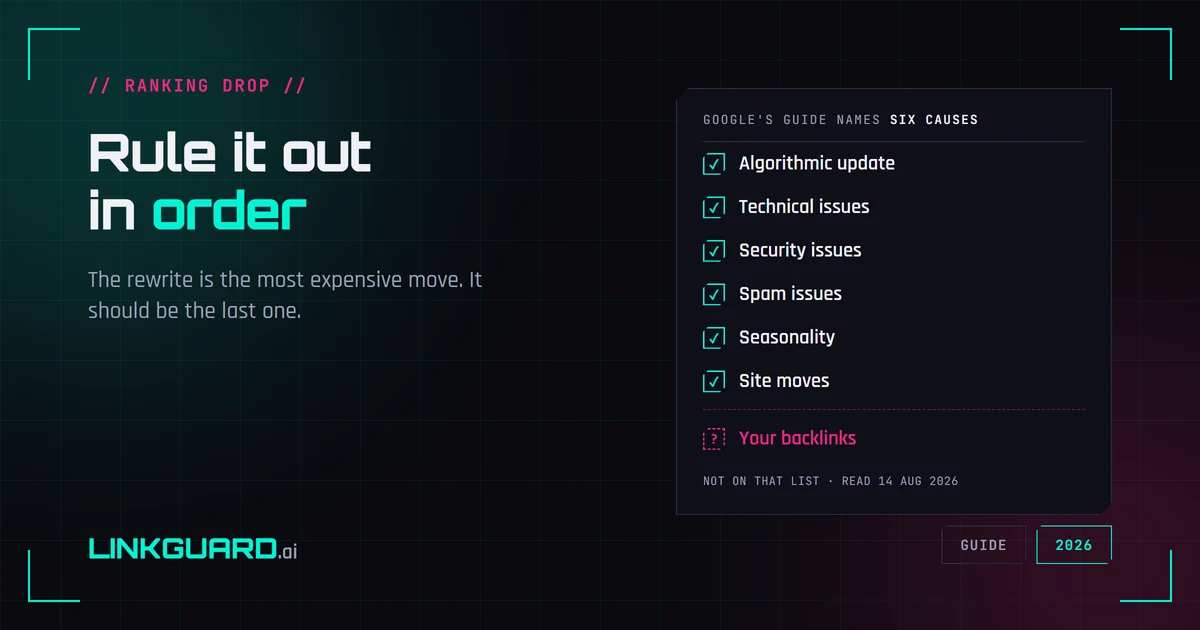
A ranking dropped: what to rule out, in order
Google publishes a debugging guide for Search traffic drops. It names six causes, and backlinks aren't among them — the word doesn't appear on the page. That's not an oversight, it's a boundary: the guide covers Google's side of the glass. Here's the full elimination order, from measurement artifacts to the box almost nobody opens, with the rewrite saved for last.
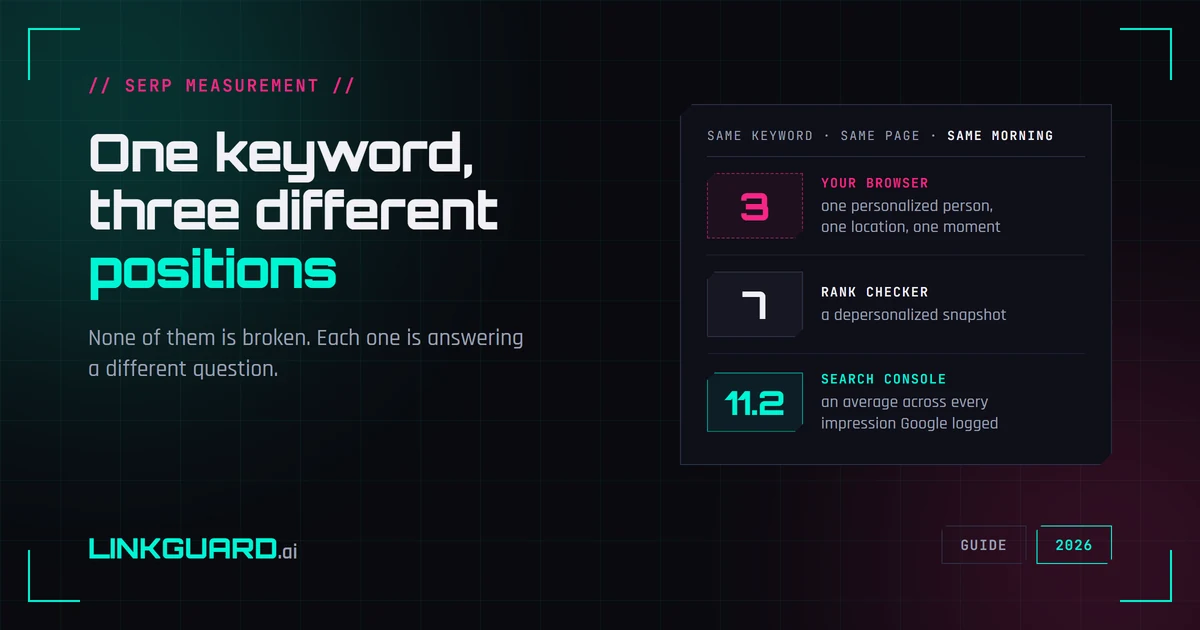
Why your SERP position is three different numbers
Your browser puts you third. Your rank tracker says seven. Search Console says 11.2. Same keyword, same page, same morning — and none of the three is broken. They answer different questions, and Google documents most of the difference itself. What each number measures, two things I checked live this week that contradict the standard advice, and the one figure worth putting in a client report.