"What's your DA?" is the first question on every link-buying call, and it's the wrong one. Domain Authority scores a whole site; Google ranks individual pages. So the number everyone quotes is measuring the wrong unit. Quote it on a buying call and you're vouching for a figure Google never reads. Page Authority, the page-level version, sits closer to how search actually works, and almost nobody asks for it.
Here's the honest version most guides dodge: Page Authority and Domain Authority are both Moz predictions on a 1-to-100 scale, neither is a Google ranking factor, and the page-level one is the more useful of the two — as a diagnostic, never as a target. Quick disclosure, since I run a backlink tool: LinkGuard shows you Ahrefs' DR on your links, read from cache, and doesn't compute PA or DA at all. I have no metric to sell you here.
The four numbers, in one breath
Two companies, two levels, four scores. Moz gives you Domain Authority (DA) for a whole site and Page Authority (PA) for a single URL. Ahrefs gives you Domain Rating (DR) for the site and URL Rating (UR) for the page. All four run 0 to 100, all are logarithmic (90 to 91 is far harder to move than 20 to 21), and all four are built from backlink data by the vendor, not by Google. PA and UR weigh the links pointing at one page; DA and DR weigh the links across the entire domain. That's the whole taxonomy.
The fact nobody leads with: Google ranks pages, not domains
This is the load-bearing fact, and it isn't an opinion. It's in Google's own documentation: "Our ranking systems are designed to work on the page level," Google writes, "using a variety of signals and systems to understand how to rank individual pages" (Google Search Central). Site-wide signals feed into that, but the unit being ranked is the page. Gary Illyes said the domain half plainly back in 2016: "we don't really have 'overall domain authority'" (Search Engine Roundtable), and John Mueller repeated it in 2019, that Google "doesn't evaluate a site's authority" (Search Engine Journal).
So Domain Authority is the vanity number
If Google ranks pages and keeps no domain-authority score, then "what's your DA?" asks about a number Google never consults. A strong domain doesn't haul every page up with it — Google says it in the same guide: "having some good site-wide signals does not mean that all content from a site will always rank highly" (Search Central). High-DA sites are full of deep pages that rank for nothing, because nothing links to those pages directly. The domain score flatters the homepage and oversells the rest.
The page number is closer to the truth
Look at the page instead of the site and the asymmetry shows. Ahrefs documents the routine case where a single URL's UR is higher than its domain's DR: one page earned its own links and outranks its neighbors (Ahrefs). It runs the other way too — a DR 80 site can have a target page sitting at UR 3 because not one external link points at it. The page-level number tells you whether this URL has earned the links to compete. The domain number can't, because it's averaging over thousands of pages you aren't trying to rank.
The catch: they're all guesses
Nor is either of them PageRank — PageRank itself, and what still runs on it, has had no public score since 2016.
Don't trade one fixation for another. PA, DA, UR and DR are third-party predictions, not Google signals: Page Authority is "not a part of PageRank or Google's ranking factors" (Page One Power), and the other three are the same kind of estimate. So the lesson isn't "chase PA instead of DA." It's that the page-level score is the better diagnostic and the domain-level score is the worse target, and no score belongs on a goals dashboard. The number is the thermometer; the links and the content are the fever. And the guessing isn't uniform across a tool's dashboard either — UR and DR are computed from a crawl, while traffic and difficulty scores are modeled on data only Google holds, a split worth knowing before you quote any Ahrefs number.
What to actually do
Use the page-level number once, as a gut-check: does the URL you want to rank have the direct links to compete for its query, or is it a UR 4 page hoping a strong domain will carry it? If it's bare, the fix is links and relevance aimed at that page, not a better site-wide average. Then stop watching the score and watch what sits under it: the actual backlinks pointing at that page, and whether they survive. That's the job LinkGuard does — it monitors the links to your individual pages and tells you when one dies, flips to nofollow, or gets removed. It won't lift your PA. It'll stop you quietly losing the links that page-level number is built on.
Questions people ask
Is Page Authority a Google ranking factor?
No. Page Authority is a Moz metric, not a Google signal — a third-party prediction of how a page might rank, built from backlink data Moz crawls itself. Google neither computes it nor consults it, and the same holds for Domain Authority and for Ahrefs' DR and UR. Useful as estimates; never something Google looks up.
Which matters more, PA or DA?
The page-level number (PA, or Ahrefs' UR) is more decision-relevant, because Google ranks individual pages, not whole domains. Domain Authority describes the site as a whole, which is rarely the unit you're trying to rank. Treat PA as the better diagnostic, but don't treat either as a goal, since neither is used by Google.
Does a high Domain Authority mean all my pages will rank?
No. Google evaluates pages individually; a strong site doesn't carry every page with it. Its own documentation says good site-wide signals don't make all of a site's content rank well. A high-DA site routinely holds pages that rank for nothing, usually because no external links point at those specific URLs. A high domain score guarantees nothing for any single page.
What's a good Page Authority score?
There's no official threshold. PA is relative, best read against the specific pages you're competing with rather than as a grade out of 100. A "good" PA is simply one in range of the URLs already ranking for your target query. Since the scale is logarithmic, moving from 60 to 70 is far harder than 20 to 30, so compare locally instead of chasing a round number.
Is Page Authority the same as PageRank?
No. PageRank is Google's internal link-analysis system; Page Authority is Moz's external estimate, built from Moz's own crawl. Both lean on links, but one is Google's and private, the other is a third-party guess at the outcome. Don't treat a PA number as a peek at PageRank; it isn't.
The short version
Google ranks pages, not domains, and uses none of these scores. So the page-level number (Moz PA, Ahrefs UR) sits closer to how ranking works than the domain-level number (DA, DR) everyone quotes. All four are third-party predictions, not targets. Check the page's own links once, fix them if they're thin, then watch them instead of the score.
This is the third piece of a short set on backlink metrics: pair it with referring domains versus backlinks for the counts underneath these scores, and DA vs DR for the domain-level numbers in full. If you'd rather watch the links to your pages than grade them, start free with 1,000 tokens, no card.
About the Author

Related Articles

Link juice and link equity: what actually passes through a link
Google's documentation says PageRank is still part of its core ranking systems. The arithmetic everyone teaches for it was last restated by a Google employee in 2009, inside his own disclaimer. Both of those are on the record.

A ranking dropped: what to rule out, in order
Google publishes a debugging guide for Search traffic drops. It names six causes, and backlinks aren't among them — the word doesn't appear on the page. That's not an oversight, it's a boundary: the guide covers Google's side of the glass. Here's the full elimination order, from measurement artifacts to the box almost nobody opens, with the rewrite saved for last.
Why your SERP position is three different numbers
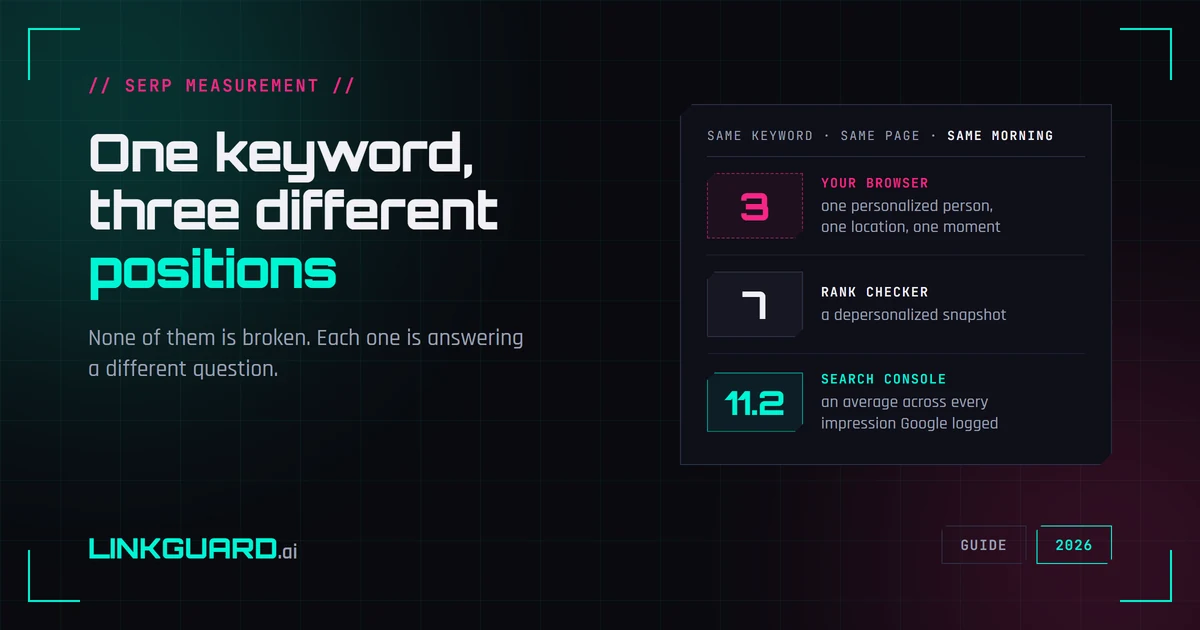
Your browser puts you third. Your rank tracker says seven. Search Console says 11.2. Same keyword, same page, same morning — and none of the three is broken. They answer different questions, and Google documents most of the difference itself. What each number measures, two things I checked live this week that contradict the standard advice, and the one figure worth putting in a client report.