You export your backlinks, the report opens, and the first two numbers already disagree. 4,000 backlinks. 180 referring domains. Same site, same profile, and the tool hands you both like you're supposed to know which one to trust. So most people grab the bigger number, quote it to a client, or buy a link because a seller waved a backlink count in their face, and quietly optimize for the figure that matters less.
These two numbers measure different things, and the gap between them tells you more than either one alone. What follows is the short, practical version: what a backlink actually is, what a referring domain actually is, why a single site can hand you fifty backlinks that still count as one domain, which number tracks with rankings, and what Google actually said when someone asked it to choose. I build a backlink-monitoring tool, so I'll also point at the part most guides skip. These numbers can drop, and you usually find out late.
What is a backlink?
A backlink is one link from another website to yours. That's the whole thing. If a page somewhere has a clickable link pointing at your page, you've got a backlink. Ahrefs states it about as flatly as it can be stated: "Backlinks are hyperlinks that point from one website to another. You can have multiple backlinks from a website or web page" (Ahrefs, updated October 2025).
That second sentence is where people trip. One website can link to you many times over — a mention in the body, a link in the author bio, a sidebar widget, a credit baked into every page's footer. Each of those is a separate backlink. Five links from one blog is five backlinks. Hold that thought.
What is a referring domain?
A referring domain is one unique website that links to you, however many times it does it. Those five links from the same blog? Five backlinks, one referring domain. Ahrefs' own example locks it in faster than any definition: two links from the New York Times are two backlinks but a single referring domain; a link from the Times plus one from Forbes are two backlinks and two referring domains.
So referring domains measure the breadth of your profile: how many separate corners of the web vouch for you. Backlink count measures total volume, repetition included. Semrush frames it with a smaller example that says the same thing: "If Website A links to your website twice, then you have two backlinks from one referring domain" (Semrush, January 2025).
One site, fifty backlinks, one referring domain
Picture a single news site that loves linking to you. It runs a feature with three in-text links, drops your logo in a partners strip that sits in the footer of every page, and keeps an author bio that links back on all forty articles your founder wrote for them. That's dozens of backlinks. It is still one referring domain.
Now flip it. Forty different small blogs each link to you once. Forty backlinks, forty referring domains. The second profile is the stronger one in almost every case, and that's the intuition the two numbers are trying to hand you: a backlink count can be inflated by one enthusiastic site, while a referring-domain count is harder to fake because it needs forty different people to independently decide you're worth linking to.
Which number matters more — and the answer Google actually gives
The standard advice, and it isn't wrong, is that referring domains is the more meaningful number. Neil Patel's line is the one everyone repeats: getting one site to link to you a hundred times isn't half as useful as getting a hundred different sites to link once (Neil Patel). The correlation studies point the same direction. Backlinko's analysis of 11.8 million search results found referring-domain count among the factors most closely tied to rankings (Backlinko, updated May 2025), and Ahrefs' crawl of the web found that pages with zero referring domains almost never get organic traffic: of roughly 20 million such pages, only about 3,000 pulled more than a thousand visits a month (Ahrefs traffic study).
Now the part the breezy guides leave out. Google's John Mueller was asked this exact question (does the number of unique referring domains matter more than the total number of backlinks?) and his answer torpedoed both. "I would tend not to focus on the total number of links to your site, or the total number of domain links to your website," he said, "because we look at links in a very different way... the total number essentially is completely irrelevant" (Search Engine Journal, February 2021).
So which is it? Both, once you hold them the right way up. The tools count referring domains because counting is what tools can do, and that count correlates with sites that rank well. Google says it doesn't tally either figure. It weighs individual links, where one relevant link from a trusted source can outrank a thousand junk ones. Those two ideas aren't really fighting. A high referring-domain count is usually a symptom of having earned lots of good individual links, not the thing Google rewards directly. Chase the count for its own sake and you've mistaken the smoke for the fire. Both Backlinko and Ahrefs say it plainly inside their own studies: correlation, not causation.
The terminology trap: referring domains, linking root domains, linking domains
Some of the confusion isn't conceptual at all: it's vocabulary. Different tools named the same metric differently and never apologized for it. Ahrefs, Semrush and Majestic say "referring domains." Moz says "linking root domains," defined as the count of unique root domains with at least one link to your site (Moz metric, via Databox). Same idea, different label. If you switch tools and your "referring domains" number seems to vanish, go looking for "linking root domains" — it's the same thing wearing a different name tag.
One more wrinkle. A root domain (nytimes.com) and a subdomain (cooking.nytimes.com) usually roll up into a single referring domain, though some tools let you count subdomains on their own. When two tools disagree on your domain count by a hair, this is often why.
Dofollow, nofollow, new, lost: the numbers behind the number
A raw referring-domain count flattens distinctions that matter. Twenty referring domains where fifteen link with nofollow is a very different asset than twenty that all pass equity, and the two profiles can show the identical headline number. Before you celebrate a figure, segment it by follow status. If dofollow versus nofollow is fuzzy, we pulled the two apart in what each one actually does.
The other hidden dimension is time. Referring domains arrive, and they also leave. The rate you gain them is link velocity, and the figure that means something is net velocity: new minus lost. A site adding 100 referring domains a month while losing 90 has a net velocity of 10, not 100 (Search Engine Land). Most people only ever watch the gaining side of that ledger. Worth remembering too that both counts are what one crawler has found rather than what exists, which is the first thing to sort out when reading Ahrefs' metrics: some of its numbers are counted, the rest are modeled.
So how many referring domains do you actually need?
The number you'll see quoted is that the result sitting at #1 in Google averages 200-plus referring domains, while the one down at #10 sits under 80 (Semrush). Useful for a sense of scale, useless as a target. It's an average smeared across every query on the internet, and the variance underneath it is enormous. Low-competition pages rank with a handful of links, sometimes none. Remember, Ahrefs found pages ranking with zero referring domains, just not many of them. Brutally competitive niches need hundreds. "200" isn't a finish line; it's the midpoint of a distribution you're probably not standing in.
The honest answer to "how many do I need" is "more relevant ones than the specific pages you're trying to outrank, and the quality matters more than the count." Unsatisfying. Also true.
The part most guides skip: you can lose them
Every other article on this topic ends at "here's how to get more." None of them mention that a referring domain you already earned can quietly disappear. The site deletes the post. A redesign drops the link. An editor swaps your dofollow for nofollow during a tidy-up. The domain lapses and a parker grabs it. And here's where the backlinks-versus-domains distinction stops being trivia: if a domain links to you three times and loses one of those links, your referring-domain count doesn't move. But lose the last link and the whole domain drops off your profile, usually without a sound.
That's the gap my tool exists to close, so read this as the one spot where I've got an interest. LinkGuard watches the links you've already earned and tells you when one dies, gets deindexed, flips to nofollow, or quietly changes, across whatever donors you're tracking. It doesn't go off and discover new backlinks for you; it's a watchman, not a crawler, and it can only see the links you tell it about. Want to pull your current referring domains for nothing first? Google Search Console lists the sites linking to you, and we walk through it in checking backlinks in Search Console. From there, our donor trust audit is a free way to size up a domain, and the full monitor watches your links on a schedule.
None of this moves Google on its own, to be clear. Monitoring catches loss; it doesn't manufacture rankings. But a backlink you don't know you lost is a backlink you can't go fix.
Questions people ask
Can you have more backlinks than referring domains?
Almost always, yes, and it's completely normal. Because one website can link to you many times, your backlink count is usually higher than your referring-domain count. A profile with 4,000 backlinks from 180 referring domains just means those 180 sites link to you about 22 times each on average. The reverse can't happen: you can't have more referring domains than backlinks, since every domain needs at least one link to count at all.
Are referring domains a Google ranking factor?
Not as a raw count. Referring-domain totals correlate with rankings in third-party studies, but Google's John Mueller has said the total number of links or linking domains is "completely irrelevant" to how Google ranks: it evaluates individual links, not sums. So treat a healthy referring-domain count as a sign you've earned good links, not as a lever you pull to rank higher.
Is a referring domain the same as a linking root domain?
Yes. "Referring domain" (Ahrefs, Semrush, Majestic) and "linking root domain" (Moz) are two names for the same metric: the count of unique websites linking to you. When your numbers look different across tools, it's usually because each tool crawls a different link index, not because the metric itself changed.
Do nofollow referring domains count?
They count toward your total referring-domain number, but they don't pass the same ranking signal a followed link does. A profile that's mostly nofollow can show an impressive domain count while carrying far less weight. Segment by follow status before you judge a profile by its headline figure.
What's a good number of referring domains?
There's no universal number. It depends entirely on your niche and the pages you're competing against. Some rank with a dozen relevant linking domains, others need hundreds. Chase relevance and quality over a target count, and measure yourself against the specific results you're trying to beat, not against an industry average.
The short version
A backlink is one link; a referring domain is one site that links to you, however many times it does. Referring domains usually tell you more because they're harder to inflate, the count tracks with rankings even though Google says it doesn't tally it, and the same metric hides under different names across tools. Earn relevant linking domains, segment them by follow status, and watch the lost column as closely as the gained one.
If you want to understand the scores these counts feed into next (Moz's Domain Authority, Ahrefs' Domain Rating, and why the same site gets two different numbers), that's the companion piece: DA vs DR, and what they actually mean. And if you'd rather just be told the morning one of your hard-won referring domains goes dark, start free with 1,000 tokens, no card, and point LinkGuard at the links you can't afford to lose.
About the Author

Related Articles

Link juice and link equity: what actually passes through a link
Google's documentation says PageRank is still part of its core ranking systems. The arithmetic everyone teaches for it was last restated by a Google employee in 2009, inside his own disclaimer. Both of those are on the record.

A ranking dropped: what to rule out, in order
Google publishes a debugging guide for Search traffic drops. It names six causes, and backlinks aren't among them — the word doesn't appear on the page. That's not an oversight, it's a boundary: the guide covers Google's side of the glass. Here's the full elimination order, from measurement artifacts to the box almost nobody opens, with the rewrite saved for last.
Why your SERP position is three different numbers
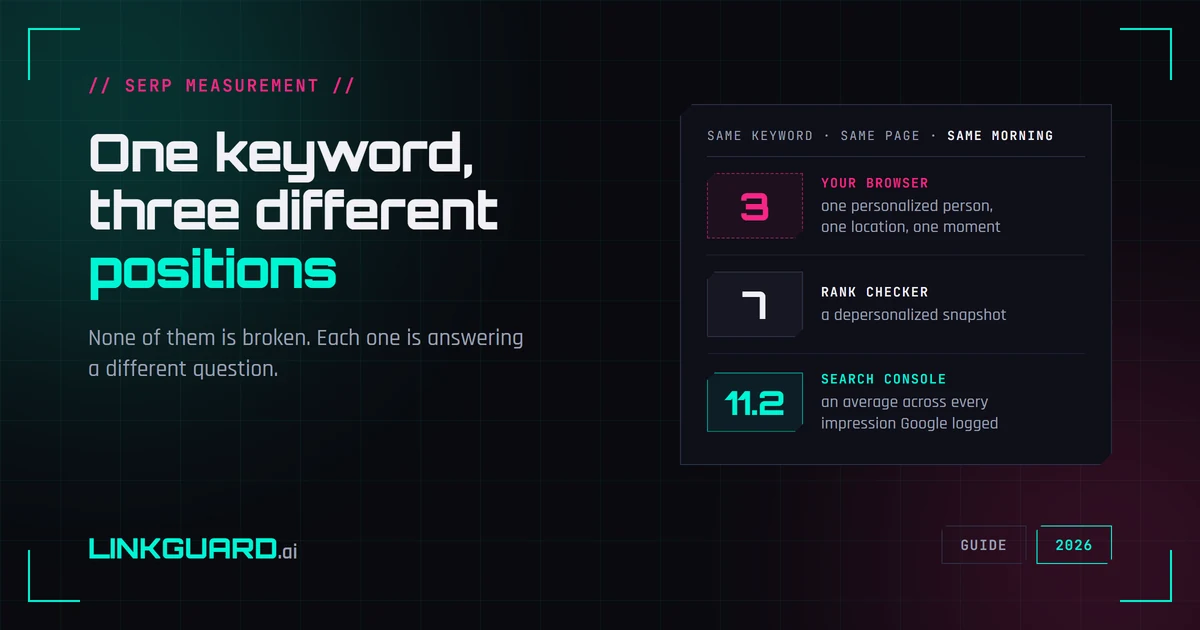
Your browser puts you third. Your rank tracker says seven. Search Console says 11.2. Same keyword, same page, same morning — and none of the three is broken. They answer different questions, and Google documents most of the difference itself. What each number measures, two things I checked live this week that contradict the standard advice, and the one figure worth putting in a client report.