A link seller emails you a list. Every row has a number next to it — DR 58, DA 44 — and a price that climbs with the number. You're meant to read those scores as a verdict: higher means stronger, stronger means worth more, pay up. Most of the SEO industry runs on exactly that reflex, and most of it never stops to ask the obvious question. Stronger according to whom?
Domain authority vs domain rating really comes down to whose ruler you're using. They're two different scores, from two different companies, built from two different link databases, trying to estimate roughly the same thing, and Google uses neither. That last part is the one nobody selling you links wants to dwell on. Here's what each score actually measures, why the same website gets two different numbers, and the honest read on what they're good for and what they're not. Full disclosure before we start: LinkGuard displays the DR of the sites linking to you, pulled from Ahrefs and read from a cache. We don't calculate it. It's Ahrefs' number, not ours, and we don't compute Moz's DA at all. So when I say no third-party score is a Google ranking factor, that includes the one we put on your screen.
The 30-second answer
Domain Authority (DA) is Moz's score. Domain Rating (DR) is Ahrefs' score. Both run 0 to 100, both are logarithmic (climbing from 70 to 71 is far harder than 20 to 21), and both estimate how strong a site's backlink profile is. They are not the same number, they're not interchangeable, and a DA of 50 tells you nothing about what the DR will be. Same scale, different companies, different math.
What Moz's Domain Authority measures
Domain Authority is Moz's prediction of how well a whole site is likely to rank in search. The operative word is prediction. It's a machine-learning model that reads signals from Moz's link index (how many unique domains link to you, the overall shape of your link profile, spam signals) and outputs a single 1-to-100 score tuned to line up with what already ranks. It refreshes roughly monthly when Moz recrawls. Moz also publishes a page-level sibling, Page Authority, which does the same job for one URL instead of the domain (Moz).
Two things worth keeping. DA is a domain-level number, and Google ranks pages, not domains, so a flattering DA says nothing about whether your specific page will rank. And because the score is modeled to fit rankings, people read it backwards, as though raising DA causes ranking. It doesn't. The model watches the same link signals that happen to correlate with ranking; it's a thermometer, not a furnace.
What Ahrefs' Domain Rating measures
Domain Rating is narrower, and more honest about its own scope: it measures the strength of a site's backlink profile, and only that. Ahrefs says so in plain words: DR "represents the strength of the website's backlink profile on a logarithmic scale from 0 to 100, with the latter being the strongest" (Ahrefs). It doesn't look at your content, your traffic, or your on-page work. It looks at who links to you, how strong those linkers are, and how many other sites they link out to, and nofollow links don't pass DR. It updates close to daily.
DR is also only one of the numbers on that screen, and the others don't all work the same way — some are counted, some are modeled, and reading Ahrefs' metrics starts with telling those two apart. DR's page-level companion is URL Rating (UR), which scores the backlink strength of one specific page. If you've ever wondered why a site sitting at DR 80 has a page that won't rank, UR is part of the answer — and since Google ranks pages, not domains, the page-level numbers deserve their own piece: Page Authority vs Domain Authority.
And Semrush Authority Score, since people lump all three together
There's a third number people toss into the same bucket, and it doesn't belong there. Semrush's Authority Score isn't link-only. It's a compound metric built from eight weighted factors across three groups (link power, estimated organic traffic, and a set of spam signals), so it marks a site down when it looks like it bought its links (Semrush). That's why a domain with a pumped-up DR can carry a meek Authority Score: one is counting links, the other is sniffing for manipulation and folding in traffic. Three tools, three philosophies, three numbers that were never going to agree.
Why the same site gets three different numbers
Because they aren't measuring the same thing with the same ruler. Moz and Ahrefs crawl different slices of the web, so they see different links to begin with. Then they do different math on what they find: DA is a model predicting ranking ability, DR is a calculation of link strength, Authority Score is a blend that drags in traffic and spam. Different inputs, different formulas, different goals. So stop trying to convert one into the other. A DA 50 is not a DR 50, and there's no exchange rate between them. Compare each score against its own kind: this site's DR versus that site's DR, never its DR against somebody's DA.
Is DA or DR a Google ranking factor?
No. Not DA, not DR, not Authority Score. This is the load-bearing fact of the whole topic, and it's odd how rarely it gets to lead. Google's own people have said it for years, on the record, more than once.
Gary Illyes, back in 2016: "we don't really have 'overall domain authority'" (Search Engine Roundtable, October 2016). John Mueller in 2019: "Google doesn't evaluate a site's authority. So it's not something where we would give you a score on authority" (Search Engine Journal, June 2019). And Mueller again in 2022, with no hedging: "Google doesn't use it at all... I don't think I've ever looked up the DA for a site in the 14 years I've been doing this" (Search Engine Roundtable, April 2022).
The most disarming confirmation comes from Ahrefs itself. In its own help docs, the company that sells DR writes: "There's no evidence that search engines use Domain Rating (or similar scores such as Domain Authority...) as a ranking factor at all" (Ahrefs Help Center). When the vendor tells you its own flagship number isn't a Google signal, believe the vendor.
"But the 2024 leak showed Google has siteAuthority"
If you follow this closely, you've heard the counter: the May 2024 Google Content Warehouse leak exposed an internal field literally named siteAuthority, so didn't Google just get caught fibbing? Not quite, and the honest answer is more interesting than the gotcha. The leaked documents suggest Google does compute some site-level signal (SparkToro, 2024). But whatever siteAuthority is, it is not Moz's DA or Ahrefs' DR: those are third-party scores built from third-party link crawls, and Google has never had access to their math, nor they to Google's. You also can't optimize toward a number you can't see, computed by a formula nobody's published. "Google may have an internal site signal" and "the DA or DR on your screen isn't it" are both true at the same time.
The vanity-metric trap
Here's what happens when a number nobody outside the tools uses becomes the number everyone optimizes for: a whole economy grows up around inflating it. Link packages priced by DR. Expired domains resold for their leftover DA. Private blog networks built for the sole purpose of manufacturing the score. Jeff Ferguson laid out the case against DA in detail, and its sharpest line comes from Moz's own former search scientist, Russ Jones, who conceded "Moz doesn't claim to have a metric which mimics Google" (Search Engine Land, September 2023).
And the punchline that makes the whole game pointless: because DR is built purely from links, you can raise it by buying enough of them. You'll end up with a bigger number and not one extra position in Google, because Google never read the number. You optimized the speedometer instead of driving the car.
So what are these scores actually good for?
Triage. Nothing wrong with that: it's just a far smaller job than the industry pretends. When you're handed a list of 200 potential link targets, a domain score is a fast, rough gut-check: is this donor in a sane range, or is it a DR 2 content farm? That's a genuine use. It's the difference between a one-second sniff test and reading every prospect by hand.
What a score can't tell you is whether the link will help at all, whether the donor is relevant to you, or whether a link you already have is still alive. LinkGuard shows you the DR of your donors because it's a handy gut-check, read from cache; we don't sell you a number to grow. A high DR doesn't make a link safe, which is exactly why we wrote up what actually makes a backlink toxic, and why a seller quoting you a glossy DR is not the same as a link worth buying. The things that move rankings, like whether the link is live, indexed, followed, and still pointing where it should, are the things a domain score says nothing about. Those are what we watch.
Questions people ask
What's the difference between DA and DR?
Domain Authority is Moz's machine-learning score predicting how well a site might rank; Domain Rating is Ahrefs' measure of pure backlink strength. DA folds in more signals and is modeled to fit Google's results; DR looks only at the link profile and ignores nofollow links. Both run 0 to 100 and both are logarithmic, both come from different companies' link indexes, and neither is used by Google.
Is Domain Authority a Google ranking factor?
No. Google representatives (Gary Illyes in 2016, John Mueller in 2019 and again in 2022) have repeatedly said Google has no overall domain-authority score and doesn't use Moz's DA. DA correlates with rankings because it's modeled on link signals that also correlate with ranking, but it doesn't cause rankings and Google doesn't read it.
Is a DA of 50 the same as a DR of 50?
No, and you shouldn't convert between them. The two scores come from different link databases and different formulas, so the same site routinely gets different DA and DR numbers. Compare a site's DR only to other DR scores, and its DA only to other DA scores, never DA against DR.
What's a good DA or DR score?
There's no official threshold. "30 is average, 60-plus is strong" is an industry rule of thumb, not a number Moz, Ahrefs, or Google publishes as a target. A "good" score is really just one that's healthy relative to the sites you're competing with in your niche. Treat the number as relative, not as a grade out of 100.
Can you increase your DA or DR?
Yes, by earning (or buying) more and stronger links, which is what both scores measure. The catch is that raising the score doesn't raise your Google rankings on its own, because Google doesn't use the score. Build links for real relevance and authority and the number climbs as a side effect; chase the number directly and you've optimized a metric nobody at Google ever looks at.
The short version
DA is Moz's predicted ranking strength, DR is Ahrefs' link-profile strength, Authority Score is Semrush's spam-aware blend, and the same site gets three different numbers because three companies built three different rulers. None of them is a Google ranking factor: Google's own staff and Ahrefs' own docs say so. Use a domain score the way it deserves to be used: a quick gut-check when you're qualifying donors, not a scoreboard to chase.
The counts that feed these scores are their own rabbit hole, and if you want to see what sits underneath the number, start with referring domains versus backlinks. A high-DR link still dies the day the donor deletes the post, and that's the part we watch. When you're ready to stop grading domains and start watching whether your hard-won links survive, start free with 1,000 tokens and no card, or run a prospective donor page through our donor page trust audit first. We'll show you the DR. We just won't pretend it's the thing that ranks you.
About the Author

Related Articles

Link juice and link equity: what actually passes through a link
Google's documentation says PageRank is still part of its core ranking systems. The arithmetic everyone teaches for it was last restated by a Google employee in 2009, inside his own disclaimer. Both of those are on the record.

A ranking dropped: what to rule out, in order
Google publishes a debugging guide for Search traffic drops. It names six causes, and backlinks aren't among them — the word doesn't appear on the page. That's not an oversight, it's a boundary: the guide covers Google's side of the glass. Here's the full elimination order, from measurement artifacts to the box almost nobody opens, with the rewrite saved for last.
Why your SERP position is three different numbers
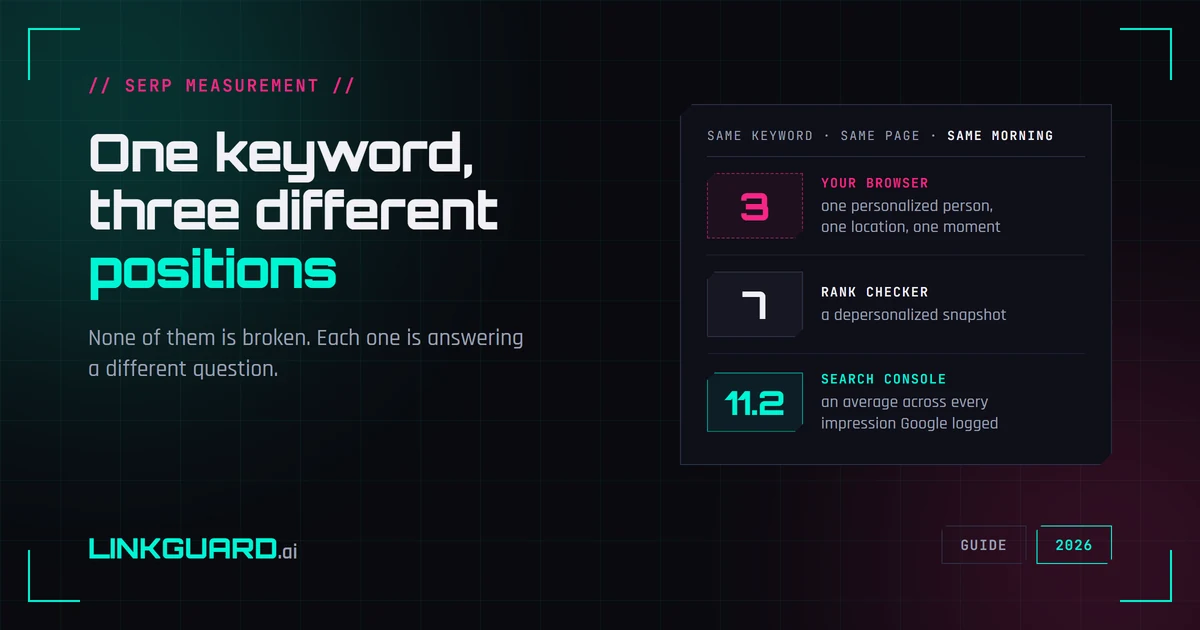
Your browser puts you third. Your rank tracker says seven. Search Console says 11.2. Same keyword, same page, same morning — and none of the three is broken. They answer different questions, and Google documents most of the difference itself. What each number measures, two things I checked live this week that contradict the standard advice, and the one figure worth putting in a client report.