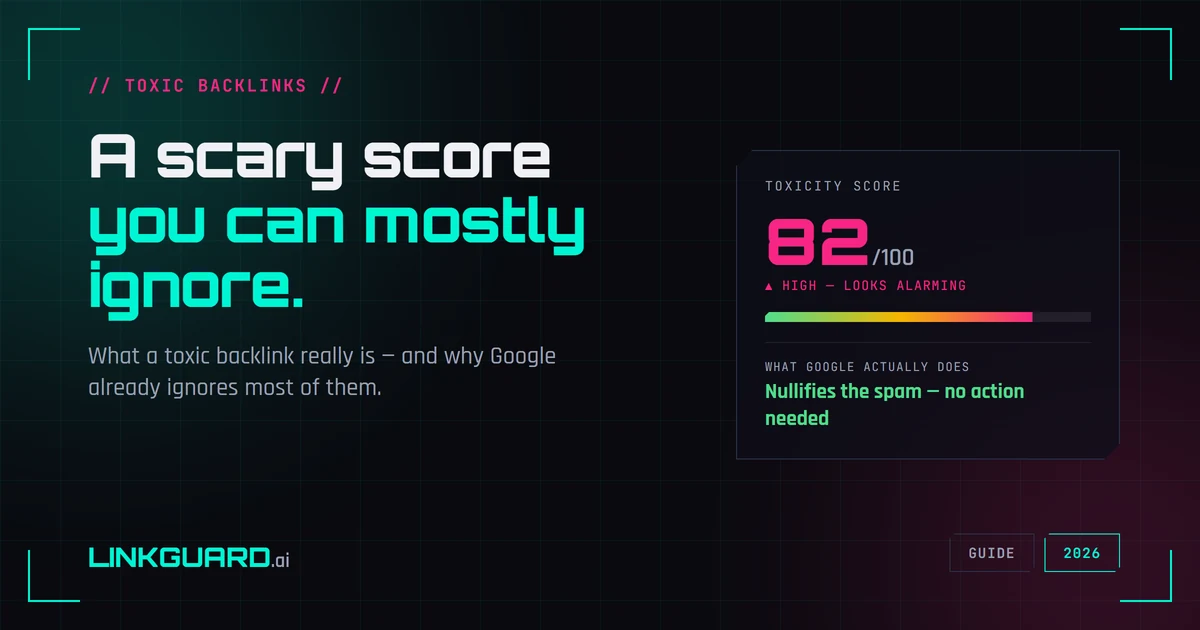
You ran your domain through a backlink tool and it came back with a number in angry red: a toxicity score, and a list of links flagged as dangerous. The instinct is immediate and wrong: disavow them all, fast, before it costs you. Before you do anything, it's worth knowing what "toxic" actually means here, who decided these links were toxic, and whether the score is measuring a real threat or just selling you one.
Short version: a high toxicity score is usually a measure of suspicion, not damage. Most of the links it flags are already being ignored by Google at no cost to you, and disavowing them can do more harm than the links ever would. Here's what a toxic backlink is, what Semrush's score checks, and the narrow set of cases where it's worth acting on.
"Toxic backlink" is a tool's word, not Google's
This is the first thing to get straight, because it reframes everything else. Google does not use the term "toxic backlink" and does not publish a toxicity score. Its official language is "spammy, artificial, or low-quality links." "Toxic" and "Toxicity Score" are inventions of third-party SEO tools — useful as a triage shorthand, but not a label Google recognizes or acts on.
That matters because the word does work on you. "Toxic" sounds like poison, like something actively harming your site that you must remove right now. A more honest word for most flagged links would be "junk": low-quality, irrelevant, often automated, and almost always already discounted. Junk doesn't demand emergency surgery. Poison does. The label is doing persuasion the underlying data doesn't support.
What Semrush's Toxicity Score measures
Semrush has the best-known version of this metric, so it's worth understanding what's under the number. Its Backlink Audit tool (under Link Building in the Semrush SEO toolkit) gives every link and referring domain a Toxicity Score from 0 to 100, where 0 is clean and 100 is highly suspicious.
The score is built from 45+ "toxic markers" — signals like links from sites Google never indexed, known link networks, site-wide footer links, pages flagged for malware, and irrelevant source domains. At the whole-profile level, Semrush calls your overall toxicity High when more than 10% of your backlinks are flagged, Medium at 3–9%, and Low under 3%. It's a competent, automated version of the eyeballing an experienced SEO would do by hand.
It's useful software for triage, and the full Semrush Backlink Audit workflow is worth understanding if you'll run one. The trouble isn't the markers. It's the leap people make from "this link has suspicious markers" to "this link is hurting me and must be disavowed." That leap is where audits go wrong, and the score's design quietly encourages it.
Why a high score rarely means what you fear
Here's the part the red number leaves out: Google already ignores most spam links on its own, automatically, for free.
Google's spam-detection system (SpamBrain) detects and nullifies unnatural and spam links algorithmically. A nullified link doesn't count — it doesn't help you and it doesn't hurt you. It simply stops registering as a ranking signal, with no action required from you. Google rolled this out as the engine behind its link spam updates, and nothing since has reversed it. The spammy footer link, the comment-spam page, the irrelevant foreign-language domain — the exact stuff that lights up a toxicity score — is largely the stuff Google has already filtered out.
Google's John Mueller has said this directly and repeatedly. As recently as January 2026, on spam comment links: "These links all have no effect — they're from spammers dropping links into comments. These would not have any effect, positive nor negative, on your site." That's the official read on the bulk of what tools call toxic: no effect. Not poison. Inert.
So a toxicity score is best understood as a suspicion meter, not a damage meter. It tells you a link has markers worth a glance. It does not tell you the link is costing you rankings, and most of the time it isn't.
When a toxic backlink actually matters
That's not "toxic links are a myth, ignore everything." There's a real, narrow set of situations where flagged links deserve action:
- You have a manual action for unnatural links. If Google Search Console shows a manual action citing unnatural inbound links, that's a real, named problem, and cleaning up plus disavowing is part of the fix. This is the one case where the disavow tool is clearly the right move.
- You knowingly built or bought a spam profile. If you ran a private blog network, bought thousands of cheap links, or inherited a domain with a history of aggressive link buying, you have actual exposure and disavowing the worst of it can be a defensible cleanup. For the narrower question of what to do about PBN backlinks specifically, the answer is usually nothing.
- A negative-SEO attack you can document. A sudden flood of obvious spam links pointed at you, in volume, is worth a defensive disavow — though even here Google's position is that it usually handles this for you.
Outside those cases, Google's own guidance is blunt: "most sites will not need to use this tool," and using it wrong "can potentially harm your site's performance." Disavowing a link the toxicity score flagged but Google was already ignoring — or worse, one that was quietly helping — is a real way to make your rankings worse in pursuit of a cleaner-looking number. The score creates urgency; the data rarely justifies it.
How to sanity-check your profile without paying for it
If you want to look at your link profile rather than trust a red number, you can do it for nothing. The full free method — export from Search Console, skim for junk, disavow only if you must — is laid out step by step in the free Search Console audit method. For the parts that are tedious to check by hand, our free donor trust audit rates a linking domain on the signals a toxicity score is approximating, and the backlink audit score gives a fast read on a whole profile — no signup, no subscription.
If you do conclude you need to disavow (most don't), the disavow file checklist walks the process safely, line by line, so you don't strip out a link that was doing you good.
The boundary: scoring toxicity vs watching your links
Honest disclosure, because it changes what you should search for next: I run a backlink monitoring tool (LinkGuard), and it does not score toxicity. We don't run our own web index, we don't assign a 0–100 number, and we won't discover spam links you didn't know about. For the toxicity-and-disavow audit, Semrush or the free Search Console method is the right tool — use it, run it once, and move on.
The job we do is the opposite end of the problem. Running a backlink audit asks "is anything bad pointing at me?" — a question you can usually answer once and largely stop worrying about. Monitoring asks "are the good links I paid for still there?" — a question that has a new answer every week, because a donor quietly rebuilds their site, an editor strips your link in a content refresh, or a placement starts 404ing after a CMS migration. That ongoing loss is the one most people lose rankings to, and no toxicity score will ever flag it. If you want the trade-offs laid out both ways, the LinkGuard vs Semrush page is honest about where each tool fits.
Questions people ask
What is a toxic backlink?
"Toxic backlink" is a third-party SEO-tool term for a link with spam signals — for example a link from a site Google never indexed, a known link network, a site-wide footer, or an irrelevant or malware-flagged page. Google itself doesn't use the term; its language is "spammy, artificial, or low-quality links." A toxic label flags suspicion, not confirmed harm: most such links are already discounted by Google and have no effect on your rankings either way.
Does Google use a toxicity score?
No. Toxicity scores are produced by third-party tools like Semrush, not by Google. Google has no public toxicity metric and doesn't endorse one. Internally it uses SpamBrain to detect and nullify spam links automatically, so the links a tool calls "toxic" are largely the ones Google has already filtered out. Treat a vendor's toxicity score as a triage hint, not a verdict from Google.
Is a high Semrush Toxicity Score bad?
Not necessarily. Semrush's Toxicity Score (0–100, built from 45+ markers) measures how suspicious your links look, not how much they're hurting you. A high score means a lot of flagged links, but most flagged links are spam Google already ignores. Unless you have a manual action or knowingly built a spam profile, a high score usually calls for a calm look, not an urgent disavow.
Does a high toxicity score mean I should disavow?
No, not on its own. A score only tells you links look suspicious, not that they're hurting you, and Google warns that using the disavow tool incorrectly can hurt your performance. Let the score start a conversation, not end one: disavow only if you also have a manual action for unnatural links or knowingly built or bought a spam profile. Acting on the number alone — disavowing links Google was already ignoring, or one that was quietly helping — can make your rankings worse, not better.
Can toxic backlinks hurt my rankings?
Rarely, for most sites. Google's SpamBrain nullifies the typical spam link so it has no effect, positive or negative. Links can hurt you mainly when you've earned a manual action for unnatural links, or built a large manipulative profile that an algorithmic spam update devalues. Random spam links you didn't create are almost never the cause of a ranking drop — lost good links and on-page issues are far more common culprits.
Do I need a paid tool to find toxic backlinks?
No. A paid toxicity score is a convenience, not a requirement. Google's own SpamBrain already neutralizes the typical spam link, so for most sites finding "toxic" links is less urgent than it's sold to be. When you do want to look, free tools cover it: a donor trust audit rates a linking domain on the signals a toxicity score approximates, and a backlink audit score gives a quick read on a whole profile, with no subscription. Reach for a paid suite when you need the wider toolset, not just to answer this one worry.
Look before you disavow
A toxicity score is a starting point for a glance, not a to-do list. The honest read on most flagged links is the one Google itself gives: spammy, already ignored, no effect. Check your profile once with free tools, act only in the narrow cases that warrant it, and don't let a red number talk you into disavowing links that were doing no harm — or some quiet good. Run a free donor trust audit to see the signals for yourself, and if you also want to stop losing the good links you paid for, start free with 1,000 tokens.
About the Author

Related Articles

Link juice and link equity: what actually passes through a link
Google's documentation says PageRank is still part of its core ranking systems. The arithmetic everyone teaches for it was last restated by a Google employee in 2009, inside his own disclaimer. Both of those are on the record.
A ranking dropped: what to rule out, in order
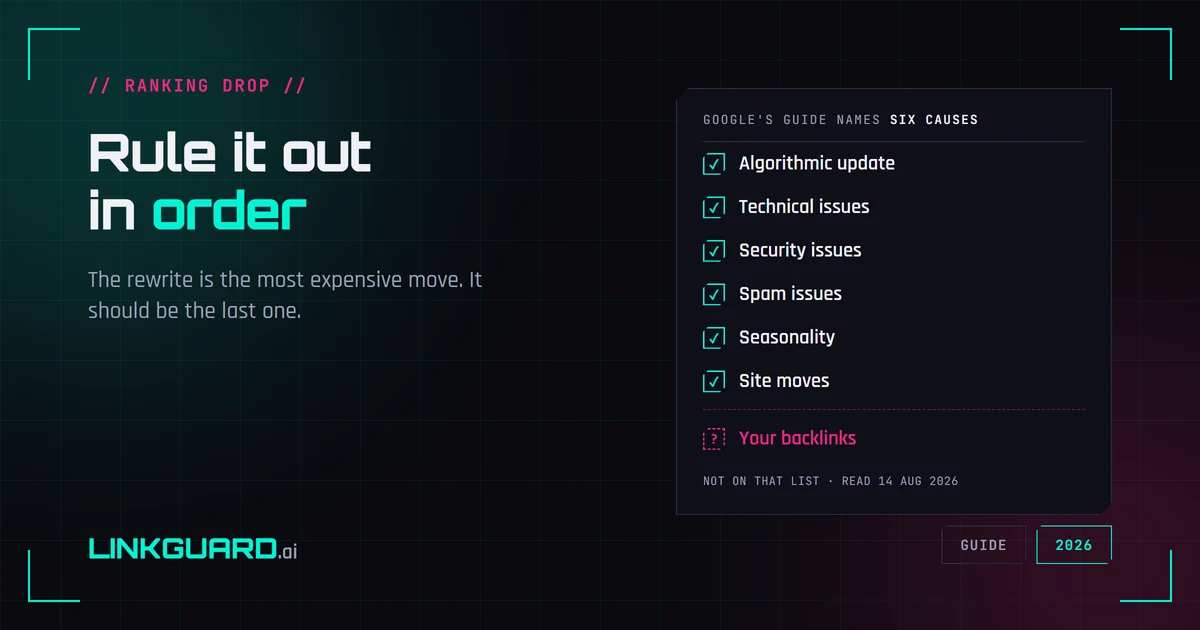
Google publishes a debugging guide for Search traffic drops. It names six causes, and backlinks aren't among them — the word doesn't appear on the page. That's not an oversight, it's a boundary: the guide covers Google's side of the glass. Here's the full elimination order, from measurement artifacts to the box almost nobody opens, with the rewrite saved for last.
Why your SERP position is three different numbers
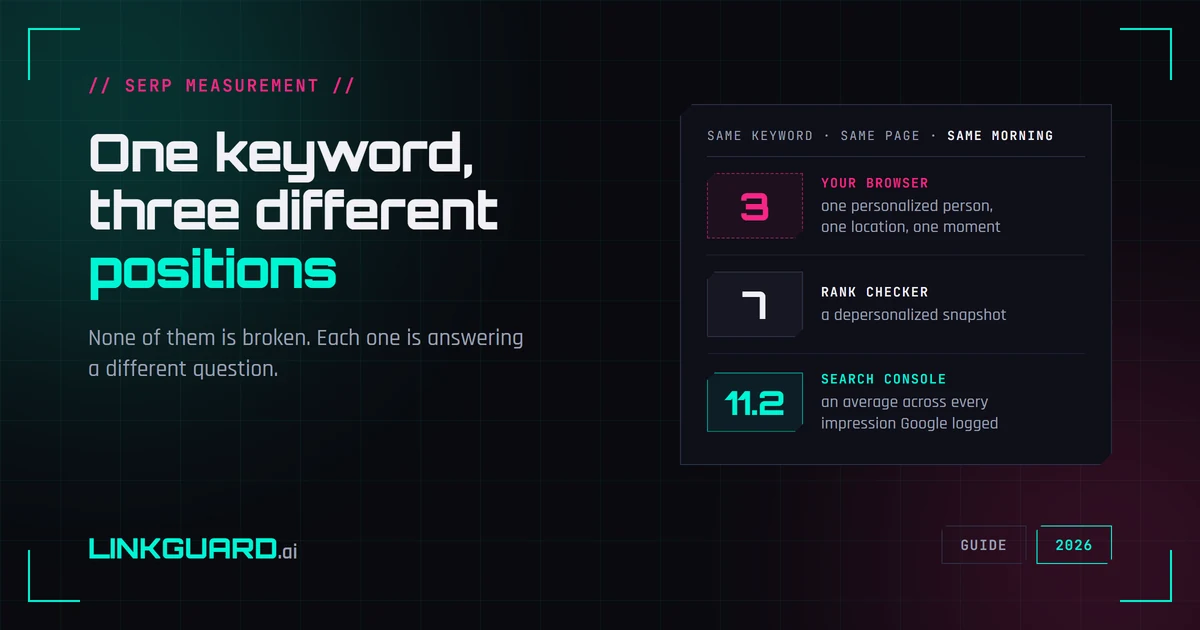
Your browser puts you third. Your rank tracker says seven. Search Console says 11.2. Same keyword, same page, same morning — and none of the three is broken. They answer different questions, and Google documents most of the difference itself. What each number measures, two things I checked live this week that contradict the standard advice, and the one figure worth putting in a client report.