The backlink manager for links you can't afford to lose
You earned some of your backlinks and you paid real money for others. A backlink manager keeps track of all of them and tells you the day one breaks — removed, turned nofollow, redirected, or quietly re-anchored. LinkGuard does that: watch every link, catch the change while you can still fix it, and recover the ones you paid for. Pay-as-you-go, free to start.
Start freeWhat a backlink manager does
Backlink management is one job split into four. A spreadsheet covers the first; it falls down on the rest.
1. Keep the list
Every backlink in one place — the URL, the anchor, the rel attribute, the donor domain, and (for bought links) what it cost and who sold it. The part a spreadsheet does fine, until it goes stale.
2. Watch for change
Re-check each link on a schedule and flag the moment one is removed, nofollowed, redirected, or re-anchored. This is the part nobody does by hand for long, and the part that costs you when it's skipped.
3. Recover what broke
When a paid link drops before its term, the manager turns the loss into a workflow: alert, outreach to the seller, replacement or refund, and a record of what you got back.
4. Know what it's worth
Tie each link to its cost so you can see the money at risk when links break and the money recovered when you claw one back — the number a spreadsheet never connects to link status.
How LinkGuard manages your backlinks
| The management job | How LinkGuard does it |
|---|---|
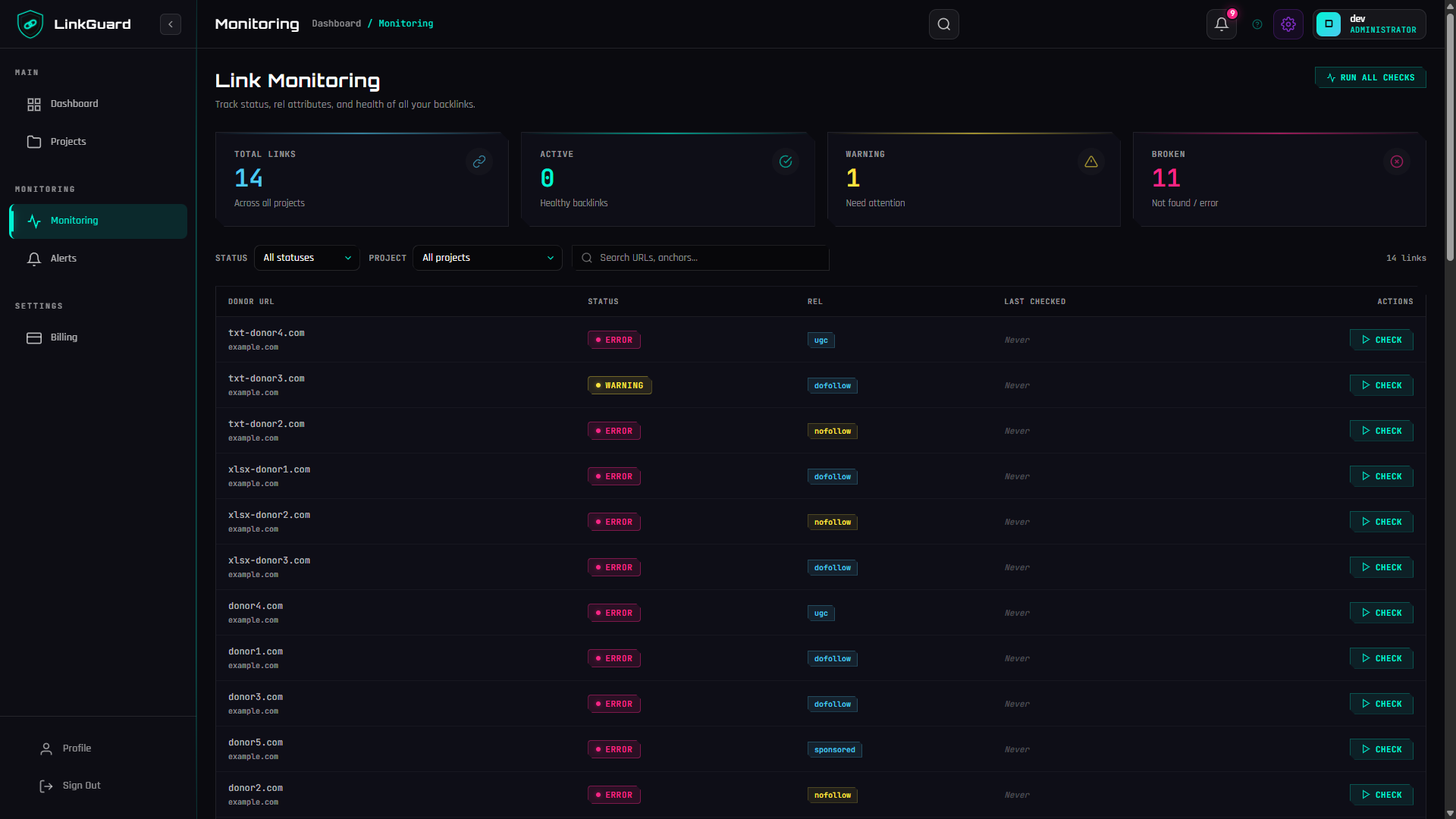
| Monitoring | Checks each link on a schedule and renders JavaScript pages in a real browser, so a link sitting on a Webflow or React page isn't falsely flagged as lost. |
| Index verification | Confirms the referring page is actually in Google's index, not just that the link is live — a link on a de-indexed page passes no value. |
| Alerts | Tells you the hour a link changes, with the specific reason (removed, nofollow, redirect, anchor edit), while the donor's editor still remembers the change. |
| Recovery ledger | Records each link's cost and seller, runs a dropped paid link through alert → outreach → replacement or refund, and tallies what you recovered. |
| Cost & risk | Shows the dollar value at risk across broken links and the amount recovered, so management is a number you can report, not a vague worry. |
| Pricing | Pay-as-you-go: charged per check, 1,000 free tokens to start, nothing owed in the months you pause. |
Why I built it as a manager, not a research tool
Most "backlink" tools are built to find links — crawl the web, score domains, surface what points where. That's research, and the big suites do it well. But the job that quietly loses people rankings isn't finding links. It's the links you already have slipping away unnoticed: a donor redesigns, an editor strips a dofollow in a cleanup, a paid placement 404s a month after you bought it.
I built LinkGuard for that job specifically — managing the links you've already got. It watches each one, renders JavaScript so it doesn't false-alarm, and the moment something changes it tells you, with the reason. Then it helps you do something about it, instead of just logging the loss. Pay-as-you-go, because a manager you only need some months shouldn't bill you every month.
— Andrii, founder of LinkGuard · LinkedIn
Who a manager like this fits
Backlink management software earns its place for some people and not others. The honest split.
LinkGuard fits if…
- You buy links and can't afford to find out a placement dropped a month too late.
- Your donors include JavaScript-rendered sites, where a plain HTTP check false-alarms.
- You want to track what each link cost and recover the money when one breaks.
- You'd rather pay per check and owe nothing in the months you're not monitoring.
LinkGuard is the wrong tool if…
- You want to discover new backlinks across the web — that's a research index like Ahrefs, not a manager.
- You need a toxicity score and disavow audit — use a suite or the free method in our toxic-backlink guide.
- You only have a few links and the discipline to check them by hand each month.
- You need a self-hosted, on-premise install — LinkGuard is cloud only.
What a backlink manager is not (so you're not surprised)
- It is not a backlink-discovery index. LinkGuard doesn't crawl the web to find links pointing at you — you bring your list or export it from Google Search Console.
- It is not a toxicity-and-disavow auditor. It won't score your profile or build a disavow file; for that, see our backlink audit guide.
- It is not a rank tracker or keyword tool. It manages links, not SERP positions.
- White-label client reports for agencies are still on the roadmap (Q3 2026).
Questions people ask
What is a backlink manager?
A backlink manager is a tool that keeps track of the backlinks pointing at your site — the ones you earned and especially the ones you paid for — and tells you when one changes. Instead of re-checking links by hand, it watches each placement on a schedule and flags the moment a link is removed, turned nofollow, redirected, or has its anchor edited. The good ones also help you record what each link cost and recover it when it breaks.
Is LinkGuard a backlink management tool?
Yes, that's its core job. LinkGuard manages the backlinks you already have: it monitors each one, checks whether the page is still indexed by Google, renders JavaScript pages in a real browser so it doesn't cry wolf, alerts you the day a link changes, and gives you a ledger to track what each link cost and recover it. What it does not do is discover new backlinks by crawling the web — for that you bring your own list or export from Google Search Console.
Do I need backlink management software?
If you have more than a handful of links you care about — especially paid placements — yes, because checking them by hand never gets done, and a link that quietly drops costs you the ranking it supported. If you have a few links and the time to check them monthly, a spreadsheet works. The moment you're paying for links, the cost of not noticing a loss is higher than the cost of the tool.
Is there a free backlink manager?
LinkGuard gives you 1,000 free tokens on signup with no credit card — roughly 83 full checks — so you can manage real links before paying anything, and a set of free standalone tools (redirect checker, donor trust audit, anchor checker) with no account at all. After the free tokens, it's pay-as-you-go: you're charged per check, not a monthly subscription, so a quiet month costs nothing.
How is a backlink manager different from Ahrefs or Semrush?
Ahrefs and Semrush are research suites: they crawl the web to discover backlinks, score domains, and audit toxicity, billed as a monthly subscription. A dedicated backlink manager like LinkGuard does the narrower, ongoing job they do least well — watching the specific links you already have and telling you the hour one breaks — for pay-as-you-go pricing. Many people use both: a suite for research, a manager for monitoring. See LinkGuard vs Semrush for the detail.
Can I import my existing backlinks?
Yes. Upload a CSV from a spreadsheet, another tool, or a Google Search Console export, and monitoring starts on import — no API keys, no onboarding call. Your signup tokens cover a first full pass so you can see every link's real status before paying anything.
Start managing the links you can't afford to lose
Bring your backlinks over — paste a few or import a CSV — and LinkGuard starts watching them on import. The first full pass is on the house, and there's no card to enter.
Start free1,000 tokens on signup · no credit card · pay per check, not per month