Two different boxes can sit at the head of Google's results, and they look close enough that most people never notice they're different things. One is a quote: a chunk lifted straight from a single web page, with that page's link right there. The other is an AI Overview, a summary Google's model writes itself, pulling from several sources at once. Same prime real estate, completely different machinery. And if you're trying to land "in the box" without knowing which box you're aiming at, you're optimizing in the dark. Spend a week rewriting a page to win a featured snippet on a query that now fires an AI Overview instead, and the effort lands nowhere.
I've watched both closely while building a free AI Overview checker, and the confusion is constant, including from people who do SEO for a living. So here's the clean version: what a featured snippet is, what an AI Overview is, how they diverge, whether they still show up together in 2026, and the honest answer to the question everyone wants. Can you optimize for either? You can nudge. You can't force. Google's own words are below.
AI Overview vs featured snippet: the short answer
A featured snippet quotes one page verbatim and links to it; an AI Overview generates a new summary from many pages and links to several. That's the whole distinction in one line. A featured snippet is extraction: Google picked a winning page and promoted a piece of it. An AI Overview is generation: Google's model read across sources and wrote something that doesn't exist verbatim on any single one of them.
Everything else, why you can win one and not the other, why schema is a switch for neither, why one shows clicks and the other often doesn't, falls out of that single difference between quoting and writing.
What's a featured snippet?
A featured snippet is the answer box Google has shown for years. It takes one page it judges best answers your question and flips the normal result around, "showing the descriptive snippet first" (Google Search Central, updated December 2025). You get a paragraph, list, or table lifted directly from that page, the page title, and a link. One source. Word-for-word. Click it and you land exactly where that text came from.
The defining trait: it's your words, from your page, that get shown. Google didn't rewrite anything. It chose you and quoted you.
What's an AI Overview?
An AI Overview is the newer box. Google's Gemini model runs a "query fan-out," several related searches at once, and writes a short, original summary from the pages it pulls, citing a handful of them (Google Search Central). No single page owns the wording. You might be one of five cited sources, or the answer might lean partly on your page without naming you at all. If you want the full breakdown, we wrote what is a Google AI Overview as a companion to this piece.
The differences that matter
| Featured snippet | AI Overview | |
|---|---|---|
| Where the text comes from | One page, quoted verbatim | Many pages, summarized into new text |
| Links shown | Usually one (the quoted page) | Several cited sources |
| Who controls the wording | You, it's your page's text | Google's model, it writes it |
| Can you mark up to force it | No | No |
| Typical query | How-to, definitions, commercial | Broad, informational, multi-part |
The row people underrate is the third one. With a featured snippet, the exact sentence a searcher reads is one you wrote and can improve. With an AI Overview, you've handed the pen to Google. You can feed it better material; you can't edit what it says about you.
Do they still show up together in 2026?
Rarely together, and the balance has tilted. Both still exist, both are documented in Google's current help pages, but AI Overviews have taken over much of the informational territory featured snippets used to own, and the two seldom render on the same result. On how-to, definition, and commercial queries you'll still hit plenty of featured snippets; on broad "explain this" questions, an AI Overview is now more likely. Google hasn't said one is replacing the other, so I won't either. But if you've felt your featured-snippet visibility slipping on informational terms, you're not imagining it.
How common are AI Overviews now? Depends entirely on who's counting. Semrush, tracking 10M+ keywords, logged them on 6.49% of queries in January 2025, peaking near 24.6% in July before settling around 15.7% in November (Semrush, updated December 2025). Other trackers that weight by industry coverage report far higher numbers. The honest read: somewhere between "common" and "very common," rising, and impossible to pin to one figure. There's no official Google number.
Can you optimize for either one?
Here's the answer nobody selling a course wants to give: you can't force your way into either, and Google says so directly. For featured snippets, asked how to mark up for one, Google's answer is literally "You can't. Google systems determine whether a page would make a good featured snippet" and promote it (Search Central). For AI Overviews it's the same story: "no additional requirements," "no special schema.org structured data," and no guarantee even if you qualify. The only switch you control is the off switch. The nosnippet and max-snippet rules let you opt out.
What genuinely raises your odds for both, because it makes your page easy to quote and easy to summarize: answer the question in the first sentence under each heading, keep it specific, and use clean lists and tables where they fit. Winning a featured snippet doesn't guarantee you a spot in the AI Overview, different systems make different picks, but the discipline that earns one tends to help with the other. That's as strong a claim as the evidence allows. Anyone promising more is selling certainty that doesn't exist. If you want the deeper playbook on earning those citations, we wrote how to get cited by ChatGPT, Perplexity and Google AI Overviews.
Which one should you care about?
Both, but for the same sobering reason: neither reliably sends a click. When an AI summary appears, Pew found people clicked any result just 8% of the time versus 15% without one, and clicked the summary's own sources only 1% of the time (Pew Research Center, July 2025). Ahrefs, looking at roughly 300,000 keywords, found pages ranking under an AI Overview saw about 58% lower click-through, and they're careful to call it correlation, not proof of cause (Ahrefs, updated 2026). Featured snippets have long had their own zero-click effect for the same reason: if the box answers it, why click?
So the goal shifts from "win the click" to "be the named source." A featured snippet at least puts your link front and center. An AI Overview may only put your name in the mix. If you want to know which one a given keyword triggers before you invest, check it: our AI Overview checker tells you whether a query fires an Overview and who it cites, and a plain SERP checker shows where you actually rank underneath.
Questions people ask
Is an AI Overview just a bigger featured snippet?
No. A featured snippet quotes one page word-for-word and links to it. An AI Overview generates new text from several sources and cites a few. One is extraction from a single winner; the other is a summary written by Google's model. They can look similar at a glance, but they're produced by different systems with different rules.
If I win the featured snippet, am I in the AI Overview too?
Not necessarily. They're chosen by different systems, so winning one doesn't hand you the other. The habits that earn a featured snippet, a direct first-sentence answer, clean structure, specific facts, do tend to help your chances in AI Overviews as well, but Google guarantees nothing, and plenty of pages win one without the other.
Can I add schema markup to get into a featured snippet or AI Overview?
No, not for either. Google says you can't mark up to request a featured snippet, and that there's no special structured data and no additional requirements to appear in an AI Overview. Schema helps Google understand your page, which is useful, but it isn't a switch that places you in either box. And a validator passing your markup isn't proof Google will use it — which schema validator actually tells you what Google will show takes that apart.
Are featured snippets gone in 2026?
No. They still exist and are still documented by Google. They've simply become less visible on the broad informational queries where AI Overviews now tend to appear. On how-to, definition, and commercial searches, featured snippets are alive and well.
Do these boxes hurt my traffic?
They can. Both reduce clicks by answering the question on the results page, and the data shows sharply lower click-through when an AI Overview is present. The upside is visibility: being the quoted or cited source keeps your brand in front of searchers even when they don't click. To be clear, that visibility is not a ranking signal or a backlink. It keeps you seen; it doesn't lift where you rank. It's a real trade, and worth planning for rather than fighting.
The honest takeaway
A featured snippet quotes one page; an AI Overview writes its own answer from many. You can't force your way into either. Google controls both, says so plainly, and offers only an opt-out, never an opt-in. What you can do is be the clearest, most quotable answer on the page, and accept that the reward is increasingly visibility rather than a click.
Both boxes sit on top of the same thing: whether Google trusts your pages enough to pull them in at all, which still comes down to the links and authority behind them. That's the part you can actually protect. Start free with 1,000 tokens (no card) and let LinkGuard watch the backlinks holding up your visibility, so when one breaks or quietly goes nofollow, you hear about it the same day instead of months later.
About the Author

Related Articles

Link juice and link equity: what actually passes through a link
Google's documentation says PageRank is still part of its core ranking systems. The arithmetic everyone teaches for it was last restated by a Google employee in 2009, inside his own disclaimer. Both of those are on the record.
A ranking dropped: what to rule out, in order
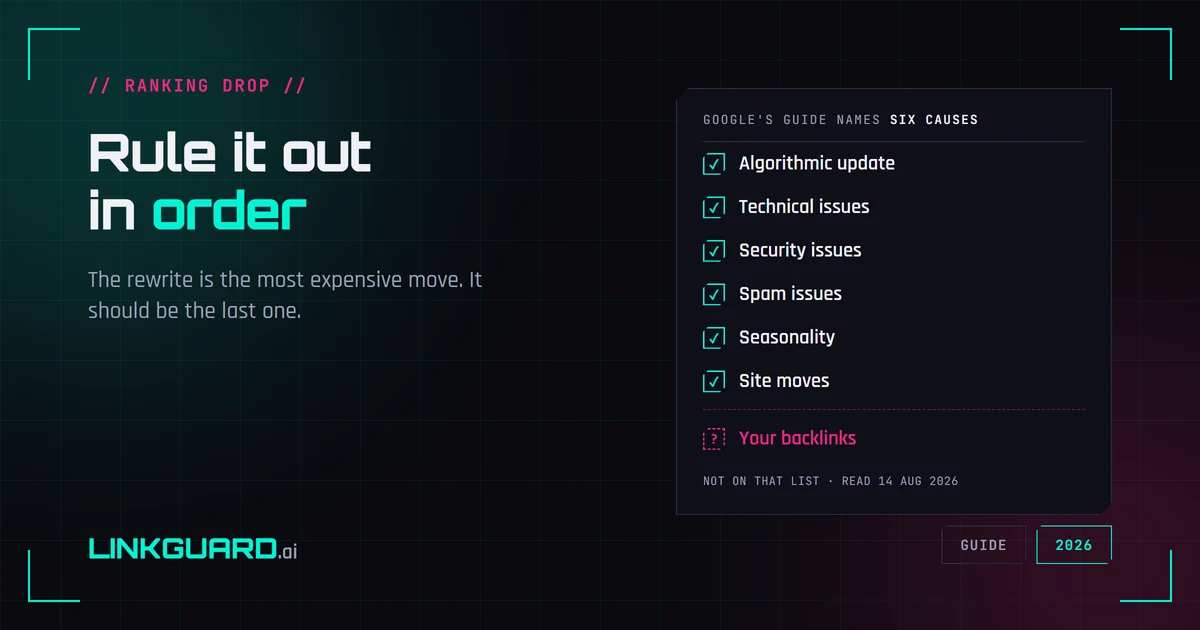
Google publishes a debugging guide for Search traffic drops. It names six causes, and backlinks aren't among them — the word doesn't appear on the page. That's not an oversight, it's a boundary: the guide covers Google's side of the glass. Here's the full elimination order, from measurement artifacts to the box almost nobody opens, with the rewrite saved for last.
Why your SERP position is three different numbers
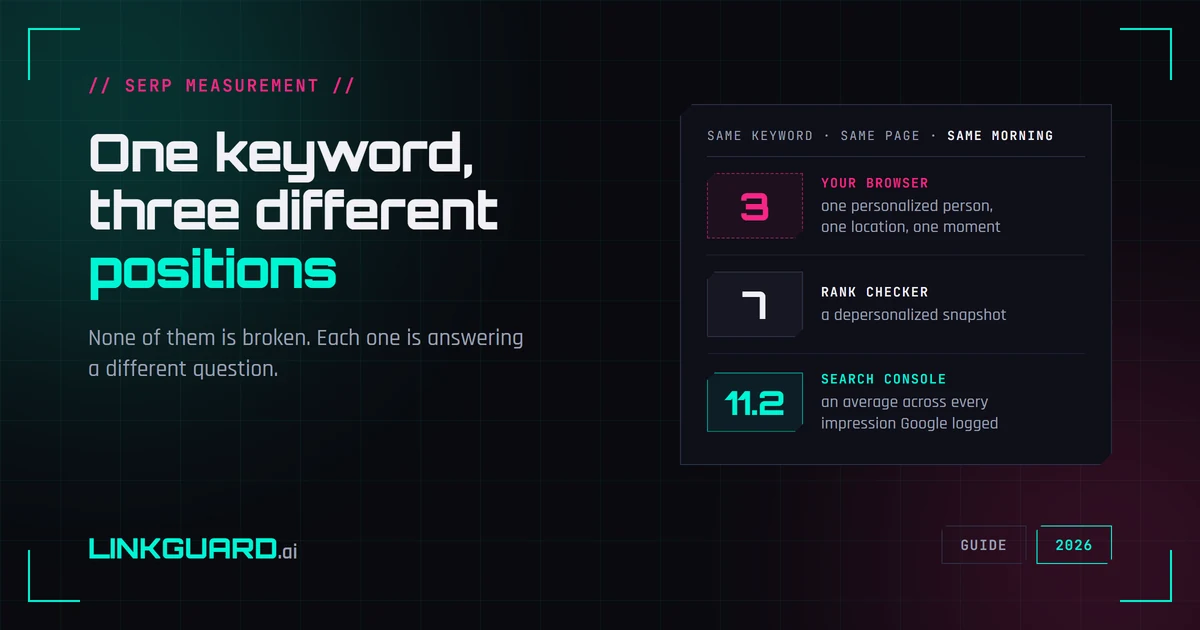
Your browser puts you third. Your rank tracker says seven. Search Console says 11.2. Same keyword, same page, same morning — and none of the three is broken. They answer different questions, and Google documents most of the difference itself. What each number measures, two things I checked live this week that contradict the standard advice, and the one figure worth putting in a client report.