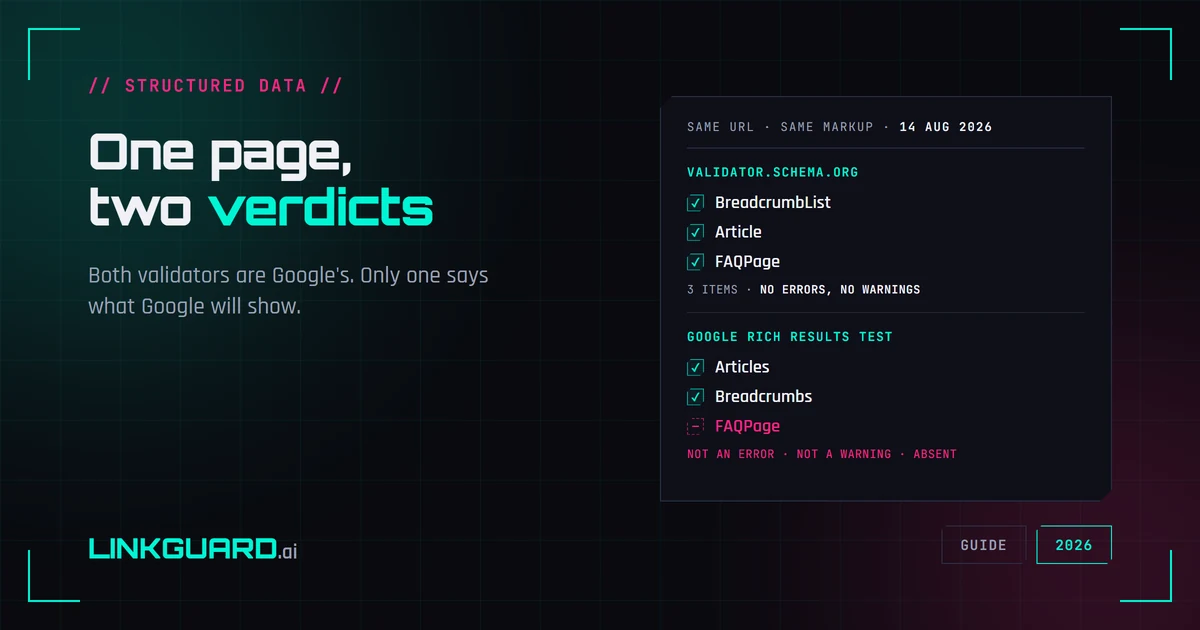
One of these tools checks whether your markup is valid schema.org vocabulary. The other checks which rich results Google can generate from it today. Both are operated by Google, and neither mentions the other, which is why the same page comes back with two different answers.
Here is what that looks like on a real page. Run through schema.org's Schema Markup Validator at validator.schema.org, one of our own articles comes back with three items — BreadcrumbList, Article, FAQPage — no errors, no warnings, everything green. The same URL through Google's Rich Results Test, minutes later: two valid items.
Nothing failed. Nothing warned. One item is just… not there. If that shape is familiar, it's the same one that makes a browser, a rank checker and Search Console report three different positions for one keyword: two instruments, two questions, one reader assuming a malfunction. And because neither tool says a word about the other, the natural conclusion is that one of them is broken or out of date.
Neither is. They are scoped to two different questions, and the gap between their answers is the most useful thing either one tells you: a type can be flawless as vocabulary and worth nothing as a rich result.
The test, run on our own page
The specimen is this site rather than a contrived example, which matters: it means the result is reproducible by anyone reading, and it means the awkward part of it lands on us.
| Schema Markup Validator | Rich Results Test | |
|---|---|---|
| Operated by | Google, "as a service for the Schema.org community" | |
| Validates against | The full schema.org vocabulary | Google's rich-result requirements |
| A type Google doesn't support | Reported as valid | Omitted — no error, no warning |
| Renders the live page | No | Yes, as Googlebot |
| Authoritative for | Whether the markup is valid vocabulary | Whether Google can show a rich result |
| Our page, 14 Aug 2026 | 3 items, no errors, no warnings | 2 valid items; FAQPage absent |
The shape of that second answer matters more than the count. FAQPage was not flagged as an error. It was not downgraded to a warning. It was not mentioned. Google's tool lists what it can build a rich result from, and our FAQ markup is no longer on that list, so it simply falls out of the report.
That is the whole failure mode. A tool that reports nothing about a type is easy to misread as a tool that found nothing wrong.
Both of these are Google's
It undoes the usual mental model of "the standards body versus the search engine".
The schema.org validator's own documentation page says it plainly: it is "based on the tool previously known as the Google Structured Data Testing Tool", and it is "provided by Google as a service for the Schema.org community". Same company, different job.
How it ended up that way is a small piece of history worth knowing, because it explains the scoping. In July 2020 Google took the Rich Results Test out of beta and announced that the old Structured Data Testing Tool would be deprecated. Then it changed its mind. In a post dated 15 December 2020, Ryan Levering of Google Search wrote that they had heard the feedback and would refocus the tool instead of killing it — migrating it to a schema.org domain where "the main purpose of the tool will be to check syntax and compliance of markup with schema.org standards", and where, going forward, "the tool will no longer check for Google Search rich result types".
So the split was deliberate, and it was announced. The community kept a general-purpose vocabulary checker; Google kept a Google-specific one. What nobody did was put a line in either interface saying the other exists.
The sentence that settles which one to believe
It's in Google's introduction to structured data, and it is unusually direct:
"Most Search structured data uses schema.org vocabulary, but you should rely on the Google Search Central documentation as definitive for Google Search behavior, rather than the schema.org documentation. There are more attributes and objects on schema.org that aren't required by Google Search; they may be useful for other search engines, services, tools, and platforms."
Note what that does and doesn't say. It doesn't call the schema.org vocabulary wrong or useless — it says explicitly that the extra objects may be useful elsewhere. It says that for the question what will Google do with this, Google's own documentation is the authority, and by extension so is Google's own tool.
Google even publishes a page that tells you which tool to pick. Its structured data documentation hub says to "start with the Rich Results Test to see what Google rich results can be generated for your page", and that "for generic schema validation, use the Schema Markup Validator to test all types of schema.org markup, without Google-specific validation". That paragraph answers the entire question. It is also several clicks from anywhere either tool will take you.
Why the missing type is the perfect specimen — and why it's still on our page
FAQ markup had a good run and a well-documented decline. It arrived as a rich result in 2019. On 8 August 2023 Google narrowed it to "well-known, authoritative government and health websites". Then it went entirely: Google's changelog records the FAQ rich result as no longer appearing in Search from 7 May 2026, and the documentation for it was removed the following month. Search Console's own data-anomalies page carries the same date from the other direction, warning of a drop in reported FAQ impressions from 7 May 2026 onwards.
Through all of that, FAQPage stayed perfectly valid schema.org. It still is. That's why the validator passes it with no warning, and why Google's test doesn't mention it — the vocabulary never changed, only what Google does with it.
It is also the reason the question keeps coming back in the form "can I use schema to get into an AI Overview". A validator can tell you the markup is well-formed. It cannot tell you Google has a use for it.
Which brings up the obvious question about our own page: if the rich result is dead, why is the markup still in it?
Partly inertia, and I'd rather say so than invent a strategy — including on the page our validator itself lives on, which ships seven FAQ questions of its own. Anyone can run our tool through our tool and watch it flag us. But the honest answer is that removing it buys nothing either. Google's guidance on the 2023 change was that structured data which isn't being used "does not cause problems for Search, but also has no visible effects in Google Search" — so leaving it costs nothing in Google. Google's own introduction to structured data is the closest thing to a case for keeping it: the schema.org objects Google Search doesn't require "may be useful for other search engines, services, tools, and platforms". What I won't do is tell you it helps. Google says it has no visible effect, and that's the claim I'll stand behind.
So: when a validator passes a type and Google's test ignores it, that's not a bug to fix. It's a maintenance decision. Check whether the type still earns a result before you spend an afternoon perfecting its recommended properties.
What neither validator can catch
Both tools read structure. Neither reads the page against the markup, and Google is refreshingly blunt about the limits of that.
From the structured data general guidelines:
"These quality guidelines are not easily testable using an automated tool. Violating a quality guideline can prevent syntactically correct structured data from being displayed as a rich result in Google Search, or possibly cause it to be marked as spam."
The rules that sit in that untestable space are the ones people break by accident:
- Don't mark up content that isn't visible to readers of the page.
- Don't mark up content that's irrelevant or misleading.
- If a page shows reviews, mark up all of them rather than the flattering ones.
Every one of those passes both validators with a green tick, and every one of them can cost you the rich result anyway.
The penalty is narrower than the folklore, and Google's structured data policies spell it out: a structured-data manual action "means that a page loses eligibility for appearance as a rich result; it doesn't affect how the page ranks in Google web search". You lose the stars, not the position. Which is worth holding on to, because "my structured data got me penalized" is one of the more durable pieces of folklore in this corner of the field.
Which one to run, and when
- Run Google's Rich Results Test when the question is whether Google will show something. It's the only tool that answers that, and even then conditionally: its own help states that Google "does not guarantee that your page will appear exactly as shown here". Eligible is a ticket to the draw, not a result.
- Run the schema.org validator when the question is whether your markup is well-formed vocabulary — marking up something Google has no rich result for, or building for a consumer that isn't Google at all.
- Run both when they disagree. The gap between three items and two isn't noise. It's a list of the types you're maintaining for no return in Google.
What neither run will tell you is whether any of it moves you up the results page, because it doesn't. Google has said structured data is not a generic ranking factor — though the clearest version of that statement dates to August 2020, so read it as long-standing rather than freshly restated. The return is a listing that takes up more space at the position you already hold. Nor is markup the way into AI answers: Google's guidance on its AI features says structured data isn't required for generative AI search and there's no special schema.org markup to add for it. If being cited in AI answers is the goal, markup isn't the lever, the same way a special file at your site root isn't, and the difference between the result types themselves is its own question.
Our own free schema markup validator sits deliberately in front of that split: it parses your JSON-LD, checks the properties Google requires for the common rich-result types, and flags the types Google has retired instead of passing them green. Think of it as the checker you run first and Google's test as the one that decides — when you've cleaned up what it finds, Google's is still the tool that renders the live page and tells you what it can build.
Questions people ask
Which schema validator should I use?
Google's Rich Results Test if you want to know what Google will show; schema.org's Schema Markup Validator if you want to know whether the markup is valid vocabulary. Google publishes that recommendation itself: start with the Rich Results Test for Google rich results, and use the Schema Markup Validator for generic schema validation without Google-specific checks.
Why does schema.org's validator show more items than Google's test?
Because it validates the whole schema.org vocabulary, while Google's test only reports the types it can currently build a rich result from. A type Google doesn't support isn't shown as an error or a warning in Google's tool — it's simply absent from the report. On our own page the difference was three items against two, with the missing one being FAQPage.
Is FAQ schema still worth adding in 2026?
Not for Google. The FAQ rich result was narrowed to government and health sites in August 2023 and stopped appearing in Google Search on 7 May 2026. Existing markup isn't harmful — Google's position on unused structured data is that it causes no problems but has no visible effect in Search — so it's a maintenance question rather than a cleanup emergency. Just don't add it expecting a result.
What happened to the Structured Data Testing Tool?
It was slated for deprecation in July 2020 when the Rich Results Test came out of beta, then reprieved. In December 2020 Google said it would refocus the tool rather than kill it, migrating it to a schema.org domain to check syntax and compliance with schema.org standards — and stated that going forward it would no longer check for Google Search rich result types. It lives on as the Schema Markup Validator at validator.schema.org, and the old URL redirects to a page that helps you pick between the two.
Is there a free schema markup checker I can run first?
Ours. The LinkGuard schema markup checker parses every JSON-LD block on the page, tells you whether the JSON actually parses (a single trailing comma makes Google ignore the block silently), checks the properties Google requires for the common rich-result types, and flags the types Google has retired instead of passing them green. It's the checker you run first; Google's Rich Results Test is the one that renders the live page and decides.
Can valid structured data still get you in trouble?
Yes, and neither validator will warn you. Google's own guidelines say the quality rules aren't easily testable by an automated tool, and that syntactically correct markup can still be blocked from rich results or marked as spam — marking up content that isn't visible on the page being the classic case. The consequence is losing rich-result eligibility rather than losing rankings.
Two tools, two questions
The disagreement was never a malfunction. One tool answers "is this valid", the other answers "will Google show this", and a page can honestly be a yes to the first and a no to the second for years without anything on it changing.
Which makes the useful habit a small one: when a type passes one tool and vanishes from the other, don't reach for the markup. Go and check whether the rich result still exists.
About the Author

Related Articles

How to find backlinks in Google Analytics 4 (it only shows the clicked ones)
GA4 has no backlink report. It counts referral sessions - visits that arrived from a link somebody clicked - so a removed link and an unclicked link produce the same empty row. The current click-path, why the referring URL arrives stripped to a domain, and the six blind spots.

How to check a backlink in Google search (we ran all four ways)
link:linkguard.ai returns 73 million results and not one backlink. What the retired operator, a quoted search, the page's own HTML and Search Console each actually prove.
How to trace a redirect chain on a link you don't control
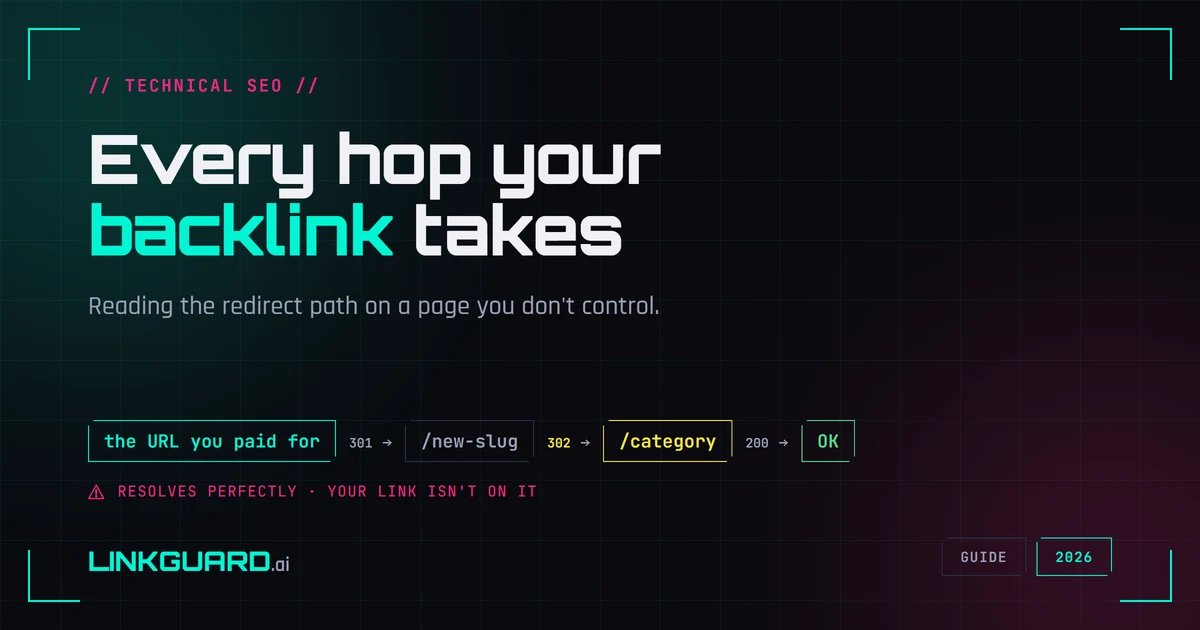
The page loads, your anchor is there, everything looks fine - and that check tells you less than it feels like it does. A bought link can arrive through hops someone else added after your money cleared. How to read the hop path on a link you don't control, and where a plain HTTP trace runs out of road.