LinkGuard Blog

Insights, Tutorials & Best Practices

Expert knowledge for SEO professionals. Learn how to build, monitor, and protect your backlink profile with our comprehensive guides.

Technical SEO

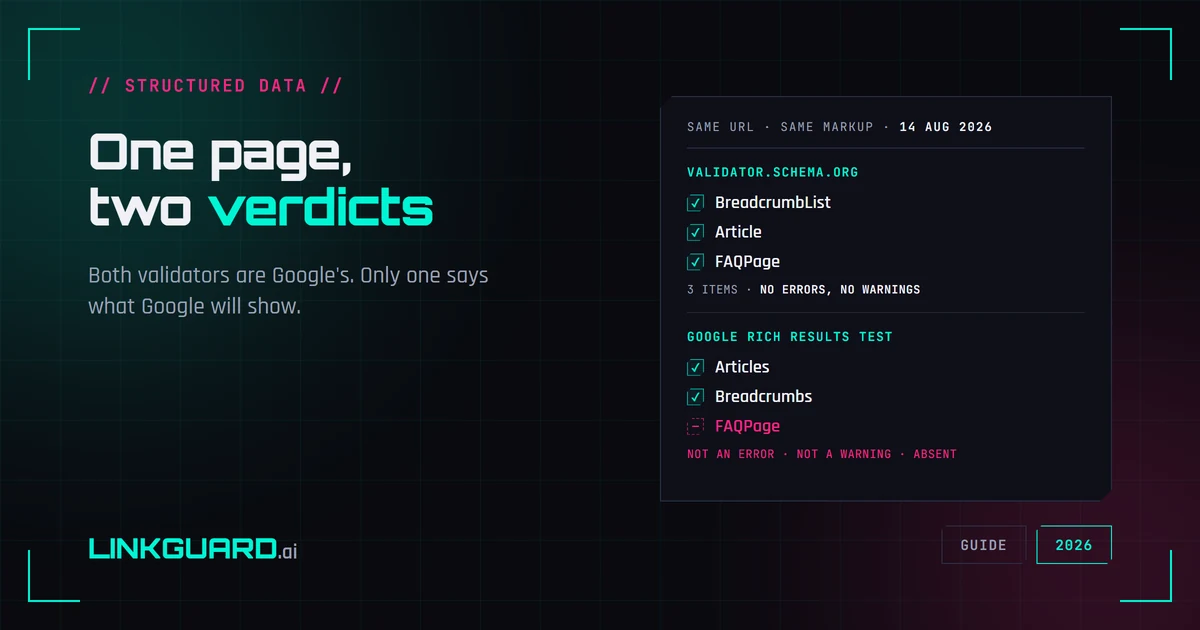
Two validator verdicts for one page side by side - schema.org reporting three items with no errors, Google's Rich Results Test reporting two valid items with FAQPage absent
Technical SEO

Two schema validators, two verdicts: which one decides your rich result

The same page passes schema.org's validator with three items and no warnings, and Google's Rich Results Test with two. Nothing errored. One item is simply absent. Both tools are Google's, both are right, and only one of them is telling you what Google will actually show. Run on our own page, on 14 August 2026.

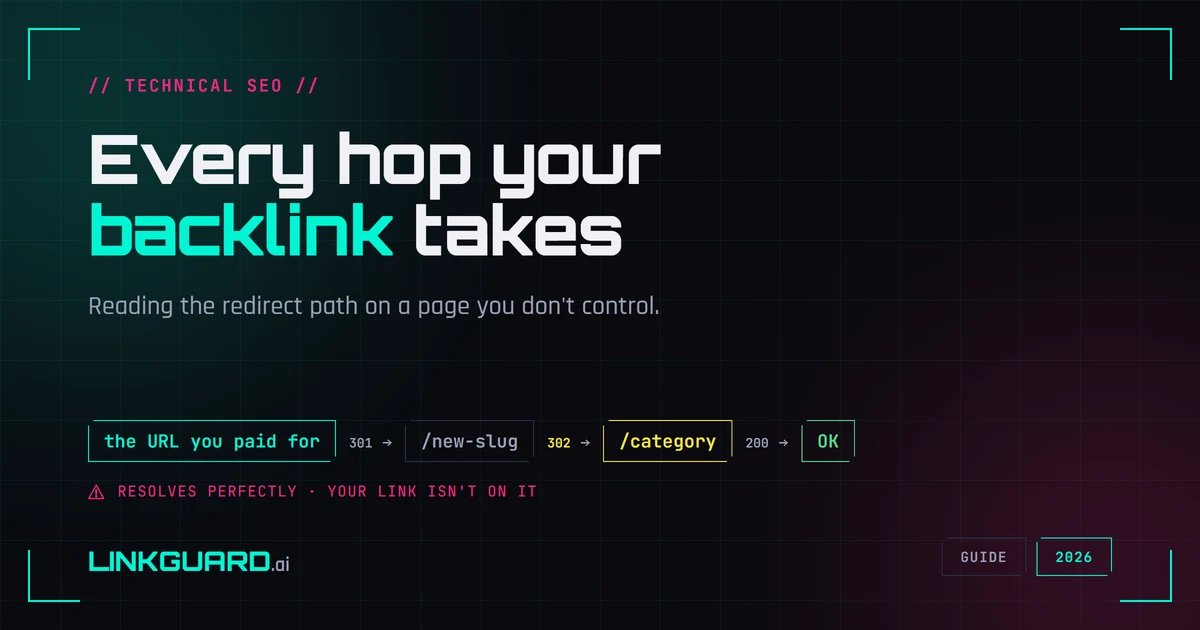
A redirect hop path from a paid URL through a 301 and a temporary 302 to a page returning 200, flagged as resolving perfectly while no longer containing your link
Technical SEO

How to trace a redirect chain on a link you don't control

The page loads, your anchor is there, everything looks fine - and that check tells you less than it feels like it does. A bought link can arrive through hops someone else added after your money cleared. How to read the hop path on a link you don't control, and where a plain HTTP trace runs out of road.

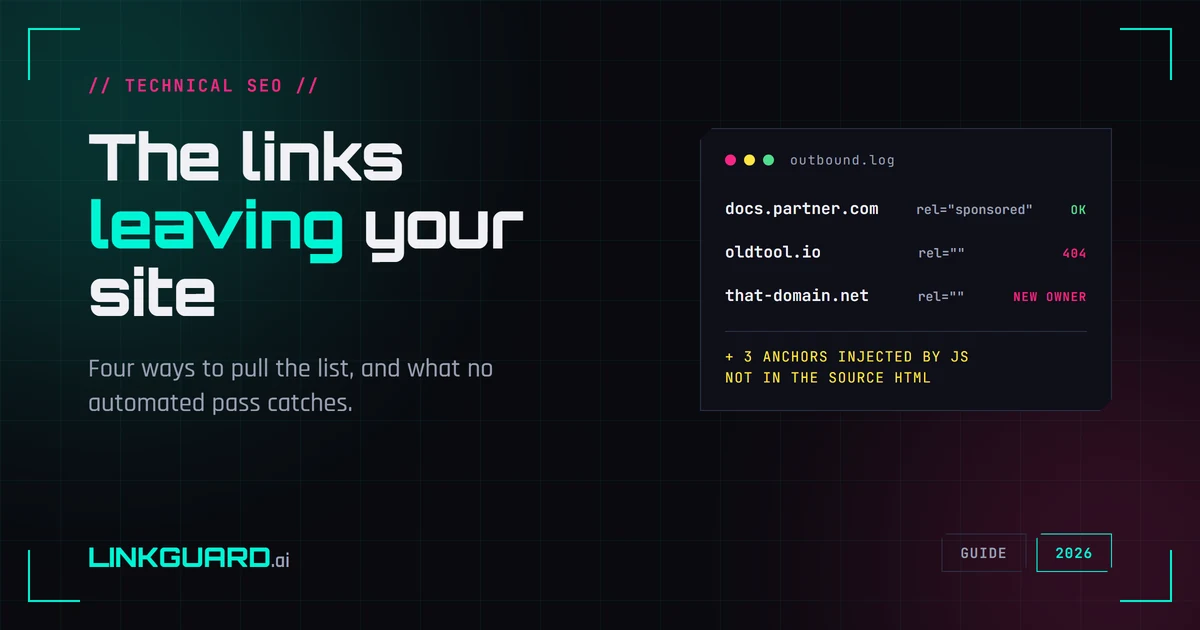
An outbound link log listing three external links with their rel values and verdicts - sponsored and fine, a 404, a domain under new ownership - plus three anchors injected by JavaScript
Technical SEO

How to find the outbound links on your own pages

Almost nobody audits the links leaving their own site, so the list quietly grows: an old resource roundup, a plugin's footer credit, an embedded feed. Then a domain changes hands and your page is recommending something you have never seen. Four ways to pull the list, and what no automated pass catches.

A folder of linked Markdown files labelled OKF pointing inward to a company's own AI agent while web crawlers pass by outside, showing OKF is an internal knowledge format, not an AI-search signal
Technical SEO

What is Google's Open Knowledge Format (OKF) — and does it do anything for SEO?

Google shipped the Open Knowledge Format in June 2026 and the AEO crowd immediately called it the next way to get cited by AI. Here's what OKF actually is, who Google really built it for, and the part the hype skips: nothing on the public web reads these files yet. An honest, date-stamped guide from a team that builds AI-readable files for a living.

A robots.txt gate allowing AI search and retrieval bots through while blocking the model-training crawlers, illustrating the training-versus-answers tradeoff
Technical SEO

Should you block GPTBot, ClaudeBot and Google-Extended?

There's a robots.txt snippet doing the rounds that 'blocks all AI.' Paste it without understanding it and you can quietly delete yourself from the AI answers you actually wanted to be in. Here's what each AI crawler really does — training vs retrieval vs search — and the honest tradeoff, with copy-paste directives that are correct as of June 2026.

An llms.txt file at a website root being walked past by AI crawler bots, illustrating that the file is rarely requested
Technical SEO

What is llms.txt — and does your site actually need one?

llms.txt is a tidy little file that's supposed to help AI tools read your site. Here's what it actually is, what the spec says, and the uncomfortable part the hype skips: as of mid-2026, the data shows almost nobody's AI is reading it. An honest guide from a team that built a generator for it.

LinkGuard cover — Why backlink monitors report false "link lost" alerts
Technical SEO

Why backlink monitors report false "link lost" alerts

Your monitor says a link is gone, you open the page, and it's sitting right there. That's a false positive, and on modern JavaScript-rendered sites it's common. Here's why backlink monitors cry "lost" when the link is fine, how to tell a real removal from a phantom one, and how to stop chasing ghosts.