About a week after Google published something called the Open Knowledge Format, my feed had already made up its mind: this was the next big lever for getting cited by AI, and if you didn't ship one this quarter you'd be left behind. The posts had that familiar shape — the breathless certainty, the "here's how to win AI search with OKF" headline, the complete absence of anyone showing it actually did anything. I'd seen this movie before. We all watched it with llms.txt last year. And I get the pull underneath it: the quiet worry that you're behind, that you'll have to explain to someone why you sat this one out.
So let me save you the doom-scroll. I'm not a neutral party here: we built a free llms.txt generator and we sell a backlink monitor, so I make my living partly on AI-readable files and the links that feed search. That's exactly why I went and read the actual spec instead of the hot takes. Here's what OKF really is, who Google actually built it for, whether publishing one does a thing for your SEO, and an honest rule for whether you should bother. Date-stamped on purpose: this is the state of it in late June 2026, roughly ten days after launch, and it's moving fast.
What is the Open Knowledge Format?
The Open Knowledge Format (OKF) is an open specification, published by Google Cloud's Data Cloud team on June 12, 2026, for writing down knowledge in a way both people and AI models can read. In Google's words, it "formalizes the LLM-wiki pattern into a portable, interoperable format." In plain terms: it's a folder of Markdown files.
That's most of it. Each concept is a Markdown file with a little YAML frontmatter at the top, and concepts link to each other with ordinary Markdown links, so the folder becomes a graph of related ideas. There's no database, no API, no account. The spec is almost aggressive about how plain it is — "if you can cat a file, you can read OKF; if you can git clone a repo, you can ship it." Google's own post puts it the same way: "no new runtime, no required SDK," and it "will never require a proprietary account or SDK to read, write, or serve."
The format asks for exactly one thing from every concept: a type field in that frontmatter, saying what kind of thing the file describes. Everything else — a title, a description, tags, a timestamp — is recommended but optional. Leave the title out and a reader is allowed to fall back to the filename. One more detail worth holding onto: this is version 0.1, marked "Draft." The spec is ten days old as I write this, and the repository notes plainly that it's "not an official Google product." Keep that in your pocket; it matters for everything below.
Hold on — is OKF even meant for the public web?
This is the part the SEO takes skip, and it's the whole ballgame: Google didn't build OKF for your marketing site. It built it for the knowledge that lives inside a company. Read the launch post and the examples are all internal — "the schema of a table, your business' meaning of a metric, the runbook for an incident, the join paths between two systems." The problem OKF sets out to solve is that a company's own AI agents can't reason about its own data because the context is scattered across wikis, dashboards, and people's heads. OKF is a tidy, portable way to hand that internal context to your internal models.
Which means the thing half my feed is excited about — publishing an OKF bundle at yoursite.com/okf/ so the AI search engines pick you up — isn't what Google described at all. It's a clever repurposing by the SEO community. Suganthan Mohanadasan, one of the first people to actually build a public bundle, says it straight: "Pointing it at a website is a repurposing. A good one, but a repurposing," and "Google built it for data teams sharing tables and metrics, not for blogs."
The cleanest framing I've seen comes from NexterWP: llms.txt points outward, at the public web and the crawlers that visit it; OKF points inward, at knowledge that lives inside an organization. "llms.txt is a signpost, and OKF is the library." That single distinction dissolves most of the confusion — and most of the hype.
Does publishing an OKF bundle get you cited by AI?
No. Not today, and there's no evidence it's coming soon. Three reasons, weakest to strongest.
First: nothing reads them yet. No answer engine — ChatGPT, Perplexity, Gemini, Google's own AI Overviews — has announced that it crawls, ingests, or cites public OKF bundles. The practitioners building them say so without hedging. Mohanadasan again: "Nothing reads OKF yet." Nothing is listening on the other end. You can publish a perfect bundle and, as of this writing, not one machine will come looking for it.
Second: it isn't a ranking signal. This is the more durable point, because it's about how Google works, not about a feature that might ship next month. As one analysis put it flatly, OKF "is not a direct ranking or visibility signal," and "is not a factor Google's ranking systems pull from your website" (seo-kreativ.de). Another analysis is blunter still: OKF isn't a Google Search feature or a ranking factor, so adding the files won't lift your rankings (NexterWP). It was never designed to be one.
Third, and deepest: you're grading your own homework. An OKF bundle on your own domain is, by definition, a thing you wrote about yourself. A model has the same reason to be skeptical of it that it has for any self-description. Google's John Mueller made this point about llms.txt on the Search Off the Record podcast in June 2026: a self-reported file is, in his words, "basically you're telling these systems, like, I have the best website ever" (via Search Engine Journal). He was talking about a different file, but the logic transfers cleanly: a format that lets you assert facts about yourself, with nothing to verify them, isn't something an engine can lean on to decide who to trust. The trust has to come from somewhere the model can corroborate.
If this all sounds familiar, it should. We just lived through it with llms.txt, and the data there is sobering: Ahrefs studied 137,210 domains in May 2026 and found that of the roughly 38,000 with a valid llms.txt file, 97% got zero requests for it all month (Linehan & Guan, June 2026). The bots were crawling those sites heavily and walking straight past the courtesy file sitting at the root. There's no reason yet to expect OKF bundles to fare differently. I dug into why in what llms.txt is and whether your site needs one; the short version is that machine-readable courtesy files have a habit of going unread.
OKF vs llms.txt vs robots.txt and sitemap.xml
OKF keeps getting confused with the files it sits beside. Here's how they actually differ, and which ones are honored at all. The quick mental model: robots.txt gates, sitemap.xml enumerates, llms.txt curates for outside crawlers, and OKF structures knowledge for your own agents. Only the first two are used by the major engines today.
robots.txt is access control — it tells crawlers which paths they may touch, and the well-behaved ones obey. (Whether to use it against AI crawlers is a real decision; we walk through it in should you block GPTBot, ClaudeBot and Google-Extended.) sitemap.xml is discovery — a full inventory of your URLs so engines can find and index everything. Both are supported standards in daily use. llms.txt is a curated reading hint for language models, and as we just covered, mostly nobody's reading it. OKF is the odd one out entirely: it isn't really a web-signaling file at all. It's a way to package a body of knowledge as a linked graph, designed first for consumption inside an organization. Publishing it on the open web is something we're doing to it, not what it's for.
So why is half my feed posting about it?
Partly because it's interesting, and partly because "new Google spec" plus "AI" is irresistible content fuel. The honest thing to notice is that Google itself isn't making the big claims. The launch post is modest: it formalizes an existing pattern, it's a v0.1 draft, and the repo disclaims being an official product. The overreach is all downstream — the AEO corner of the internet repackaging an internal-knowledge spec as a citation lever, because there's an audience that wants one more thing to optimize. When you see "get cited by AI with OKF," read it as someone selling certainty about a ten-day-old draft.
One thing that is new, and worth not confusing with OKF: on June 17, 2026, Google and partners (under a Linux Foundation working group, the AI Catalog Working Group) published a separate spec called Agentic Resource Discovery (ARD). It's about how AI agents discover what services and capabilities a site offers, via a file at a well-known path, a different job from OKF's "how to write down a body of knowledge." They're cousins, not the same thing, and they're already getting blurred together. If someone tells you OKF and ARD are one initiative, they haven't read either.
So should you make one? An honest decision rule
Here's how I'd actually decide, kept proportionate to a draft spec that nothing reads yet.
Make one if you have AI agents working over your own data and docs — internal assistants, a support bot, anything that needs your table definitions, product facts, and runbooks in one consistent place. That's the real use case, the one Google built it for, and it can pay off now regardless of what the search engines ever do. It's also reasonable to publish a small public bundle as a cheap bet on the future: if generating it is nearly free, you lose little by being early, the way some people kept a tidy llms.txt around just in case.
Don't prioritize it if you're a marketing site or a blog hoping for an AI-traffic bump. There's no evidence it delivers one, it isn't a ranking signal, and nothing is fetching these files. The real cost isn't the hour you spend on it; it's the AI visibility you don't earn while polishing a file nobody reads. The honest practitioners agree — a bundle "will not move your rankings or your AI visibility this week," as Mohanadasan puts it. If AI visibility is the goal, your hours go to the things that actually move it: clear, quotable content, and brand mentions on sites a model already trusts. I laid out what genuinely earns a citation in how to get cited by ChatGPT, Perplexity and AI Overviews.
The one thing I'd warn against is the llms.txt mistake all over again: shipping a file and telling your boss the AI problem is handled. It isn't. A bundle nobody reads is a checkbox, not a result.
We published one anyway — here's why
With all that said, we built and published our own OKF bundle, and you can read it at linkguard.ai/okf/. I want to be clear about what that is and isn't, because the whole point of this article is not overclaiming. It is an experiment and a small bet, not a traffic strategy. I'm not expecting it to get us cited anywhere, and if it does, I'll be surprised — and I'll say so.
So why bother? Three honest reasons. It's nearly free to maintain, so being early costs us almost nothing. I didn't want to write a guide about a format without building one, because you learn the rough edges by doing it, not by reading about it. One such edge: the spec makes every field but type optional, so you can ship a technically valid bundle that's nearly useless to read. A fair sign of how raw v0.1 still is. And it's a clean way to keep our own facts — what LinkGuard is, what it does and doesn't do, what each free tool is for — in one machine-readable place, which is useful internally whether or not the open web ever comes calling. That's the actual spirit of the spec, used for what it's good at.
Questions people ask
Is OKF a Google ranking factor?
No. Google has not described OKF as a ranking signal, and SEO analyses of it agree it "is not a direct ranking or visibility signal" and that adding OKF files won't improve your Google rankings. It was designed to package internal knowledge for AI agents, not to influence search. Publishing one won't help or hurt your rankings — it's simply not part of that system.
What is the difference between OKF and llms.txt?
They point in opposite directions. llms.txt is a file at your site root that curates your best pages for external AI crawlers — it faces outward, at the public web. OKF is a folder of linked Markdown files that packages a body of knowledge as a graph, built first for an organization's own AI agents — it faces inward. As one analyst put it, llms.txt is a signpost and OKF is the library. And as of mid-2026, neither is reliably read by the major answer engines.
Will publishing an OKF bundle get my brand cited by ChatGPT or Perplexity?
There's no evidence it will. No major answer engine has announced that it crawls or cites public OKF bundles, and the practitioners building them say plainly that nothing reads them yet. OKF is also a v0.1 draft with near-zero adoption outside Google. If getting cited by AI is your goal, clear quotable content and brand mentions are what move it. An OKF file is not a citation lever today.
Is OKF an official Google standard?
Not in the way that word implies. OKF was published by Google Cloud's Data Cloud team as an open v0.1 draft specification, and the repository states outright that it's "not an official Google product." It's better understood as a serious proposal with one big backer and very little outside adoption so far — an invitation, not a settled standard. Treat it as early and unproven.
What does an OKF file actually require?
Exactly one field: a type in the YAML frontmatter of each Markdown concept, saying what kind of thing the file describes. Everything else — title, description, tags, a timestamp — is recommended but optional, and readers are expected to degrade gracefully when those are missing (falling back to the filename for a title, for instance). The format is deliberately minimal: plain Markdown files in a folder, linked to one another.
The honest takeaway
OKF is a thoughtful, genuinely useful idea aimed at a real problem — getting a company's scattered internal knowledge into a shape its own AI agents can use. That's worth taking seriously if you run those agents. What it is not, as of late June 2026, is a way to get your website cited by AI: nothing on the public web reads these bundles, it isn't a ranking signal, and it's a brand-new draft with almost no adoption outside Google. The confident posts have it backwards, treating an inward-facing format as an outward-facing growth lever.
If you want the deeper context behind all this, the two pieces I'd read next are what llms.txt is and whether you need one — the closest precedent, and a cautionary one — and what actually earns an AI citation, which is where your effort pays off. And if your real worry is whether the AI engines describe your brand correctly at all, that's a different and more useful question; I covered the free and paid ways to check in how to check if AI mentions your brand.
The unglamorous foundation under all of it is still the same: clear content the engines can read, in places they already trust, and the links that earn you that trust. If you want those links watched — alive, indexed, followed, not quietly edited out — that's the part we actually do. Start free with 1,000 tokens, no card, and add them to LinkGuard. We won't pretend a file nobody reads will get you cited. We'll just tell you the morning a link you earned stops doing its job.
About the Author

Related Articles

How to find backlinks in Google Analytics 4 (it only shows the clicked ones)
GA4 has no backlink report. It counts referral sessions - visits that arrived from a link somebody clicked - so a removed link and an unclicked link produce the same empty row. The current click-path, why the referring URL arrives stripped to a domain, and the six blind spots.

How to check a backlink in Google search (we ran all four ways)
link:linkguard.ai returns 73 million results and not one backlink. What the retired operator, a quoted search, the page's own HTML and Search Console each actually prove.
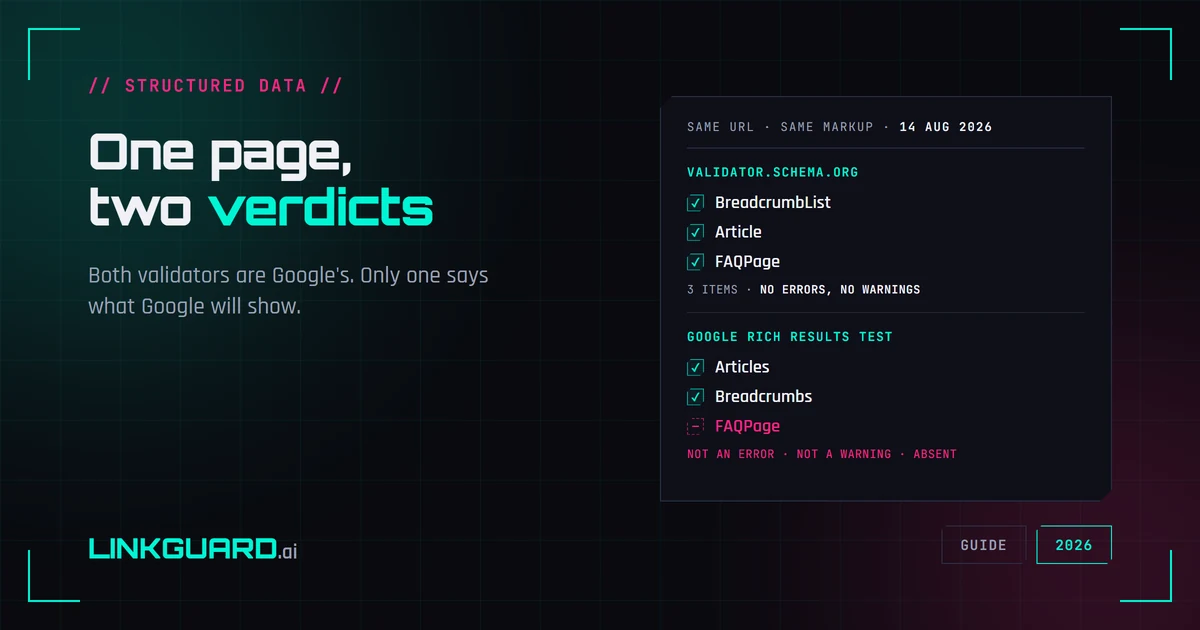
Two schema validators, two verdicts: which one decides your rich result
The same page passes schema.org's validator with three items and no warnings, and Google's Rich Results Test with two. Nothing errored. One item is simply absent. Both tools are Google's, both are right, and only one of them is telling you what Google will actually show. Run on our own page, on 14 August 2026.