You read the guide, did the work (answer-first content, brand mentions, clean structure), and now the obvious question lands: is any of it working? When someone asks ChatGPT for "the best backlink monitor," are you in the answer or not? So you go looking for a way to measure it, and within about thirty seconds you've found six dashboards promising an "AI Visibility Score" for $99 a month — each one quoting a different number for the same brand. Welcome to the least-settled corner of SEO.
Two things up front. First, this isn't something LinkGuard does. We monitor backlinks, not AI mentions, and I'll be clear at the end about where that line sits — but I'm writing this anyway, because the last guide in this set was about getting cited by AI search, and a how-to-get-cited piece that never tells you how to check whether it worked is half a guide. Second: you can measure this, just not the way the dashboards imply. Here's the real version: what's genuinely free, what the paid tools are selling, and the one caveat that makes every "score" softer than the number suggests. Everything below is current as of June 2026; this corner moves fast.
Can you actually measure AI visibility?
Yes, but not precisely — and that's not a gap you can buy your way out of. AI answers are non-deterministic by design: ask ChatGPT the same question three times and you can get three different brand lists citing three different sources. SparkToro found brand-list repeatability under 1% across identical repeated prompts. So there's no stable, single number to read. There's only a direction, estimated across many runs.
This matters because the whole category is sold as if it were a thermometer. It's closer to polling: ask the same question repeatedly and the brand it names can shift run to run. As one analysis of the problem put it, "A score of 72 out of 100 looks precise. If that score has a 95% confidence interval of 58 to 86, the precision is illusory" (Authority Tech, 2026). Personalization, phrasing, your location, and the model's last update all move the answer. None of that is a bug a vendor can patch. It's how the systems work.
So the right mental model isn't "what's my score this week." It's "over the last three months, am I showing up more often than I was, across enough checks that the noise cancels out." Direction, not readout. Keep that in your head for everything below.
The free ways to start (no budget required)
Before you pay for anything, three free signals will tell you most of what a beginner needs to know. They measure different things, and none is complete on its own, which is the whole point.
Google Search Console, as of this month. This genuinely changed on 3 June 2026: Google added a dedicated generative-AI view to GSC, the first time AI-feature visibility is broken out at all (PPC Land, June 2026). Useful, with real limits you need to know going in: it shows impressions for AI Overviews and AI Mode combined — no clicks, no CTR, no query-level data, and no way to separate AI Overviews from AI Mode. It's also rolling out to a subset of properties first, so it may not be in your account yet. Treat it as "am I appearing in Google's AI features at all, and is that trending up," not as a precise citation count. Still, it's free and it's first-party, which beats every paid estimate on trust.
Referral traffic, with a big asterisk. When someone clicks through to you from an AI answer, it can show up in your analytics as a referral from chatgpt.com, perplexity.ai, gemini.google.com, or claude.ai, and GA4 now auto-classifies recognized AI assistants as their own channel. The asterisk is large, though: some AI in-app browsers, ChatGPT's Atlas among them, strip the referrer, so an unpredictable chunk of those visits land in "Direct" with no source attached (MarTech, 2025). And here's the part people miss: referral traffic measures clicks earned, not mentions made. In a zero-click world you can be named by the AI and get no visit at all. So this undercounts twice over. It's a signal, not a scoreboard.
Just ask the engines — and a couple of free snapshots. The most direct method costs nothing but time: write down the ten or so queries a real buyer would type, run them through ChatGPT, Perplexity, and Google's AI Mode, and log whether you're named, where, and whether you're linked. Do it every quarter, not every morning — remember the <1% repeatability, so one run is noise. Want a faster snapshot? HubSpot's free AI Search Grader and Semrush's free AI Search Visibility Checker both give you a one-time read of how the major engines describe your brand, no payment required. They're snapshots, not monitors, but for a sanity check they're plenty.
Are the paid AI-visibility tools worth it?
For most people, not yet. For agencies and enterprises tracking many brands at scale, maybe — as long as you read the output as a range, not a verdict. The category is real and well-funded (Profound, one of the bigger players, raised a reported $96M in early 2026), so this isn't vaporware. It's just young, and the better vendors admit as much.
The notable trackers as of mid-2026: Profound and Ahrefs' Brand Radar at the enterprise end, Semrush's AI visibility toolkit (bolted onto its suite), and smaller, cheaper entrants like Otterly.AI and the EU-based Peec AI. I'm deliberately not quoting hard prices — they start anywhere from roughly $25 a month for the small tools to four figures for enterprise, the "prompt" units differ between them, and the whole category reprices constantly. Check the current number yourself before you commit; any figure I print today is stale by autumn.
Here's the part the sales pages skip. Because the underlying answers are non-deterministic, different tools report different scores for the same brand, and there's no agreed, standard way to calculate an "AI Visibility Score," so the term means something different in every product. The credible takeaway from people who study this: a tool that runs a query once and hands you a clean number is selling you noise dressed as signal, while a useful one samples the same prompts many times to average the variance out. The point of paying, then, isn't precision you can't get anyway. It's automation and history: running prompts on a schedule so you can watch the trend without doing it by hand.
So what should you actually do?
Depends entirely on your size, and I'd rather tell you to spend nothing than sell you a habit you don't need.
If you're a solo founder or a small team: skip the subscriptions. Run a free snapshot (HubSpot or Semrush) once a quarter, glance at your new GSC generative-AI view if you have it, keep half an eye on AI referrals in analytics, and do a manual ten-query check every few months. That's enough to know whether you're trending the right way, and it costs you an hour a quarter. If you're an agency or a larger brand tracking many names across many markets, a paid tracker earns its keep — not for the score on the dashboard, but for running the volume of prompts that makes the trend readable, and for the client-facing history. Just brief the client that the number is a range, before they treat it as gospel.
Either way, the move is the same: watch the trend over quarters, sample widely, and don't let a single confident-looking number talk you into a strategy change. The measurement is fuzzy. Pretending otherwise is the one mistake that turns this from useful into theater.
Where this leaves your backlinks (and us)
I promised I'd be straight about where LinkGuard fits, so here it is: not here. We don't track AI mentions or sell a visibility score, and I'm not going to pretend a backlink monitor secretly does that job. If AI-mention tracking is what you need, the tools above are where to look, not us.
What does connect is the layer underneath. AI engines mostly cite what classic search already surfaces — and classic search still runs partly on links and the authority they carry, as that same Ahrefs research showed even while it found brand mentions correlating more strongly with AI Overview visibility. So the backlinks you've earned are part of the foundation the whole AI-citation game is played on. Watching that — making sure the links you fought for stay live, indexed, and followed instead of quietly dying — is the boring, measurable thing we actually do. It won't tell you if ChatGPT loves you. It'll tell you the foundation isn't crumbling while you're busy measuring the weather upstairs.
Questions people ask
Can I see if ChatGPT cited my website?
There's no first-party dashboard from OpenAI that says "you were cited." The closest free signal is referral traffic from chatgpt.com in your analytics — but that only captures clicks, not mentions (you can be cited with zero clicks in a zero-click answer), and AI in-app browsers often strip the referrer so those visits hide in "Direct." The more direct method is simply to ask ChatGPT the queries your buyers use and see whether you're named, repeated across several runs because a single answer isn't repeatable.
Does Google Search Console show AI Overview traffic?
As of 3 June 2026, yes — partly. Google added a dedicated generative-AI view to GSC showing impressions for AI Overviews and AI Mode, but combined into one figure, with no clicks, no CTR, and no query-level breakdown, and it's rolling out to a subset of sites first. So you can see whether you're appearing in Google's AI features and whether that's trending up — but not how many clicks they sent or which queries triggered them. It's a real improvement on the previous situation, where AI traffic was silently folded into the main report with no way to isolate it.
Are paid AI-visibility tools worth the money?
For agencies and enterprises tracking many brands, often yes — for the automation and trend history, not for precision the underlying data can't provide. For solo founders and small teams, usually not: free snapshots plus a quarterly manual check cover the same ground. Whatever you use, treat the "visibility score" as a noisy range — the same query can swing from a 20% to an 80% mention rate, and no two tools calculate the score the same way.
Why does ChatGPT give me a different answer every time I ask?
Because large language models are non-deterministic — even at the same settings, the same prompt can produce different output, and personalization, phrasing, and model updates add more variance. SparkToro measured brand-list repeatability at under 1% across identical repeated prompts. That's why a single check tells you almost nothing, and why any honest measurement of AI visibility relies on many runs over time rather than one reading.
What's the best free way to check my AI visibility?
Combine three free things: the new generative-AI view in Google Search Console (if your property has it yet), AI-referral traffic in GA4, and a manual prompt test — run ten buyer-style queries through ChatGPT, Perplexity, and Google AI Mode and log whether you're named. For a quick one-off snapshot, HubSpot's free AI Search Grader and Semrush's free AI Search Visibility Checker both work without payment. None of these is a continuous monitor, but together they tell a small site everything it needs.
The honest takeaway
You can measure whether AI search mentions your brand, but you can't measure it cleanly, and the tools that imply otherwise are selling false precision. Start free: the new GSC generative-AI view, your AI-referral traffic, a quarterly manual prompt test, and a free snapshot grader will tell a small business everything it reasonably needs to track AI visibility over time. Pay for a tracker only when scale makes the manual version impractical, and even then, read the score as a range and the trend over quarters as the real signal.
This was the measurement companion to getting cited by AI search. If you're earlier in the journey, the cluster also covers whether an llms.txt is worth adding and which AI crawlers to let in.
And the foundation under all of it is still the backlinks that feed what AI retrieves. Keeping those alive, indexed, and followed instead of quietly lost is the boring, measurable job LinkGuard actually does: start free with 1,000 tokens, no card. We won't grade your AI visibility. We'll keep the floor it stands on from rotting.
About the Author

Related Articles

Link juice and link equity: what actually passes through a link
Google's documentation says PageRank is still part of its core ranking systems. The arithmetic everyone teaches for it was last restated by a Google employee in 2009, inside his own disclaimer. Both of those are on the record.
A ranking dropped: what to rule out, in order
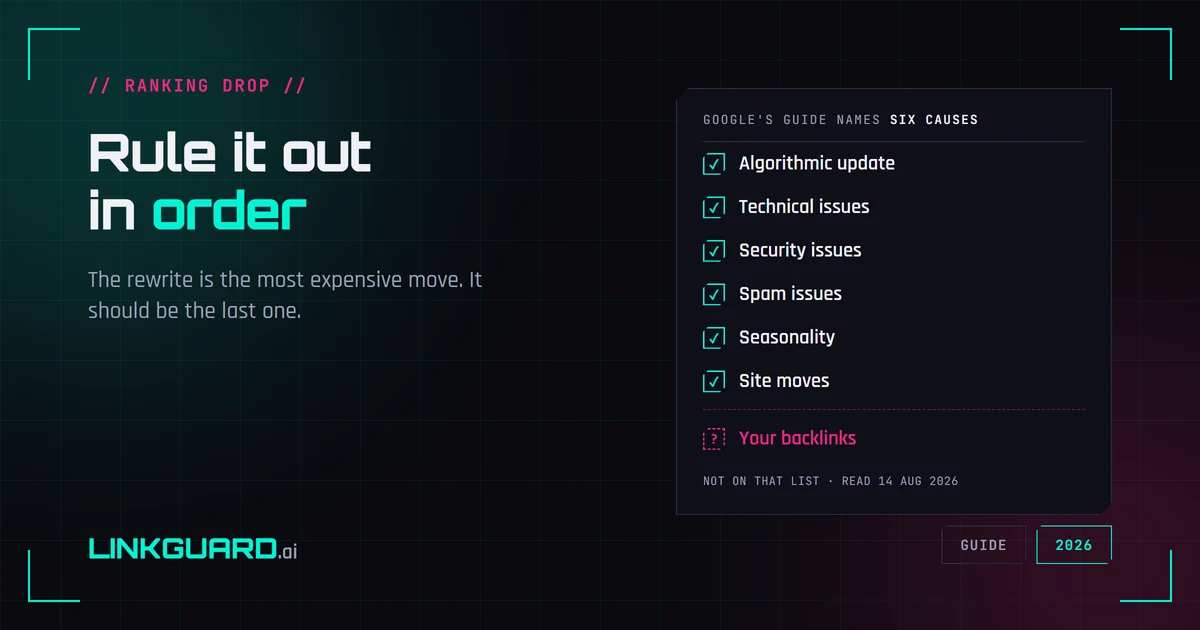
Google publishes a debugging guide for Search traffic drops. It names six causes, and backlinks aren't among them — the word doesn't appear on the page. That's not an oversight, it's a boundary: the guide covers Google's side of the glass. Here's the full elimination order, from measurement artifacts to the box almost nobody opens, with the rewrite saved for last.
Why your SERP position is three different numbers
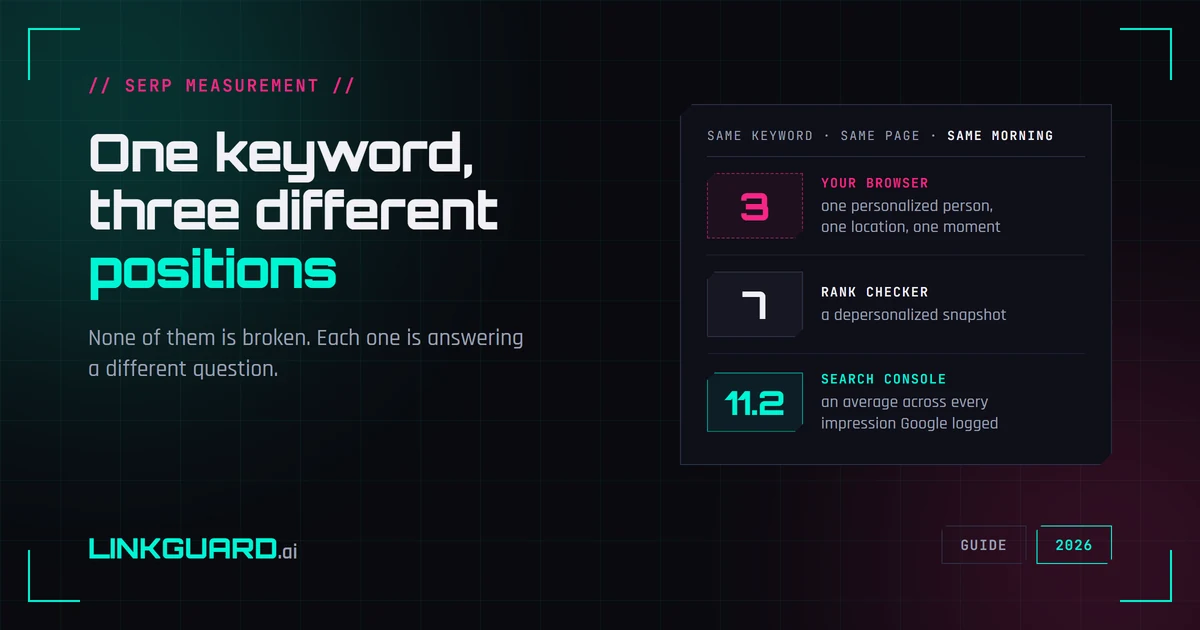
Your browser puts you third. Your rank tracker says seven. Search Console says 11.2. Same keyword, same page, same morning — and none of the three is broken. They answer different questions, and Google documents most of the difference itself. What each number measures, two things I checked live this week that contradict the standard advice, and the one figure worth putting in a client report.