Say the last three weeks went like this. Forty pitches into journalist queries, two replies, one placement: a real outlet, your name spelled right, a link pointing at your pricing page. It went into the client report as a win, because it was one.
Open that article now. The quote is still there. Read the sentence with your brand in it: same words, no link. Or the link is there and it carries rel="nofollow", which it may well have carried from the first minute.
Nobody warned you either way, and nobody owes you anything. That's earned coverage. No invoice, no contract, no way to make anyone do anything, and for most people no second look after publication day.
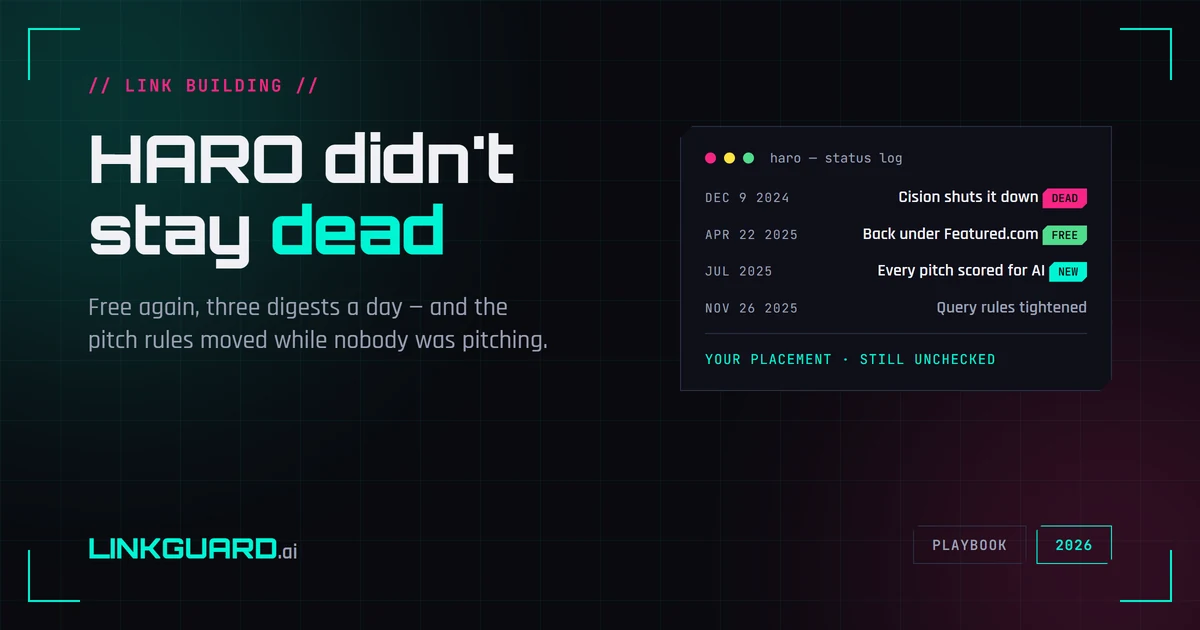
The tactic itself has moved on since. HARO was shut down in December 2024, came back under a different owner four months later, and picked up rules on the way through, one of which turns an AI-written pitch into a scored liability. What follows: what exists in 2026 and what it costs, what a placement gets you, and the four things worth checking once the coverage is live. We sell backlink monitoring, so that last section is where we have a stake. It's marked.
What happened to HARO
HARO, short for Help a Reporter Out, is running, it's free, and Cision doesn't own it anymore. Cision discontinued the platform, by then renamed Connectively, on December 9, 2024, to concentrate on CisionOne. For four months the service most link builders had in their morning inbox since 2008 wasn't there.
Featured.com then bought the HARO brand from Cision, announced April 16, 2025, and restarted the emails on April 22. The shape is the old one: free for journalists, free for sources, three digests a day, funded by newsletter sponsors instead of subscriptions. Featured's CEO Brett Farmiloe put the reasoning plainly in the release: "As AI floods the internet with generic content, journalists need credible, human sources more than ever."
Connectively is back as well, as HARO's platform sibling under the same owner: filtering, response tracking, opportunities in a dashboard rather than an inbox. Featured announced on May 26, 2026 that it's moving its own media opportunities, profiles and subscriptions into it. Two brands, one owner, and the free email is still the front door.
HARO alternatives: where journalists ask for sources in 2026
Two newsletters and two platforms carry most of the volume. Prices below were checked in August 2026; the paid tiers drift, so confirm before you budget anything around them.
| Service | What it is | Cost |
|---|---|---|
| HARO | The original newsletter, now run by Featured.com. Three email digests a day. | Free |
| Source of Sources | Built by Peter Shankman, who founded HARO in 2008 and sold it. Same idea, up to three emails a day, with queries screened by hand. | Free |
| Qwoted | Platform rather than newsletter, with a searchable expert database and a reporter dashboard. | Free tier: 2 pitches a month, released to the journalist on a 2-hour delay. Pro: $149/mo for 35 pitches and no delay. |
| Connectively | HARO's platform sibling, back under Featured. | Not stated in the relaunch announcement |
They overlap more than the marketing implies. The same journalist often posts the same request in two places, so if you subscribe to everything you'll spend your morning recognizing queries you already answered. Source of Sources says it reaches over 20,000 journalists; that's their number, not an audited one, and every platform in this category quotes something similar.
The delay on Qwoted's free tier is worth reading twice. Two hours behind the paying pitches, on requests that are frequently answered within one. It's not a limitation, it's the business model.
What changed after HARO came back?
Both matter if you're doing this for links rather than for coverage.
Since July 2025, HARO runs every response through Pangram, an AI-detection tool, and hands journalists two controls: a "No AI responses" checkbox when they post a query, and an AI-likelihood score beside every pitch in their dashboard. Detectors aren't oracles, and false positives cost someone who writes in clean, plain sentences. It doesn't change what you should do. A pitch a model wrote end to end can now be filtered out by a checkbox before a human reads a word of it.
The second is a floor under who may post queries at all. HARO's submission guidelines, published November 26, 2025, require an outlet to have Domain Authority 20 or 10,000 monthly visitors; a social, Medium or Substack account needs 5,000 followers. They also state that "no guest blogging, link exchanges, or backlink solicitation is allowed," enforced with a one-strike policy. Those rules govern the journalist side. Read them anyway, because they tell you what the service you're pitching into is policing: people who show up to trade links.
We build with models every day, so here's our line. Use one to pressure-test a draft. Does this answer the actual question? Is there a claim in here nobody else could make? Then write the sentences yourself. A model can explain your expertise; it can't have any.
What is a HARO link actually worth?
Less than the tactic's reputation, and in a shape you don't control.
You don't decide whether you get a live link or a name in bold. You don't choose the anchor text. And you don't set the rel attribute: the journalist does, or their CMS does, or a house rule written into the theme in 2019 does, and none of those three will discuss it with you.
Which makes "HARO link building" a slightly oversold phrase. It's digital PR that sometimes produces a link, and you're buying lottery tickets with time instead of money. Fine trade when your time is cheaper than your budget, bad one when it isn't.
Two things do land in your favor, though. A mention with no link still moves something: brand names sitting in editorial text are part of what language models read back when someone asks them for tools in your category. Worth checking whether AI assistants mention you at all, and worth understanding what gets a brand cited in the first place.
And the links you do get are clean. No disclosure question, no policy to break, no seller to vet. That's not the case on the paid side, where the honest version of the math is in should you buy backlinks and the mechanics of paying for a placement sit in niche edits and guest posting. The other unpaid route, broken link building, shares the virtue and fails differently.
What to check after the coverage goes live
Marking the stake: this is what we sell. LinkGuard runs these checks on a schedule, and they're the same checks whether you run them by hand on a Friday, script them, or pay someone. Take the list and ignore the product.
Start with a baseline the day it publishes, because everything after this is a comparison. Save the URL, the sentence your brand sits in, the anchor text, whether the link was follow or nofollow, and the date. Thirty seconds. Without it, every later conversation with an editor is your memory against their CMS.
What you're guarding against is never someone telling you no. It's the silent edit: a change to your placement that arrives with no message, no notification and no broken page. Four of them are worth watching, and most people watch only the first:
- Is the link still in the HTML? Not "does the page load", because the page will keep loading. Roundups get refreshed, editors trim, a new writer inherits the post and tightens it. Your quote can survive the edit that kills your link. And on a JS-rendered page the link may not be in the first response at all, which is why checking one properly means running a real browser against it.
- Is it still follow? A site-wide policy change can flip every external link on the domain overnight, and it looks identical on the page. Our nofollow checker answers that in one request, free.
- Then indexation. News and roundup pages drop out of the index more often than people expect, and a link on a page Google isn't holding does nothing for you. Run it through the index checker.
- And the one nobody thinks about: the article moves. Site redesign, category restructure, a switch to a dated URL scheme. If it 301s cleanly you're fine; if it lands on a category page or a soft 404 you've lost it without any of the above firing. A redirect check tells you which happened.
How often is a judgment call rather than a rule. A tier-one feature you'll be citing in pitches for two years is worth a monthly look; a mention on a DA-25 roundup probably isn't worth more than a glance each quarter.
When a spreadsheet is the honest answer
Under roughly 50 links, that is exactly what Search Console plus a spreadsheet is, and we'd say so rather than sell you a subscription. Earned coverage is also the weakest case for monitoring there is: nobody owes you the link, so there is no invoice to point at and knowing early buys you no leverage.
What it does buy is a message that still makes sense. Notice in week two that a link came out of a piece, and you're writing to an editor who remembers publishing it. Notice fourteen months later and it's a recovery job with bad odds, while the placement sits in a report you sent a client last spring. The good version is unspectacular: six months on, you open that report, point at the coverage, and know it's live, followed and indexed, because something checked it while you were working on something else.
We charge per check, not per month: 5 tokens for an HTML check, 7 for an indexation check, 12 for both. New accounts get 1,000 tokens free, no card, which is 200 HTML checks or 83 full ones. After that a full check costs about a cent at the $25 tier. Earned coverage arrives at unpredictable times in small numbers, which is the shape a monthly subscription bills you for regardless.
Questions people ask
Is HARO still free in 2026?
Yes. Featured.com relaunched it on April 22, 2025 as a free service for both journalists and sources, funded by sponsors inside the newsletter, and it has stayed free since. You get up to three email digests a day. Connectively, its platform sibling under the same owner, is a separate product and its pricing isn't stated in the relaunch announcement.
What replaced HARO after the shutdown?
For the four months between December 2024 and April 2025, mostly Qwoted and Source of Sources, the latter built by Peter Shankman, who started HARO in 2008. Both are still the best-known HARO alternatives now that HARO itself is back, and both are still worth subscribing to, because journalists spread their requests across all three. Nothing replaced HARO in the end: it came back, and the alternatives kept their audiences.
Do HARO links still work for SEO?
When you get one, it's an editorial link on a page a journalist chose to publish, which is the kind Google's guidelines are written to reward. The catch sits upstream of that. You don't control whether a link appears at all, what it points at, or whether it's marked nofollow. Treat it as digital PR that sometimes produces a link, budget it by the coverage, and check the link afterward rather than assuming it.
Can I use AI to write HARO pitches?
You can, and since July 2025 the journalist can see a score suggesting you did. HARO scores responses for AI authorship through Pangram and lets reporters exclude flagged pitches entirely when they post the query. The workable use is editing and pressure-testing your own answer; generating the whole thing gets filtered before anyone reads it.
How do I know if my HARO link was removed?
Not from the URL, which keeps returning 200 after the link comes out of the article. You need the page's current HTML compared against what was there on day one, which means saving a baseline when the piece goes live. Run that comparison on a schedule yourself, or have something run it for you. A status check will never see this.
The link is the by-product, not the deal
Answering journalist queries is worth doing in 2026. It's free, it's clean, and the platform is stable again under an owner with a reason to keep it alive. That already puts it ahead of the other tactic that outlived its own playbook: what's left of directory submission. What it isn't is a channel with predictable output. You send pitches, most vanish, and the ones that land pay you in a form somebody else chooses.
Which makes the after-check the part you control. Take your best placement from this year and look at it now: confirm the link is still follow, or confirm the page is still indexed. Both free, neither needs an account.
About the Author

Related Articles

Expired domain backlinks decay before the auction closes
Policy requires an expired .com to resolve to nothing for weeks before anyone can buy it. The links you're bidding on were counted before that, by a crawler that hasn't been back.

PBN backlinks don't fail one at a time
Google's spam documentation never uses the word. What a network link actually is in 2026, which footprints still identify one, and why four of them tend to go in the same week.
Directory submission in 2026: what a listing is actually worth
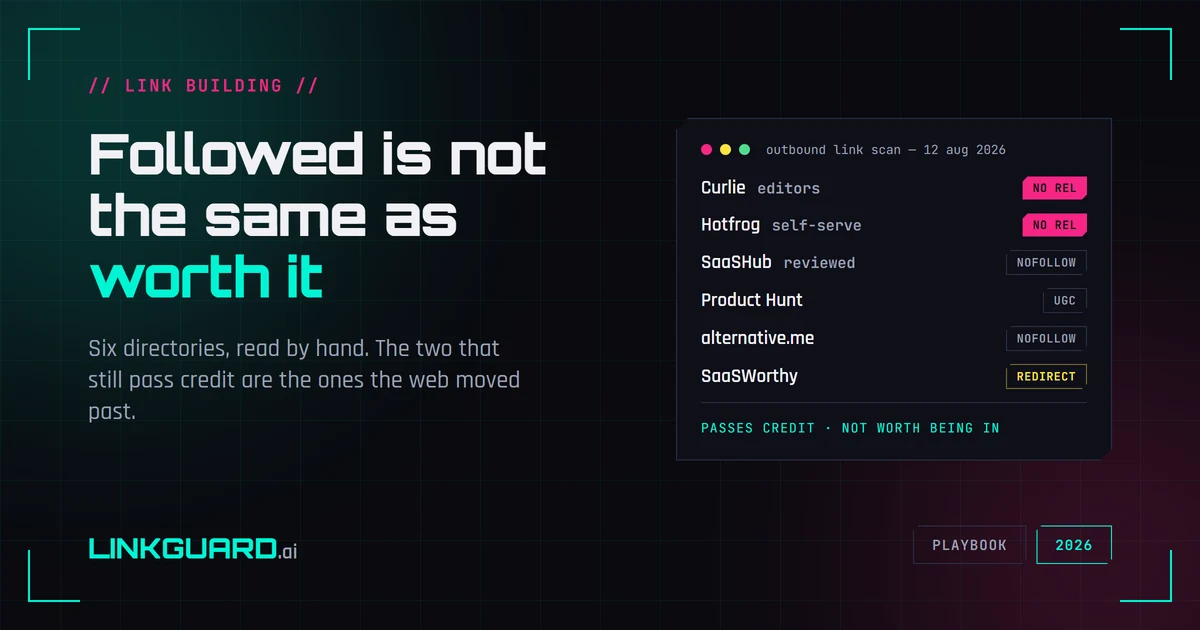
Google's spam policy names low-quality directory links as link spam. We opened six web directories and read the raw HTML: the two that still pass link credit are the general-directory survivors, while every vertical directory worth being listed in withholds it. What the tactic is still good for, and what to check once a listing is live.