Here is the pitch almost everyone sends: "Hi, I found a broken link on your page, and I happen to have an article on the same topic — mind swapping it in?" It goes to a list of two hundred sites scraped that morning. It gets a reply rate you could count on one hand. And then the person who sent it decides broken-link building "doesn't work."
It does work. I've landed links with it and I've watched it land links for other people. But it works for a narrower, more patient reason than the "free backlinks" headlines suggest, and the part that decides whether you get a yes happens long before you write the email. This is the version with the boring truth left in: what broken-link building actually is, the hit rate to expect, how to find dead links worth chasing, and how to pitch a replacement a real editor would say yes to.
What broken-link building actually is
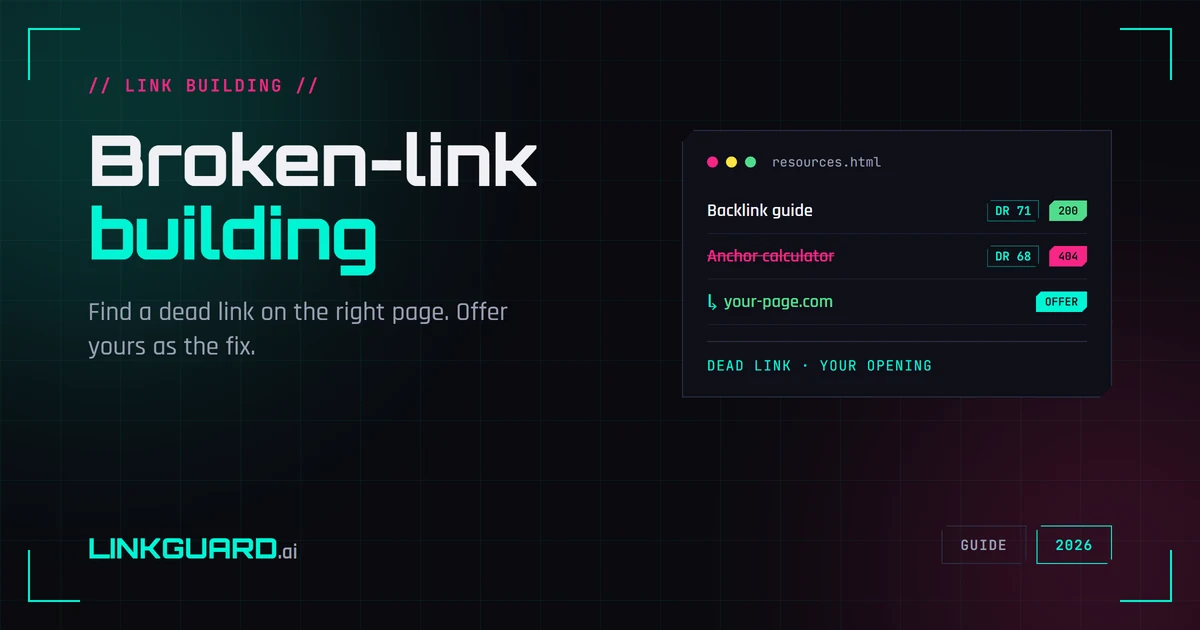
The mechanic is simple. Somewhere on the web, a page links out to a resource that has since died — the URL now 404s, the domain lapsed, the article got deleted. That dead link is a small, real problem for the page owner: it makes their page look unmaintained and sends their readers to a wall. Broken-link building is finding that dead link, having a genuinely equivalent page of your own, and emailing the owner to point out the broken link and offer yours as the fix.
The reason it's more durable than most outreach is that you're not asking for a favor out of nowhere. You're reporting a defect and handing over the patch. The webmaster gets a tidier page; you get a link. When the fit is real, that's an easy yes. When the fit is forced — your page is only loosely related, or clearly worse than what died — it's an easy no, and no amount of clever subject-line writing rescues it.
Why it works at all, and why it mostly doesn't
Time for the number nobody puts in the headline. Cold broken-link outreach, done well, converts in the low single digits. A 2–5% link rate on a tight, relevant list is a good day; a 1% rate on a loose one is normal. If a guide promises you 20%, they're either counting replies instead of links, or selling you something.
So the lever isn't a magic template. It's the inputs. Three things move the rate far more than wording:
- Relevance of the page you target. A dead link on a page that's squarely about your topic is worth ten on pages that merely mention it.
- How good your replacement actually is. If your page is plainly the best available substitute for what died, you barely have to sell it. If it isn't, you can't.
- Whether the page is maintained at all. A resource list someone updates earns you a fix; an abandoned page from 2014 earns you silence, because nobody's home to make the edit.
Get those right and the email is almost a formality. Get them wrong and the email is the thing you'll blame, incorrectly.
Step 1: find pages worth checking
You want pages that (a) are likely to contain outbound links that have aged out, and (b) are topically close enough that your replacement belongs there. The usual suspects: "resources" and "useful links" pages, link roundups, tool directories, curated reading lists, and long reference posts in your niche — the older the better, because links rot with time.
Find them the cheap way: search your topic plus the phrases these pages use — "useful links", "resources", "recommended reading", inurl:links, inurl:resources. You're not looking for the biggest sites; you're looking for pages that link out a lot and look at least occasionally tended. Save the URLs. The next step tells you which of them are actually carrying dead links.
Step 2: find the dead links
Now you check each candidate page for links that no longer resolve. Doing it by hand means opening every outbound link and watching for a 404 — fine for one page, miserable across fifty. This is the step our free broken link checker exists for: paste a page, and it requests every link on it and reports the HTTP status of each, with the dead 404s and 410s flagged. Filter to broken external links and you've got your shortlist: each row shows the dead URL, the anchor text it used (which tells you exactly what the page was trying to link to), and, for external links, the Ahrefs Domain Rating of the destination domain — so a dead link pointing at a high-authority site jumps out as the opportunity worth chasing.
Two honest cautions, because a false read wastes your time and the webmaster's. First, "broken" and "blocked" are not the same. A link that comes back 404 or 410 is genuinely gone. A link that comes back 401, 403, or 429 is blocked — the server refused an automated request, but the page may load perfectly in a browser. Never pitch a "dead" link you haven't opened yourself. Second, the checker reads up to 50 links per page and reads what a crawler sees, not a logged-in session, so treat it as the tool that narrows the field, not the final word. The outbound links analyzer is the companion when you want to see a page's whole external neighborhood, anchors and rel included — before you decide it's worth your time.
Step 3: qualify the dead link before you get excited
A confirmed 404 is necessary but not sufficient. Before it goes on your pitch list, ask three questions:
- Is it really gone, or just moved? Sometimes the "dead" resource lives at a new URL. If the original author simply relocated it, the right fix for the page is the new URL, not yours — and pitching yours over a living resource reads as opportunistic.
- Was it pointing at something you can actually replace? Read the anchor and the surrounding sentence. If the dead link was a free calculator and your page is a sales page, the fit isn't there. The replacement has to do the job the dead link was doing.
- Is the page maintained? Check when it was last updated, whether other links on it are fresh, whether the site still publishes. A dead link on a living page is an opportunity. A dead link on a corpse is a dead end.
Most of your raw list won't survive this filter, and that's the point. Twenty qualified targets beat two hundred unqualified ones, because the qualified twenty are where the yeses live.
Step 4: have the replacement ready (this is the real work)
Here's the inversion most people miss: broken-link building isn't an outreach tactic with a content step bolted on. It's a content tactic with an outreach step at the end. The link is only as good as the page you're offering, and the offer only works when your page is a clean substitute for what died — same intent, at least as useful, ideally better.
If the dead resource was a step-by-step guide, a thin blog post won't replace it. If it was a tool, an article about the tool isn't the same thing. Sometimes the honest answer is that you don't have the replacement yet, and the move is to build it first — which is slower, and also why the links you earn this way tend to stick: they sit in a context where they genuinely belong.
Step 5: write the pitch like a person doing someone a favor
Only now does the email matter, and it matters less than the four steps before it. Keep it short, specific, and free of flattery. Name the exact page and the exact dead link. Say what it was pointing to. Offer your page as the replacement in one line, and make it trivially easy to say yes — the page is right there, no hoops. Then stop.
What kills these emails: a generic "I was reading your amazing article" opener that proves you didn't read it, a pitch that buries the broken link under three paragraphs about you, and an ask for more than the swap. If you want help drafting the note without it sounding like a mail-merge, our outreach email generator writes a first draft from the specifics, and the wording in our backlink email templates — written for link recovery, but the calm, specific tone carries straight over — is a good model. One more detail worth checking before you celebrate a win: make sure the replacement link you get is a followed one, since a nofollow link won't pass the ranking value you did all this work for.
The part nobody mentions: the links you win this way die too
Sit with the irony for a second. The entire tactic depends on other people's links rotting. Yours are not exempt. The link you just earned on that resource page will, eventually, meet the same fate as the one it replaced — the page gets restructured, a new editor nofollows the outbound links, the site migrates and drops the section, or the whole page quietly 404s. You did real work to land it; it can vanish without a sound.
That's the gap we built LinkGuard to close. The same check you just ran on someone else's page to find an opportunity is the check worth running on your own links, forever, so a placement you earned doesn't quietly break or go nofollow months before you notice. Add the links you care about. It watches their status and their rel attribute on a schedule, and flags the day one breaks or stops passing value: the difference between catching it in a week and discovering it next quarter. It can't stop a webmaster from editing their page, and it only watches the links you add; what it does is make sure the link you fought for doesn't die in silence.
Questions people ask
What's a realistic success rate for broken-link building?
Low single digits on a tight, relevant list — roughly 2–5% of pitches turning into a placed link is a good outcome, and 1% on a looser list is normal. The biggest lever isn't the email; it's the relevance of the pages you target and how clearly your page replaces what died. If a source quotes you 15–20%, check whether they're counting replies or actual links, because those are very different numbers.
Does a broken link have to be a 404 to be useful?
A hard 404 or 410 is the cleanest case — the resource is genuinely gone, so the page owner has a real reason to fix it. A 401, 403, or 429 is not the same thing: the server refused an automated request, but the page may be perfectly alive in a browser, so always open it yourself before pitching. A 5xx server error is usually temporary and worth re-checking later rather than acting on. Treat "broken" as 404/410 you've confirmed by hand, not anything that merely looked off to a crawler.
Is broken-link building still worth it in 2026?
Yes, with realistic expectations. It's slower and lower-volume than its reputation, and it only pays off when you already have, or are willing to build, a genuinely good replacement page. What it has going for it is durability: links won on relevance, in a spot where they truly belong, tend to outlast links won by volume. It's a craft tactic, not a scale tactic — judge it on the quality of links earned, not the count of emails sent.
Should the replacement link be dofollow?
For ranking value, yes — that's the point of the exercise. A followed link passes credit; a nofollow, sponsored, or ugc link, by Google's own position, generally doesn't. It's worth checking the link you actually receive, because some sites nofollow all external links by policy regardless of context. If yours comes back nofollow, you've still earned a real referral and brand mention, just not the SEO value you were after. Our guide to dofollow vs nofollow covers what each attribute does.
How many pages do I need to check to land a link?
Work backward from the hit rate. If a well-qualified list converts at around 3%, landing five links means roughly 150 solid pitches, which means qualifying several hundred candidate pages, which means running a lot more than that through a checker to find the ones carrying confirmed dead links. The funnel is wide at the top on purpose. The way to keep it sane is to qualify hard early so you only spend writing time on targets that can actually say yes.
Isn't this just spam?
It is when it's done as spam — a scraped list, an identical template, a forced replacement nobody asked for. It isn't when the broken link is real, your replacement genuinely fits, and you've actually looked at the page you're writing to. The honest version is a small service: you're telling someone their page has a defect and handing them the fix. The test is simple — if you'd be glad to receive your own email, send it; if you'd delete it, don't.
The honest summary
Broken-link building isn't free backlinks and it isn't a volume game. It's a relevance game with an outreach step at the end: find the right pages, confirm the dead links by hand, have a replacement that genuinely belongs, and write a short, specific note to a page that's actually maintained. Do that and the low hit rate stops mattering, because the links you land are the kind that stay.
Start by running a few likely resource pages through the broken link checker to see what's actually dead out there. And when you start landing links, start free with 1,000 tokens and point the same kind of check at your own placements, so the links you worked to earn don't break in silence the way the ones you replaced did.
About the Author

Related Articles

Expired domain backlinks decay before the auction closes
Policy requires an expired .com to resolve to nothing for weeks before anyone can buy it. The links you're bidding on were counted before that, by a crawler that hasn't been back.

PBN backlinks don't fail one at a time
Google's spam documentation never uses the word. What a network link actually is in 2026, which footprints still identify one, and why four of them tend to go in the same week.
Directory submission in 2026: what a listing is actually worth
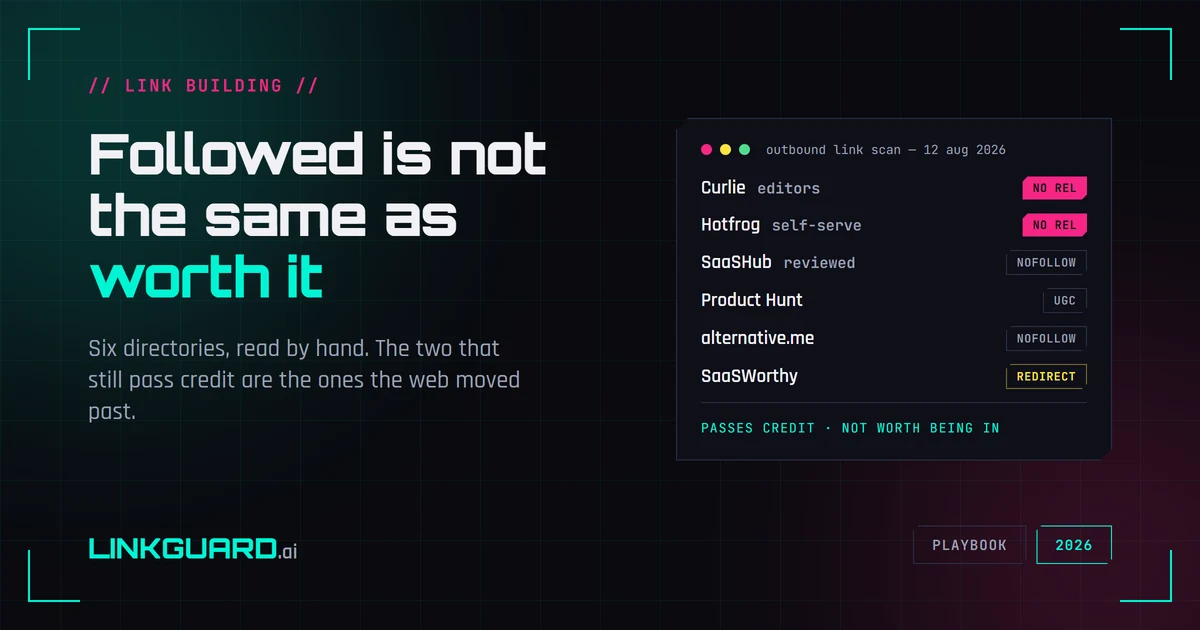
Google's spam policy names low-quality directory links as link spam. We opened six web directories and read the raw HTML: the two that still pass link credit are the general-directory survivors, while every vertical directory worth being listed in withholds it. What the tactic is still good for, and what to check once a listing is live.