You went looking for a "backlink manager," and the results can't agree on what one is. The first is a tool that emails you the morning a link dies. The next sells a toxicity score and a big red disavow button. A third turns out to be an outreach CRM for running link-building campaigns. Same two words, three different products, three different prices, and no page stops to say which one you came for.
So here's the untangling: what the term really covers, the three separate jobs hiding under it, how a "manager" differs from a monitor, an audit, and a checker, what Google thinks about you managing links at all, and the honest answer to whether you need one. If part of what brought you here is the quiet worry that a placement you paid for has already gone dead and nobody told you, that fear is the honest reason this whole category exists. I build one of these (the monitoring kind), so treat the last section as the spot where I've got a stake, and weigh it accordingly.
Nobody actually owns the term "backlink manager"
Start with the thing the marketing pages won't tell you: no major SEO authority defines "backlink manager." Ahrefs, Semrush and Moz all document backlink management as an activity — analyze your links, monitor them, audit the bad ones, disavow if you must — but none of them publishes a product or a glossary entry called "the backlink manager." It's a market label, stapled onto whichever slice of that work a given tool does.
Which means the useful question isn't "what is the backlink manager." It's "which job do I need done?" There are three, and most tools are strong at one.
The three jobs hiding under one name
1. Monitoring: keeping the links you already have. This is the always-on job: watch your existing backlinks and tell you the moment one changes. Linkody, for one, says its links are "monitored 24/7" and it flags when a link starts returning a 404 or 410, drops to nofollow, gets the wrong anchor text, or simply stops linking back (Linkody, from $14.90/mo). SE Ranking does the same shape of thing, alerting on new, lost, or modified backlinks and on anchor-text changes (SE Ranking Help). Nothing here discovers links for you; it guards the ones you point it at. The step-by-step of running that watch is a piece of its own: how to monitor your backlinks.
2. Auditing and disavow: cleaning up the bad ones. This is a periodic job, not an always-on one. Semrush's Backlink Audit scores every referring domain across 45 toxicity markers, tracks new and lost links in a "Lost & Found" report, and exports a one-click disavow file for Google (Semrush Backlink Audit docs). We pulled apart what that toxicity number does and doesn't mean in the Semrush backlink audit, explained.
3. Outreach management: getting new links. A different animal entirely. BuzzStream is a CRM for link building and digital PR: prospecting, bulk personalized outreach, automatic follow-ups, and a full conversation history per contact (BuzzStream). It manages the earning of links, not the keeping of them.
Most products sold as a "backlink manager" do one of these three well and wave at the other two. That's why the category feels muddy: you're comparing a watchman, a cleaner and a salesperson as if they were the same hire.
Manager vs monitor vs audit vs checker, in one breath
- Checker: a one-time snapshot of a link profile. You look, you close the tab.
- Monitor: always-on. It tells you when a link you already have dies or changes.
- Audit: a periodic toxicity review that ends in a disavow file.
- Manager: the umbrella word for doing some mix of the above, on an ongoing basis.
"Manager" is the fuzziest of the four precisely because it's the umbrella. When a page calls itself one, read on to find out which of the three jobs it does.
Does Google even want you managing your backlinks?
If "managing backlinks" in your head means policing and disavowing them, Google is quietly telling you to relax. Its own disavow documentation is blunt: "In most cases, Google can assess which links to trust without additional guidance, so most sites will not need to use this tool," and it warns the feature is "advanced" and, used wrong, "can potentially harm your site's performance in Google Search results" (Google Search Console Help).
Google's John Mueller put it more plainly on Bluesky in March 2026: "The disavow file is a tool, not a religion :-)" — his point being that most sites don't need it, though a few legitimately do (Search Engine Journal, March 2026). So the anxious version of link management (hunt down every scary-looking link and disavow it) is mostly wasted effort, and occasionally a self-inflicted wound. The management that actually pays off is the quiet kind: not losing the good links you already earned.
So do you actually need one?
It comes down to what you've got to lose.
A small site with a handful of links and no paid placements: probably not. Google auto-handles trust, disavow is an edge case, and running a free Search Console check now and then covers you. A dedicated tool is solving a problem you don't have yet.
A profile you invested in — links you earned or paid for: this is where monitoring earns its keep, because links rot. Ahrefs' 2024 link-rot study found that 66.5% of the links it sampled had rotted over the years, and the rate climbs on sites with more live links to begin with (Ahrefs, 2024). The more you've built, the more quietly leaks away, and a paid link that flips to nofollow or drops off entirely is money you're no longer getting.
An agency juggling many clients' profiles: different job again. At that scale the outreach-CRM category exists for a reason, and you're managing pipelines and relationships, not just watching for dead links.
The honest test: if one of your links vanished tomorrow, would you notice, and would it matter? If both answers are yes, you want something managing them. If either is no, keep the subscription in your pocket.
Where I sit in this
LinkGuard is the monitoring kind, so this is the interested part. It watches the links you've already earned and tells you when one dies, gets deindexed, flips to nofollow, or has its anchor quietly changed, across whatever donors you're tracking. It doesn't discover new backlinks and it doesn't run outreach; it's a watchman, not a crawler or a salesperson, and it can only see the links you tell it about. For sizing up a single donor before you chase a link, the donor trust audit is free, and the fuller picture of the monitoring job lives on the backlink manager page. If you want the whole management picture instead — know, monitor, audit, recover — there's how to manage your backlinks. If what you actually need is the audit-and-disavow slice, that's Semrush's turf, not ours. And if you're weighing named tools against each other, we laid three of them side by side in Ahrefs vs Linkody vs Monitor Backlinks.
None of this moves Google on its own. Monitoring catches loss; it doesn't manufacture rankings. But a link you don't know you lost is a link you can't go fix.
Questions people ask
What is a backlink manager?
It's a loose market term for a tool that helps you handle your backlinks on an ongoing basis — usually by monitoring existing links for loss or changes, sometimes by auditing and disavowing toxic ones, and occasionally by managing outreach to earn new ones. No major SEO authority defines the term precisely, so different products mean different things by it. Check which of those three jobs a given "manager" actually does before you buy.
Is a backlink manager the same as a backlink monitor?
Not quite. Monitoring is one job a manager might do: the always-on watching of links you already have, with alerts when one dies or changes. "Manager" is the broader umbrella term that can also include auditing, disavowing, or outreach. Every monitor is a kind of manager; not every manager is only a monitor.
Do I need a backlink manager for a small website?
Usually not. If you have a handful of links and haven't paid for placements, Google handles trust automatically and an occasional free check in Search Console is enough. A dedicated tool starts to pay off once your link profile is large or valuable enough that silently losing links would cost you.
Does Google require you to manage or disavow backlinks?
No. Google's own guidance says most sites will never need the disavow tool, and warns it can harm your site if used carelessly. John Mueller has called disavow "a tool, not a religion," adding that most sites don't need it. Actively policing your backlinks is rarely necessary; watching that the good ones survive is the more useful habit.
What's the difference between a backlink manager and Semrush's Backlink Audit?
Semrush's Backlink Audit is the audit-and-disavow slice: a periodic toxicity review that scores links and builds a disavow file. A backlink manager in the monitoring sense does a different job: it watches your existing links continuously and alerts you to loss or changes, rather than scoring toxicity. Many sites want the monitoring far more often than they'll ever want to disavow anything.
The short version
"Backlink manager" isn't one thing: it's three jobs (monitor, audit, outreach) wearing one label, and no authority pins the term down. Google doesn't want most sites policing or disavowing links, so the management that matters is keeping the good links you already earned from quietly dying. Small site, few links: you probably don't need a dedicated tool. A profile you've invested in: you want something watching it. If the job you've decided you need is the monitoring one — keeping the links you already earned, not auditing or outreach — start free with 1,000 free tokens (~83 checks), no card, and point LinkGuard at the links you can't afford to lose.
About the Author

Related Articles

Link juice and link equity: what actually passes through a link
Google's documentation says PageRank is still part of its core ranking systems. The arithmetic everyone teaches for it was last restated by a Google employee in 2009, inside his own disclaimer. Both of those are on the record.
A ranking dropped: what to rule out, in order
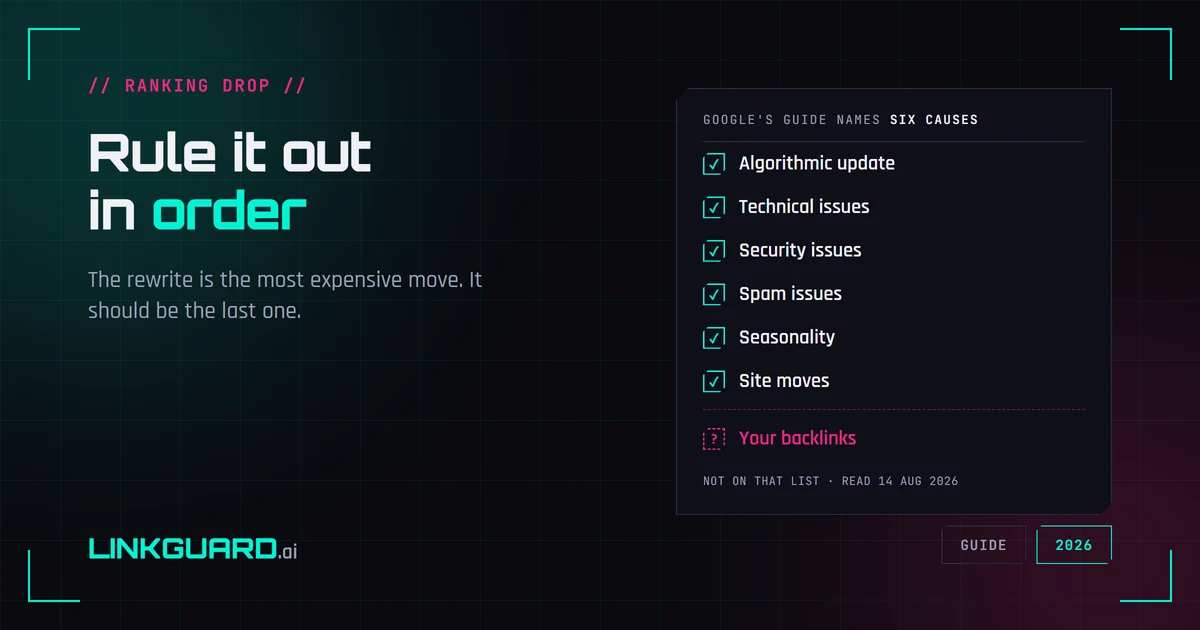
Google publishes a debugging guide for Search traffic drops. It names six causes, and backlinks aren't among them — the word doesn't appear on the page. That's not an oversight, it's a boundary: the guide covers Google's side of the glass. Here's the full elimination order, from measurement artifacts to the box almost nobody opens, with the rewrite saved for last.
Why your SERP position is three different numbers
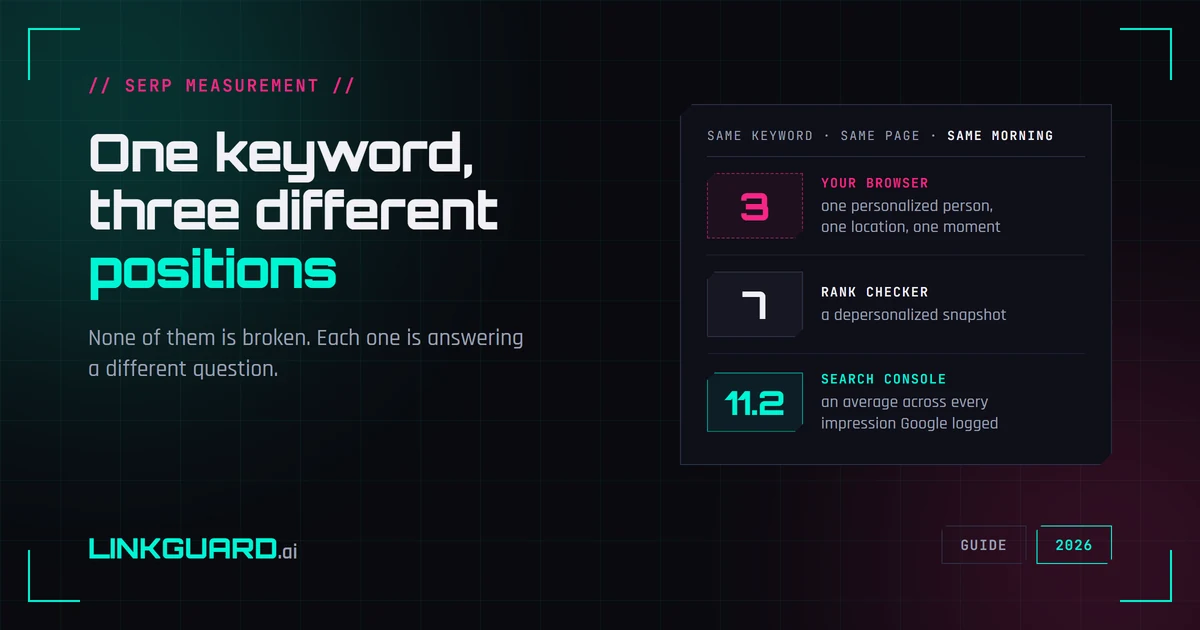
Your browser puts you third. Your rank tracker says seven. Search Console says 11.2. Same keyword, same page, same morning — and none of the three is broken. They answer different questions, and Google documents most of the difference itself. What each number measures, two things I checked live this week that contradict the standard advice, and the one figure worth putting in a client report.