You're comparing backlink monitors and the search results aren't helping. Half the "best tools" lists are affiliate posts ranking their highest payout. The other half still recommend a product that got acquired and stopped being itself two years ago. And somewhere in there you just want to know: is Ahrefs overkill, is Linkody too basic, and is Monitor Backlinks even a real option anymore?
Fair warning before we go further: LinkGuard is a fourth tool in this category, and I built it. So I'm not a neutral reviewer — I'm the founder of one of the options. What I can promise is that I'll tell you where each of these three wins, where they beat me, and which to pick if it isn't us. Every price below was checked on each vendor's own site on 3 August 2026; tools rename plans and shuffle pricing constantly, so confirm the number before you buy.
This compares the three names people actually search together — Ahrefs, Linkody, and Monitor Backlinks — for the specific job of watching backlinks you already have. For the full field, including the rest of the monitors, there's our complete backlink-monitoring roundup. Here I'm staying with these three (plus a note on where I fit).
First, the split nobody names: checker vs monitor
A backlink checker gives you a snapshot — who links to you today. A backlink monitor watches that list over time and alerts you when something changes. Most comparison posts blur these together, and it's the difference that should drive your whole decision.
Ahrefs is, at heart, a discovery-and-research suite that happens to include monitoring. Linkody and Monitor Backlinks are dedicated monitors. They sit in different weight classes, and the right pick depends entirely on whether you need to find links across the web or just keep the ones you've earned. Hold that distinction; it does most of the work here.
Ahrefs: the suite, with monitoring bolted in
Ahrefs is the heavyweight. It runs one of the largest link indexes in the business (the company claims tens of trillions of links and fast re-crawls), and for discovering who links to you and your competitors, nothing on this list comes close. The backlink monitoring (new, lost, broken-link alerts) lives inside Site Explorer and Alerts.
The catch is price, and it's a moving target right now. In January 2026 Ahrefs launched a Starter plan at $29/month — a big cut to the old entry point. But read the fine print: Starter is light (limited credits, one project, basic research) and the real backlink toolset and alerts effectively need Lite at $129/month. So the honest line isn't "Ahrefs from $29" and it isn't the old "Ahrefs from $99" either. It's: you can get in the door for $29, but practical backlink monitoring sits at $129.
Who should pay that? People who need the whole machine — competitor link research, keyword data, site audits, rank tracking — and treat monitoring as one feature among many. If link discovery is the job, Ahrefs wins this comparison outright and it's not close. If you only want to babysit a list of links you already know about, you're renting a warehouse to store a bicycle. There's a piece on exactly when an Ahrefs seat is overkill for link watching if that's where you've landed.
Linkody: the cheap, focused monitor
Linkody is the opposite proposition. No suite, no discovery ambitions: just dedicated backlink monitoring, and it's been doing it since around 2015. It watches your links 24/7, alerts you on gained, lost, and nofollow changes, pulls in Moz's Domain Authority and Spam Score, has a built-in disavow tool, and does white-label PDF reports that small agencies like.
Pricing is its pitch. The entry Webmaster plan is $14.90/month for 2 domains and 500 monitored links, scaling up to a $153.90 Agency XL tier. (You'll see a "$9.90" figure floating around third-party blogs — that's stale; Linkody's own page says $14.90.) There's a 30-day trial with no card.
Where Linkody shows its age is the experience. The dashboard feels like its 2015 vintage, there's no JavaScript-rendered fetching (so links on modern Webflow or React donor pages can read as "lost" when they're fine), and there's no AI anywhere. None of that matters if you want cheap, simple, set-and-forget monitoring on straightforward sites — for that, Linkody is hard to beat on sticker price. If "cheapest flat monthly fee" is your single criterion, Linkody wins and you can stop reading. We don't try to out-cheap it; there's a fuller Linkody versus a no-subscription monitor breakdown if you want the trade-offs.
Ahrefs vs Monitor Backlinks: read this before you sign up
Here's the one the listicles get wrong. Monitor Backlinks was acquired by SEOptimer in August 2023 and folded into SEOptimer's platform. The standalone product you're picturing — the one those 2026 "best tools" posts still recommend, isn't really being developed as its own thing anymore.
What that means in practice: you now have two ways in, and both work. The legacy app lives on under SEOptimer, still takes new signups on a 30-day trial, and still lists its own ladder — $25/month for one domain and 2,500 monitored links, up to $249.90 for ten domains (every tier above the $25 one currently carries a 5-25% promotional discount, so check what their page shows you). Or you buy SEOptimer itself, where monitoring starts at $39/month on the White Label plan (the $29 DIY plan is audit-focused and doesn't include it). What you can't buy is a roadmap. SEOptimer's own page calls the original the legacy tool, and its CEO has said the plan is one brand for everything. We pulled that apart in our Monitor Backlinks alternative comparison.
I wouldn't start fresh on Monitor Backlinks in 2026. Not because it's bad. It's a solid tool, and 2,500 links for $25 is still generous. But the company that owns it files it under legacy, and that's a bet you don't need to make when Linkody costs less and is actively developed. If you're already on it and happy, stay. If you're choosing today, that word — legacy — is the whole decision.
So where does LinkGuard fit?
This is the part where I'm supposed to declare myself the winner. I won't, because that's exactly the move that makes a founder-written comparison worthless. So here it is straight.
LinkGuard is a dedicated monitor, like Linkody — we watch the links you already have and alert you when one is removed, redirected, nofollowed, or has its anchor quietly edited. Two things make us different: we run a JavaScript-capable fetcher (so modern donor pages don't throw false "lost" alerts), and we price by pay-as-you-go prepaid tokens instead of a monthly subscription. Roughly $25 covers monitoring around 190 links at our default twice-weekly cadence, you start with 1,000 free tokens and no card, and the months you don't run checks, you owe nothing. That last part is the point. If your monitoring is seasonal or project-based, you're not paying a subscription to watch nothing in the quiet months: a flat $29 plan still bills you about $87 over three idle months, for zero checks run.
Now the boundaries, because a comparison without them is an ad. Short version: you're trading a decade of track record for modern fetching and no-subscription pricing. The specifics:
- We do not discover backlinks. We don't run a web index. If you need to find links you don't already know about, that's Ahrefs, full stop — not us.
- We don't assign a toxicity score or audit your profile. Our donor scoring is a rule-based heuristic, not AI magic; the only real AI in the product is a Claude-written summary of your alerts.
- If you check a tiny profile once in a while, a free tier elsewhere (Linkwatcher has one) or just Google Search Console beats paying us anything. Below roughly 50 checks a month, free wins.
- We're young — a few months of real-world use, a solo-founder product, no public reviews yet. If named social proof and a decade of track record are what reassure you, the older incumbents have that and we don't. Yet.
Right for some people, wrong for others. That's the whole spirit of this comparison.
How to choose, in one screen
Skip the feature matrix. It comes down to the job:
| If your job is… | Pick | Why |
|---|---|---|
| Finding links you don't know about + full SEO research | Ahrefs | Best index on the list; monitoring is a bonus. ~$129/mo for the real toolset. |
| Cheap, simple monitoring on straightforward sites | Linkody | $14.90/mo, focused, actively maintained. Dated UI, no JS fetch. |
| Monitoring on modern (JS) sites, seasonal or project-based usage | A pay-as-you-go monitor | No subscription in quiet months; JS fetch kills false "lost" alerts. |
| A tiny profile, checked occasionally | Google Search Console (free) | Don't pay anyone. GSC plus a quarterly skim is enough. |
| Starting fresh in 2026 | Probably not Monitor Backlinks | Cheap and still running, but its owner files it under legacy. |
Whatever you choose, the work after you choose is the same: set a checking cadence and actually look at the alerts. The quarterly backlink audit checklist is how to run that cadence without it becoming a chore. And two of our free tools do the spot-checks no matter whose monitor you land on — spot a dropped link and snapshot your link profile, both without a signup.
If you meant URLmonitor: that's a different tool
If you searched "urlmonitor alternative" and landed here — URLmonitor is a page-change watcher (it tracks edits to your own pages' titles, text, and tracking codes), not a backlink monitor. Different category entirely. If page-change monitoring is what you want, none of the tools above are the answer; if you meant backlink monitoring, the table covers you.
Frequently asked questions
What's the difference between a backlink checker and a backlink monitor?
A checker shows a one-time snapshot of who links to you today. A monitor re-checks that list on a schedule and alerts you when a link is added, removed, redirected, or switched to nofollow. Ahrefs leans checker-plus-research; Linkody, Monitor Backlinks, and LinkGuard are monitors. Pick based on whether you need to discover links or keep the ones you have.
Should I pick Ahrefs or Monitor Backlinks in 2026?
Different jobs, so start with the job. Ahrefs is worth $129/month only if you need to discover links and run research; for watching a list you already have, it's a warehouse for a bicycle. Monitor Backlinks is the cheaper watcher at $25/month for 2,500 links, and it still runs on a 30-day trial — but SEOptimer has owned it since August 2023 and calls it the legacy tool. If neither trade appeals, Linkody at $14.90 is the third answer.
Is Ahrefs or Linkody better for backlink monitoring?
For pure monitoring on a budget, Linkody — it's $14.90/month and built for exactly that. For link discovery, competitor research, and a full SEO suite where monitoring is one feature, Ahrefs, but expect to pay around $129/month for the real backlink toolset. They're different weight classes, not direct rivals.
How much does backlink monitoring cost in 2026?
It ranges from free to about $129/month. Google Search Console covers basic own-link checking for nothing. Linkody starts at $14.90/month. Pay-as-you-go options price by checks performed rather than a flat fee. Ahrefs' practical backlink tier is around $129/month. Match the spend to whether you need discovery or just monitoring.
Can I monitor backlinks for free?
For your own site, yes — Google Search Console shows the links Google knows about, and it's free. The catch is it won't alert you when a link disappears or changes, and it caps the list at a sample. For a small profile checked occasionally that's genuinely enough; paid monitors earn their keep on alerting, modern-site accuracy, and recovery workflows.
The honest takeaway
Ahrefs if you need to find links and run real SEO research. Linkody if you want cheap, simple monitoring and don't mind a dated dashboard. Don't start fresh on Monitor Backlinks — its owner files it under legacy. And if your monitoring is on modern sites or comes in bursts, a pay-as-you-go monitor (mine included, and I'll let you judge that) is worth a look precisely because you stop paying when you stop checking.
Want to try the no-subscription version on your own links? Start free with 1,000 tokens, no card — or just check if a link is even indexed first and decide nothing today.
About the Author

Related Articles

Link juice and link equity: what actually passes through a link
Google's documentation says PageRank is still part of its core ranking systems. The arithmetic everyone teaches for it was last restated by a Google employee in 2009, inside his own disclaimer. Both of those are on the record.
A ranking dropped: what to rule out, in order
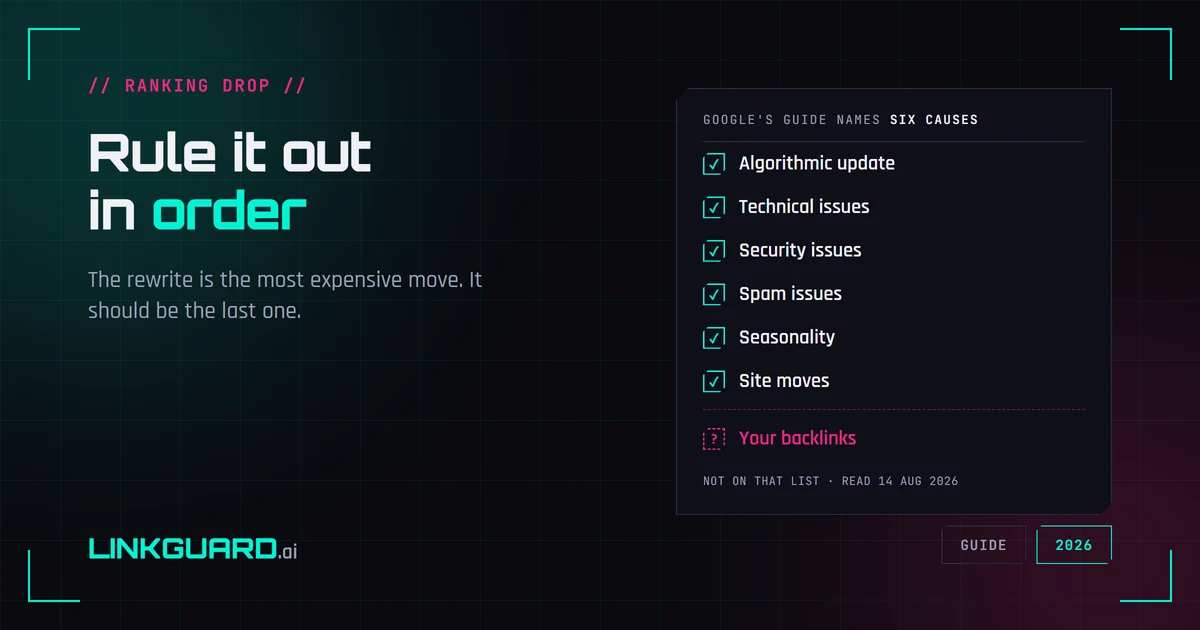
Google publishes a debugging guide for Search traffic drops. It names six causes, and backlinks aren't among them — the word doesn't appear on the page. That's not an oversight, it's a boundary: the guide covers Google's side of the glass. Here's the full elimination order, from measurement artifacts to the box almost nobody opens, with the rewrite saved for last.
Why your SERP position is three different numbers
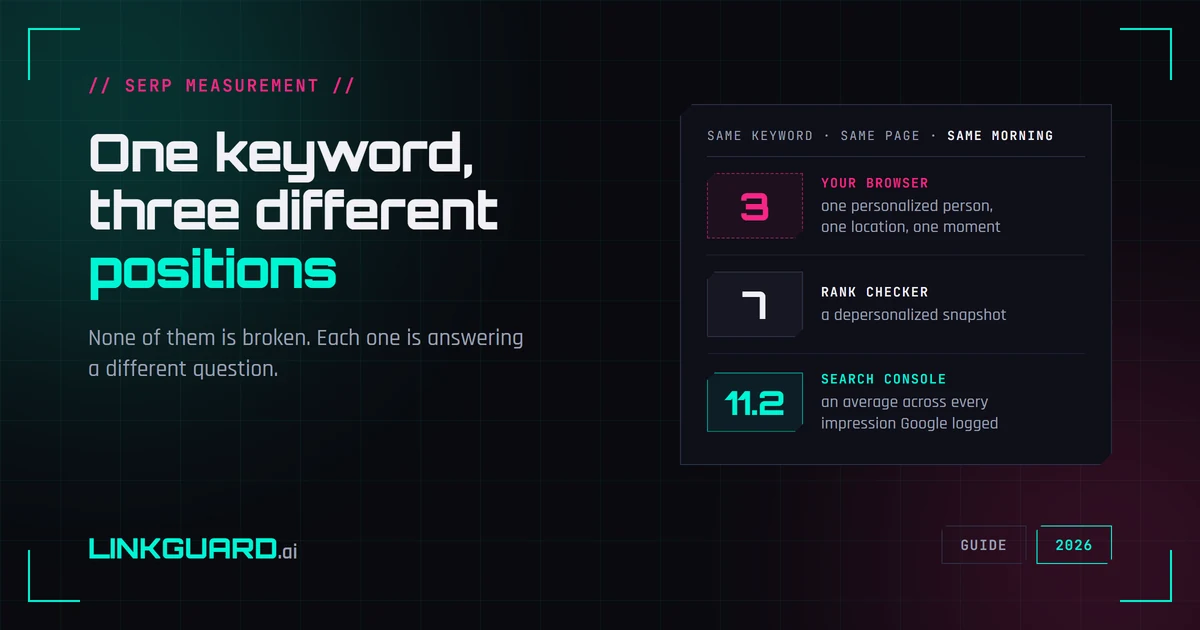
Your browser puts you third. Your rank tracker says seven. Search Console says 11.2. Same keyword, same page, same morning — and none of the three is broken. They answer different questions, and Google documents most of the difference itself. What each number measures, two things I checked live this week that contradict the standard advice, and the one figure worth putting in a client report.