Pricing pages don't answer the question you're asking. They quote tiers: 200 links, 500, 2,500. You want to know what your portfolio costs to watch, at the frequency your work needs, per month. The short version: dedicated monitors start at $14.90 to $39 a month for 200 to 500 links, research suites that carry backlink data start at $29, and metered tools price per check instead.
Disclosure: we sell one of the four pricing models below, the metered one. Below we show, with numbers, where that model is the wrong thing to buy. Every price here came from the vendor's own pricing page on 2 August 2026; they move, so check before you commit.
Don't you already pay for this?
If you have an Ahrefs or Semrush seat, you already have backlink data, including new and lost link reports. For a lot of people the honest answer to "what should I spend on monitoring" is nothing extra, and any article that skips this question is selling you something.
The difference is what each tool is built to answer. A suite answers "what changed in this domain's backlink profile", on its own crawl schedule, for the links its crawler happened to find. A dedicated monitor answers are these specific links, the ones you paid for or earned, still there right now? You supply the list, you set the schedule.
Tracking twenty links, live in the suite. Four hundred placements across nine clients, on the suite's crawl schedule, is a different job. That's the whole case for spending anything.
Four ways backlink monitoring gets priced
Every price below resolves to two variables: how many links you watch, and how often each gets checked. The packaging is what makes comparison hard.
Per-link tiers. You pay for a link ceiling; the vendor fixes the frequency. Simple to compare, and it punishes you at the boundary: one link over and you buy the next tier.
Bundled into a research suite. Monitoring rides along with everything else. Cheap if you need the suite, expensive if monitoring is all you wanted.
Seat-based. Priced by people, not links. Fine for an agency with many hands. A solo operator watching 3,000 placements pays for one seat and gets everything, which is the only time this model is a bargain.
Credit or token metering. You pay per check performed. Idle months cost nothing; aggressive checking gets expensive fast. We built our pricing this way. That's the stake we declared at the top.
What backlink monitoring costs across the market today
This is a tier ladder, not a verdict on which tool is better. For that, we keep a roundup at best backlink monitoring tools, including where we're not the answer. Prices are per month; "buys" is monitored links unless the cell says otherwise.
| Tool | Entry | Buys | Next rung | Free |
|---|---|---|---|---|
| Linkody | $14.90 | 500 | $24.90 / 2,000 | 30-day |
| LinkChecker.pro | $25 | 400 | $50 / 1,000 | — |
| Linkwatcher | $29 | 500 | $69 / 1,000 | 25 links |
| BacklinkManager | $39 | 200 | $99 / 1,000 | Yes |
| Ahrefs | $29 | Starter, metered | $129 Lite | Yes |
| Semrush | $139 | SEO plan | $199 Starter | 10/day |
| LinkGuard | $25 once | 25k tokens | no tiers | 1k tokens |
Higher up the ladders the spread widens sharply. At 2,500 links, LinkChecker.pro is $100 and Linkwatcher $129; at 5,000, Linkody is $49.90 and BacklinkManager $249. That gap, not the entry price, is what decides your bill in two years.
Two footnotes. BacklinkManager's figures are the monthly-equivalent rates on annual billing; it sells a monthly plan too but doesn't publish that price. LinkChecker.pro discounts about 20% for annual.
The arithmetic, at three portfolio sizes
Frequency decides your bill on a metered plan and your value on a fixed one — on a per-link tier you pay the same whether the vendor checks daily or weekly. One rule saves more than switching vendors: check daily for the first 30 to 45 days after a placement goes live, because that's when removals cluster, then weekly for everything that isn't a money page. Cadence is its own question, worked through in our backlink monitoring workflow.
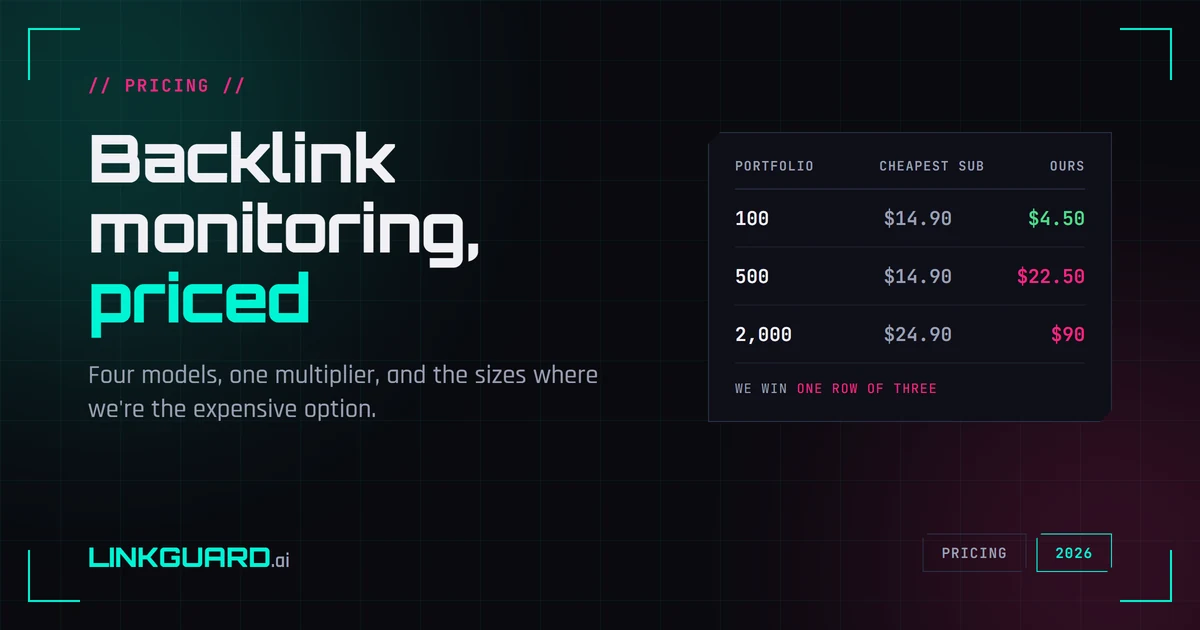
Our tokens cost about $0.001 each at the $25 pack. Monitoring runs 45 tokens per link per month on the economy schedule, 130 on the default, 585 on the most aggressive, covering both checks: link still there, page still indexed. Liveness alone is about 40% less. Below, that's multiplied out at the $25-pack rate, even where a bigger pack would be cheaper. The last three columns are ours; the "cheapest sub" column is Linkody's Webmaster plan at 100 and 500 links, and its Advanced plan at 2,000. All figures are dollars per month.
| Links | Cheapest sub | Economy | Default | Aggressive |
|---|---|---|---|---|
| 100 | $14.90 | $4.50 | $13 | $58.50 |
| 500 | $14.90 | $22.50 | $65 | $292.50 |
| 2,000 | $24.90 | $90 | $260 | $1,170 |
One row is ours to win. At 100 links the economy schedule runs $4.50 against Linkody's $14.90, and the default still lands under. Everywhere else we lose, and not narrowly: 500 links costs $22.50 on our lightest schedule against that same $14.90, and 2,000 links costs $90 against Linkody's $24.90 Advanced tier. That's not a flaw in the model, it's the model — if you want everything checked twice a day forever, a flat subscription is the better deal and you should buy one.
Read our figures as token-burn rates, not invoices: the smallest pack is $25, which at the 100-link economy rate lasts about five and a half months. And your portfolio is none of these three sizes. Signing up puts 1,000 free tokens in the account with no card, about 83 full checks — enough to read your own number instead of estimating it: start free.
The costs that aren't on the pricing page
You budget $99 for a 1,000-link tier in January. In March a client migration adds 60 links and you're over the ceiling. What happens next is worth checking before you buy, because vendors don't handle it the same way and most don't publish which way: some bump you a tier, some charge overage, some stop checking the extras. Nothing about your work changed. You crossed a line someone else drew.
Same family, different shapes. Annual commitments lock the tier for twelve months. Some plans keep counting a link you deleted until the billing period rolls over. Re-check limits cap how often you can force a manual verification, which bites on exactly the link you're arguing about with a publisher.
So: what happens the day I cross the tier? Does deleting a link free the slot immediately? Can I force an on-demand re-check without burning a quota? Send those three before you pay. It's the same argument we've made about our own pricing in why we don't charge for portfolio size.
When not to buy anything, including ours
Under about 50 links, a spreadsheet and Search Console will do it and no vendor on this page is worth the line item. That stops working when you can't hold the list in your head, when someone else is paying you to be accountable for those links, or when the gap between a link dying and you noticing costs more than the subscription — for most people somewhere between 50 and 150 links, sooner if the links were paid for.
Run the other side of that arithmetic once, because it's the number nobody puts on a pricing page. Take whatever you last paid for a placement, assume it died in month two and you found out in month six: that's the fee plus four months of whatever it was doing for you, against $4.50 a month to watch a hundred links. The question was never whether the tool is cheap. It's whether it costs less than finding out late — and the number that hurts is the one you say out loud when a client asks why the link they're paying for isn't there.
Ours is the wrong buy above a few hundred links checked daily, or on a large stable portfolio at maximum frequency — both are flat-subscription jobs, and the two losing rows above are the rule, not the exception. What the table can't show is the third reason to skip us: if an identical invoice matters more to your finance process than paying for what you use, that's a real reason and we don't have an answer for it. Pay-as-you-go earns its keep in the opposite conditions — portfolios under a few hundred links, work that arrives in bursts, a client roster that changes, and no monthly floor. Still working out what a monitor does before you price one? Start with what a backlink manager is.
Questions people ask
How much does backlink monitoring cost?
Dedicated monitors start around $14.90 to $39 per month for entry tiers covering 200 to 500 links. Above that the ladders diverge hard. 5,000 links costs $49.90 at Linkody and $249 at BacklinkManager, so where a vendor's tiers land matters more than its entry price. Research suites carrying backlink data start at $29 on Ahrefs' Starter plan and $139 on Semrush's cheapest tier — though Starter is metered by report credits rather than sold as a full seat, so treat it as an entry point and not a like-for-like substitute. Metered options price per check instead: cheaper at low volume, more expensive at high frequency. All figures checked 2 August 2026.
Is backlink monitoring worth paying for?
It depends on accountability more than portfolio size. If you paid for the links, or someone pays you to keep them alive, the cost of finding out late is usually larger than the subscription. If the links were earned, the portfolio is small, and nobody invoices anyone over them, a monthly manual check is a reasonable substitute.
What's the cheapest way to monitor backlinks?
Free, using Search Console and a spreadsheet, which works well under roughly 50 links. Past that the cheapest paid entry points are Linkody at $14.90 per month and LinkChecker.pro at $25, with metered options coming in lower at small volumes and higher at high check frequencies.
How much does it cost to monitor 1,000 backlinks?
On a subscription, between about $24.90 and $99 a month depending on the vendor's ladder — the spread at that size is wider than at entry, which is why tier shape matters more than sticker price. On our metered pricing, 1,000 links runs $45 a month on the economy schedule and $130 on the default. Above a few hundred links checked often, a flat subscription is usually the cheaper instrument.
Why do backlink tools price by number of links?
Because checking a link costs the vendor a page fetch, and often an index lookup on top, so their cost scales with links multiplied by frequency. Per-link tiers are the simplest way to package that. The trade-off is that a tier charges you the same whether you use the frequency you're paying for or not.
Work out your own number first
Count your links. Pick the frequency you'd defend to a client, not the one that sounds thorough. Multiply. If the answer is under $15 a month, you don't have a tooling problem — your spreadsheet is fine. If it isn't, you now know which of the four models you're shopping for, which is the part the pricing pages won't tell you.
About the Author

Related Articles

Link juice and link equity: what actually passes through a link
Google's documentation says PageRank is still part of its core ranking systems. The arithmetic everyone teaches for it was last restated by a Google employee in 2009, inside his own disclaimer. Both of those are on the record.
A ranking dropped: what to rule out, in order
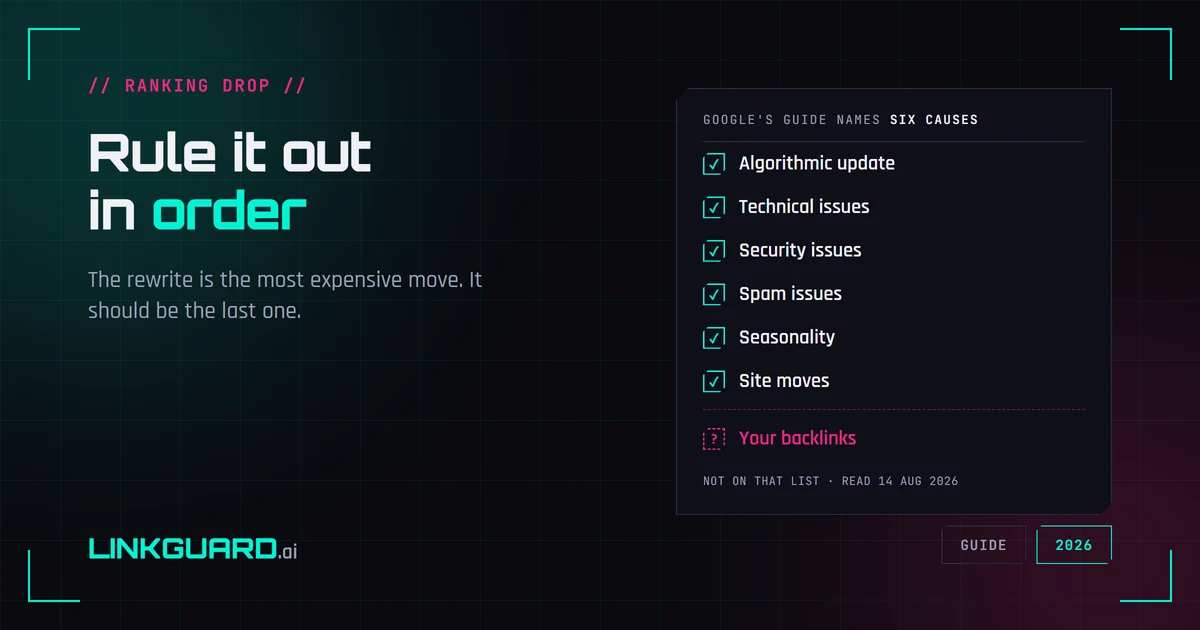
Google publishes a debugging guide for Search traffic drops. It names six causes, and backlinks aren't among them — the word doesn't appear on the page. That's not an oversight, it's a boundary: the guide covers Google's side of the glass. Here's the full elimination order, from measurement artifacts to the box almost nobody opens, with the rewrite saved for last.
Why your SERP position is three different numbers
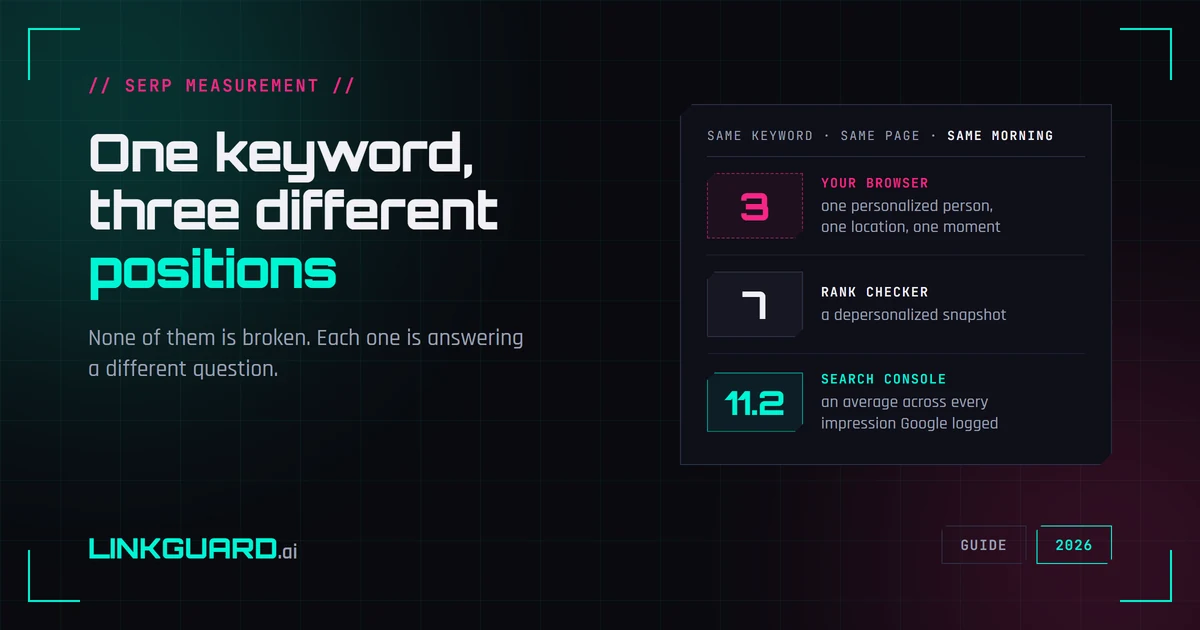
Your browser puts you third. Your rank tracker says seven. Search Console says 11.2. Same keyword, same page, same morning — and none of the three is broken. They answer different questions, and Google documents most of the difference itself. What each number measures, two things I checked live this week that contradict the standard advice, and the one figure worth putting in a client report.