Short version: most backlink monitors bill you for how many links you store. LinkGuard bills you for the checks you run. If your monitoring load rises and falls, that's cheaper. If it's high and flat, it might not be — and I'll show you where the line sits.
Here's a bill that always bugged me. You're an agency. You take a client off for two months — seasonal, budget freeze, whatever. Your backlink monitor keeps charging the full subscription the whole time, for work it isn't doing. Two months, full price, zero checks run.
And you feel it every time you approve that invoice. It's not a huge number. It's just waste you can see: money for nothing. You sign off anyway, because switching tools is a pain.
Or this one: you add your 1,001st link. Nothing about your work changed. But you crossed a tier line, so the monthly bill jumps, including for hundreds of links you only glance at twice a year.
I built LinkGuard, and I priced it to kill both of those moments on purpose. You pay for the checks you run, not for links sitting in your account. Add 10,000 links and check 50 of them, you pay for 50. Pause for a month and you owe nothing — the balance is still there when you come back.
That's the idea. Below: why storage is the wrong thing to bill, a worked month of token math, the real comparison against the tools agencies put us next to, and — because no pricing model is a free lunch — the cases where pay-as-you-go is the wrong call and a flat subscription wins.
The hidden cost of billing by portfolio size
Almost every backlink monitor — Linkwatcher, Linkody, BacklinkManager — prices the same way. A monthly fee tied to how many links you store. 50 links on the free tier. A few hundred on the next one up. Cross the cap, move up a tier.
It's clean for their metrics. Predictable recurring revenue, easy to model. The problem is it bills the wrong thing.
Your cost as a link-builder isn't storage. Keeping a URL in a database costs fractions of a cent. The real cost is the checking — visiting the donor page, parsing it, confirming your link is still there, still dofollow, still indexed. That's the work, and that's where the compute goes. Portfolio-size pricing charges you the same whether you check a link hourly or never look at it again.
So two things happen. Idle months still cost full price. And big, mostly-dormant portfolios — the directory links, the old placements you review once a quarter — get billed at the same rate as the VIP links you watch every day.
What I bill for instead: checks, not links
LinkGuard runs on prepaid tokens. You buy a balance, and each check spends from it. The per-check cost is flat:
| Check | What it does | Cost |
|---|---|---|
| HTML check | Visit the donor, parse it, find your link | 5 tokens |
| Indexation check | Confirm Google still has the donor page indexed | 7 tokens |
| Full check | Both, run together | 12 tokens |
Signup gives you 1,000 tokens free, no credit card — about 200 HTML checks or 83 full ones, enough to put a live portfolio through real use before paying a cent. After that, the top-up packs are:
- Lite — $25 for 25,000 tokens
- Standard — $50 for 55,000 (a 10% bonus)
- Pro — $100 for 115,000 (15% bonus)
- Agency — $500 for 625,000 (25% bonus)
The balance doesn't expire. Cancel, walk away for six months, come back — it's exactly where you left it. Top up and decide it's not for you? Unused balance is refundable within 14 days. There's no subscription to forget to cancel, because there's no subscription.
The mental model flips. You're not renting a parking space sized to your busiest month. You're buying fuel, and you burn it only when you drive.
How token pricing works over a month
Tokens-per-check is the easy half. The question agencies actually ask is "what does monitoring one link for a month cost me?" That depends on cadence, and you set it per project. Three presets:
| Cadence | What runs | Tokens / link / month |
|---|---|---|
| Economy | HTML every ~5 days, indexation every ~10 | 45 |
| Balanced (default) | HTML every ~2 days, indexation weekly | 130 |
| Paranoid | HTML ~2×/day, indexation daily | 585 |
Multiply that by the token packs and you get the part that matters — how many links each top-up monitors for a month:
| Pack | Tokens | Links at Economy | Links at Balanced |
|---|---|---|---|
| Free signup | 1,000 | ~22 | ~7 |
| Lite — $25 | 25,000 | ~555 | ~190 |
| Standard — $50 | 55,000 | ~1,220 | ~420 |
| Pro — $100 | 115,000 | ~2,555 | ~880 |
| Agency — $500 | 625,000 | ~13,900 | ~4,800 |
The spread between Economy and Balanced is the whole point. The same $25 monitors 190 links if you watch them closely, or 555 if you check them lightly. You decide which links earn which cadence — VIP placements on Paranoid, the long tail on Economy — so you're never paying VIP rates for links that don't deserve them.
A worked example: one link, one month
Concrete numbers. A VIP placement you watch on Paranoid runs 585 tokens a month. At the Lite pack's rate ($25 for 25,000 tokens, so a tenth of a cent each), that's about 59 cents to watch one link twice a day, with daily indexation, for a month. A long-tail directory link on Economy costs 45 tokens over the same month: under a nickel. Nothing else lands on the bill — no per-seat fee, no minimum, no "you've used 80% of your plan" email. You can run that one VIP link and 200 sleepy directory links side by side and pay each its real cost, instead of a blended tier price that overcharges the cheap links to subsidize the expensive ones.
Is pay-as-you-go cheaper than a subscription for backlink monitoring?
For variable usage, usually. For flat-out constant usage, not always. Real numbers make it concrete.
Linkwatcher's Pro plan is $29/month and covers roughly 100–200 actively monitored links. Their free tier is 50 links, forever. On LinkGuard, $25 buys 25,000 tokens — about 190 links at the Balanced cadence, or past 500 if you check lightly. So at steady monthly use, we land in the same ballpark on price.
The gap opens up in the months you don't run flat out:
- Pause a client for two months? Linkwatcher's Pro plan costs ~$58 for those two months. LinkGuard costs $0, balance intact.
- A 2,000-link portfolio where 1,800 are low-priority quarterly checks? A subscription bills all 2,000 every month. We bill the checks you scheduled — put those 1,800 on Economy and they cost almost nothing between quarters.
Picture the good version. You pause three clients for the summer. Your monitoring bill for those three: nothing. No invoice to frown at in July, no line item to explain to whoever signs off on the company card. Come September the work picks back up, the balance you didn't burn is still sitting there, and you start checking again without re-subscribing to anything — no sales call, no re-onboarding, no "welcome back" upsell. That's the month pay-as-you-go is built for.
I'm not claiming we're always cheaper. I'm claiming you stop paying for time and links you aren't using.
Where pay-as-you-go is the wrong choice
No model wins everywhere, and I'd rather you know this before you sign up than feel cheated after. Pay-as-you-go loses in two clear cases.
Heavy, steady, high-volume monitoring. Run a large portfolio at the Paranoid cadence — say 500 links at ~585 tokens each — and you're burning around 290,000 tokens a month. That's real money. A flat-rate agency plan that doesn't meter usage can come out cheaper. When your load is high and constant, a fixed price you amortize beats a meter.
Tiny usage. If you only ever watch 30–40 links and check them now and then, a competitor's "50 links free forever" tier wins. Our 1,000 free tokens are generous for trying us out, but a permanent free tier you never outgrow is hard to argue with at that size.
The summary: we're built for usage that varies — seasonal agencies, mixed portfolios, projects that spike and go quiet. If your usage is a flat line, the advantage shrinks.
So who should pick what
Pick a flat subscription if your monitoring is high and steady and you'd rather not watch a meter.
Pick a free tier — ours or someone else's — if you're watching a few dozen links and that's the whole job.
And LinkGuard? It's for when your work looks the way most agencies' work does: clients come and go, some portfolios are huge but mostly quiet, busy months alternate with slow ones, and you're tired of paying full freight for the slow ones. Add every link you've ever built, ignore the ones that don't need attention this month, pay only for the checks you run.
If yours is a different shape, I'd rather you pick the tool that fits — the head-to-head math is on the Linkwatcher and Linkody comparison pages, and there's a straight roundup of the whole field on the alternatives page.
If that shape sounds like yours, start free: 1,000 tokens at signup, no credit card, no expiry.
FAQ
Do LinkGuard tokens expire?
No. The balance stays until you spend it. Pause for months and it's still sitting there.
How many links can I monitor on the free signup tokens?
1,000 tokens is about 200 HTML checks or 83 full checks — roughly 22 links monitored for a month at the Economy cadence, or a one-off spot-check of a much longer list.
What's the difference between pay-as-you-go and subscription backlink monitoring?
A subscription charges a fixed monthly fee tied to how many links you store, whether you check them or not. Pay-as-you-go charges only for checks performed, so idle months and dormant links cost nothing.
Is pay-as-you-go cheaper than a subscription?
For variable or seasonal usage, usually yes — you stop paying during idle months and for dormant links. For heavy, constant, high-volume monitoring, a flat subscription can be cheaper. It comes down to how steady your usage is.
Can I monitor 10,000 backlinks without upgrading a tier?
Yes. There are no portfolio-size tiers. You can store any number of links and pay only for the ones you check, at whatever cadence you set.
How do I decide which cadence a link gets?
Rule of thumb: the more a link is worth and the more likely it is to vanish, the closer you watch it. Paid placements and links on flaky sites go on a tight cadence; aged, stable links on big domains can sit on Economy and still get caught if something changes. It's set per project, and you can change it any time — nothing locks you in.
What happens if my balance runs out mid-month?
Monitoring pauses instead of overdrafting you. You're never billed past what you topped up, and you top up again when you're ready.
Can I get a refund on unused tokens?
Yes — unused balance is refundable within 14 days of a top-up. There's no subscription to cancel.
About the Author

Related Articles

Expired domain backlinks decay before the auction closes
Policy requires an expired .com to resolve to nothing for weeks before anyone can buy it. The links you're bidding on were counted before that, by a crawler that hasn't been back.

PBN backlinks don't fail one at a time
Google's spam documentation never uses the word. What a network link actually is in 2026, which footprints still identify one, and why four of them tend to go in the same week.
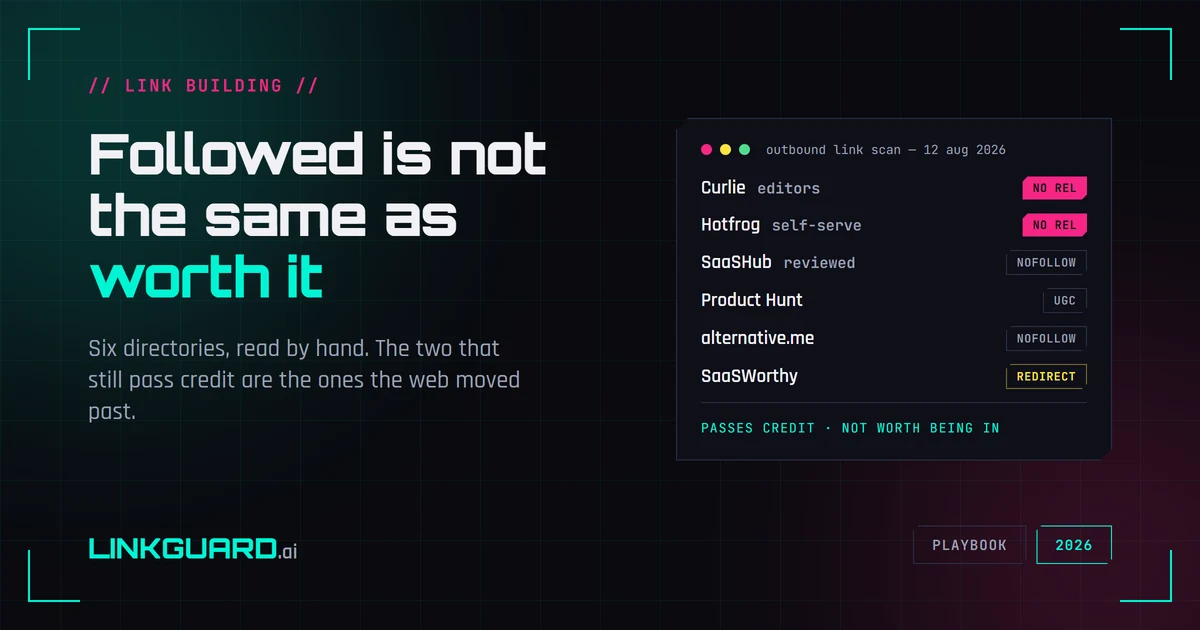
Directory submission in 2026: what a listing is actually worth
Google's spam policy names low-quality directory links as link spam. We opened six web directories and read the raw HTML: the two that still pass link credit are the general-directory survivors, while every vertical directory worth being listed in withholds it. What the tactic is still good for, and what to check once a listing is live.