Spoiler: links didn't die. They just got a new job.
Every year someone buries link building. In 2024, they said AI Overviews would kill organic traffic. In 2025 — that Zero-Click searches made SEO pointless. And now, at the end of 2025, we're seeing something interesting: 75% of URLs that Google cites in AI Overviews are in the top 12 organic results.
Guess how they got there.
What actually changed (and what didn't)
Links no longer work as "votes" in the old PageRank sense. That would be too simple.
Now links are truth verification layers for AI systems. Sounds complicated, but the idea is straightforward: large language models hallucinate. They make up facts, confuse dates, sometimes invent studies that don't exist. Google knows this. And to prevent Gemini from citing fabricated statistics in AI Overviews, the algorithms aggressively filter sources.
The filter works like this: if other authoritative sites link to you — you exist, you're trusted, you're safe to cite. No links? To the AI, you're unstructured data. Noise. Invisible.
The Google API leak: technical proof
In mid-2024, a massive leak of Google's internal API documentation hit the SEO community. I spent two weeks parsing through it with my team. Honestly — half of it didn't make sense on the first read.
But here's what became clear:
sourceType — Google explicitly categorizes where a link comes from. News site, blog, "small personal site." A link from the Wall Street Journal and a link from a Wix blog aren't just weighted differently. They're in different categories entirely.
navBoost — the system uses clickstream data from Chrome. Built a thousand links but nobody clicks them? They get devalued. Not immediately, but over time.
anchorMismatchDemotion — a specific penalty. If the link anchor doesn't match the target page's actual topic — demotion. This kills cheap programmatic link building with generic anchors.
And there's spamScore with anchorSpamCount. Google keeps historical memory of your link velocity. A sudden spike in low-quality links isn't just ignored — it can permanently flag a domain as "unsafe for AI citation."
Permanently. That part bothered me the most.
What the experts are saying
Tim Soulo, CMO at Ahrefs, late 2025:
"Citations are the new backlinks. Unlinked brand mentions correlate 3x more strongly with AI Overview citations than backlinks do. AI systems care more about whether people are talking about your brand than whether they're linking to it."
When I first read this, I thought: okay, so we can skip links and just do PR? But no. Mentions work alongside links, not instead of them.
Rand Fishkin from SparkToro explains the mechanics:
"It's not that the link is discarded. The LLM still associates your brand with the sentence and paragraph where it's mentioned. It confirms the entity relationship."
So even a nofollow link, even just a text mention — the LLM uses that proximity of your brand to relevant keywords to "learn" that you're an expert in that field.
And here's Lily Ray, SEO strategist, on the flip side:
"Generative AI has intensified the vicious cycle. Search results are flooded with repetitive, low-value content. Real opportunities remain for those who focus on authenticity and research that can't be copied."
Three stories: a failure, a win, and a lesson from forums
UrbanTrekker: how to become invisible
This case comes from an SEO agency's report (name changed). An outdoor gear e-commerce store, about 800 SKUs, decent on-page SEO. After the full AI Overviews rollout, they lost 40% of organic traffic.
Diagnosis: they had solid product descriptions, technically everything checked out. But zero external validation. Nobody linked to them. The AI Overview for "best hiking backpacks" pulled information from sites that major publications cited. UrbanTrekker simply didn't exist in the model's eyes.
They weren't demoted in rankings. They were just... ignored. Big difference.
Search Initiative: 2,300% growth in AI referral traffic
Another case, positive this time. A client pivoted to GEO — Generative Engine Optimization. Strategy: find sites that AI already uses as sources for answers, and build links/mentions specifically there.
Result: AI referral traffic grew 2,300% year-over-year.
Sounds unbelievable? I didn't buy it at first either. But the logic is solid: if you show up on sites the model already considers authoritative — it starts citing you too. You kind of "infect" it with your presence in the right places.
Forum links: it's complicated
And here's a third story — this one's messier.
One site built 3,000+ forum links in 6 months. Classic gray-hat link building. At first, everything grew. Then, 8 months later — crash.
Why? The updated "Helpful Content" systems (now integrated into core) determined the links had no "human engagement." Nobody clicked, nobody discussed, the threads were dead.
But — and this is an important "but" — active Reddit threads where the brand was discussed organically actually worked. One living Reddit thread turned out to be worth more than a hundred forum links.
Not because Reddit is somehow special. But because real people were actually discussing the product there.
The argument for skeptics: why spend budget if AI answers for users?
Say a stakeholder asks: "What's the point of links if users get answers right in the search results and don't click anything?"
Here's the answer.
First, the gates. AI Overviews don't invent facts — they summarize sources. 75% of cited URLs are in the top 12 organic results. You can't be cited in an AI Overview if you don't rank on page one. You don't rank on page one for competitive queries without links.
No links → no rankings → no AI citation → invisible brand.
Second, hallucination defense. LLMs are tuned to minimize risk. They prefer "high-consensus" information. Your link profile works as a "consensus engine." If 50 industry blogs link to your study — AI treats your data as "fact." If nobody links to it — it's "unverified information" that's better skipped.
Third, referral traffic. With Zero-Click searches rising to 60%, "ranking" matters less than "referral." Quality links on sites that real people actually read — industry portals, active newsletters — provide traffic that doesn't depend on Google's algorithm changes.
What to do: link building standards for 2026
I won't give you a perfectly formatted 10-point list. Here's what actually works:
Digital PR over guest posts. Aim for mentions in news outlets and research reports. sourceType: News is a VIP pass for AI trust. One quality link from Forbes or TechCrunch is worth hundreds of blog links.
"Seed sites." Find the top 3 ranking sites for your keywords. See who links to them. Build links from those same sources. This is "neighborhood optimization" — you become part of the same information cluster.
Knowledge Graph. Make sure your links use consistent N-A-P data (Name, Address, Phone) and Entity information. You're teaching a robot who you are. Inconsistent data = weak entity signal.
Also: Reddit and Quora are now Tier 1. Don't spam. Don't write "Check out our tool at..." Start genuine discussions. An active Reddit thread is now more valuable than a guest post on a DA30 blog, because Google trusts Reddit's "human signal."
Though... I've seen this backfire too. One client overdid the Reddit marketing, got banned from three subreddits. So, careful there.
Wrapping up (but not "in conclusion")
In 2026, link building isn't about "tricking the algorithm to rank higher."
It's about establishing the digital credentials an AI system needs to trust you enough to cite you. Without links, your brand is unstructured data. Noise. Invisible to the models that will curate the internet's future.
Links didn't die. They just got a new job — verifying reality for machines.
Sources:
- Google API Leak Documentation (mid-2024)
- Tim Soulo, Ahrefs CMO — Q4 2025 interview
- Rand Fishkin, SparkToro — 2025 SEO analysis
- Lily Ray, SEO Strategist — commentary on generative AI impact
- Botify research: AI Overview source analysis
- Originality.ai: AI content in search results study (September 2025)
Author: Bagdulin Maxim— 8 years in SEO. Lost a client in 2023 over unmonitored link rot. Been slightly paranoid about backlink tracking ever since.
About the Author

Related Articles

Expired domain backlinks decay before the auction closes
Policy requires an expired .com to resolve to nothing for weeks before anyone can buy it. The links you're bidding on were counted before that, by a crawler that hasn't been back.

PBN backlinks don't fail one at a time
Google's spam documentation never uses the word. What a network link actually is in 2026, which footprints still identify one, and why four of them tend to go in the same week.
Directory submission in 2026: what a listing is actually worth
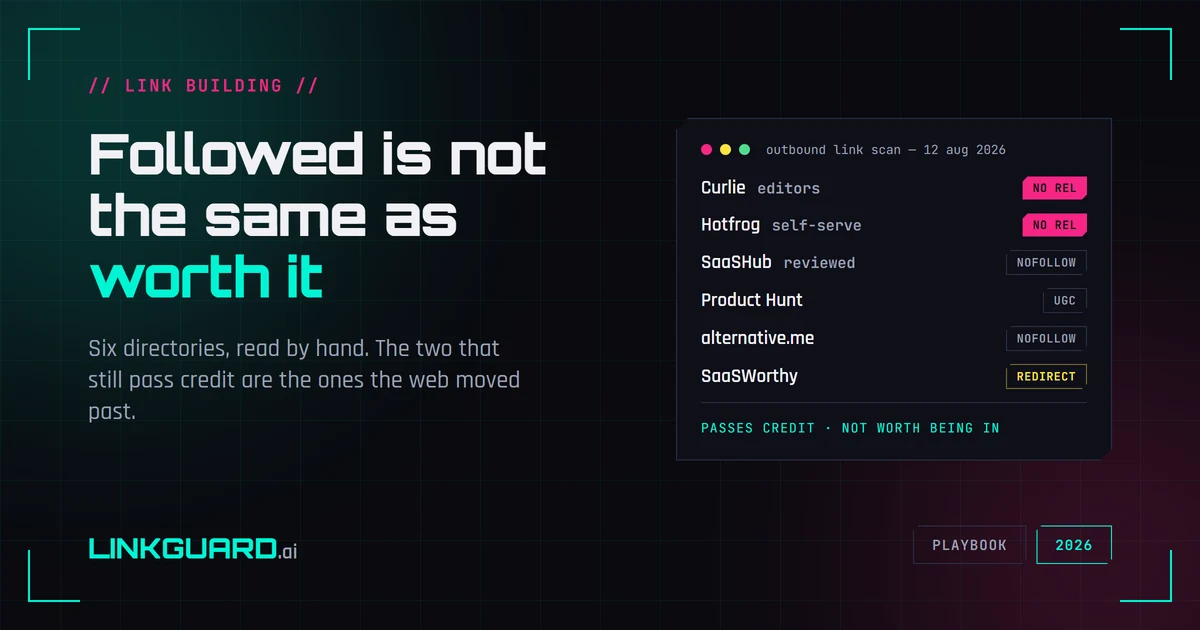
Google's spam policy names low-quality directory links as link spam. We opened six web directories and read the raw HTML: the two that still pass link credit are the general-directory survivors, while every vertical directory worth being listed in withholds it. What the tactic is still good for, and what to check once a listing is live.