You spent six months building backlinks. You hit page one. Traffic was growing. And then — silence.
Not a penalty. Not a competitor stealing your spot. Something worse: Google's AI Overview answered the user's question before they ever clicked your link. Your ranking stayed the same. Your traffic dropped 34%.
Sound familiar? If it doesn't yet, give it a few months.
I've been tracking this shift since late 2023, when Princeton researchers first published their GEO study. Back then, most SEOs dismissed it as academic theory. Now? 42% of marketers are actively optimizing for AI responses. The other 58% are watching their click-through rates evaporate and wondering what happened.
This article covers what GEO actually is (not the buzzword version), how it differs from traditional SEO, and what you can do about it without throwing out everything you've learned. We'll also look at which tactics work — and which ones backfire badly.
What is GEO, exactly?
GEO stands for Generative Engine Optimization. It's the practice of optimizing content so AI systems — ChatGPT, Google Gemini, Perplexity, Claude — cite you as a source when generating responses.
The distinction matters. With SEO, you're competing for position in a list of blue links. With GEO, you're competing to become part of the answer itself.
Think about how you search now versus two years ago. If you're like most people, you're increasingly asking ChatGPT or Perplexity direct questions instead of typing three-word queries into Google. According to OpenAI and Harvard research, 21.3% of ChatGPT prompts are now "search-like" queries. Perplexity processes 780 million queries monthly — up 192% year-over-year.
The term itself got serious traction after Pranjal Aggarwal and researchers from Princeton, Georgia Tech, and the Allen Institute for AI published "GEO: Generative Engine Optimization" in late 2023. Their finding? GEO techniques can boost your visibility in AI-generated responses by 30-40% compared to traditional SEO methods alone.
That's not a typo. 30-40%.
The real difference between GEO and SEO
I've seen people treat GEO like it's just "SEO but for AI." That's... partially true? But it misses the fundamental shift in what success looks like.
SEO success metric: You ranked. Users clicked. They landed on your site.
GEO success metric: The AI mentioned you. Users may never visit your site, but they trust your brand more because ChatGPT recommended you.
Here's a breakdown that actually makes sense:
What matters SEO GEO Main goal Get clicks from search results Get cited in AI responses Key signal Backlinks, domain authority Clarity, structure, cited sources Typical user query 4 words ("best running shoes") 23 words (conversational questions) Success looks like Position 1-3 in SERP Being the source AI quotes Traffic model Click-through to your site Zero-click brand awareness Now, here's what nobody tells you: the two aren't mutually exclusive. Danny Goodwin from Search Engine Land put it well:
"GEO has emerged as the label of choice in the evolving AI search paradigm. But SEO remains as important as ever. The job has evolved, not disappeared."
Good SEO creates the foundation GEO needs. If your site isn't crawlable, fast, and authoritative, AI won't cite you either.
What actually works (according to the research)
The Princeton study tested nine different optimization methods. Some worked spectacularly. Some made things worse. Here's the actual data:
Rising Impact of GEO Strategies on AI Search
Source: Princeton Study | Expert quotes lead with 41% boost
Source: Princeton University GEO Study (arXiv:2311.09735)
Source: Princeton University GEO Study (arXiv:2311.09735)
The winners
Expert quotes: +41% improvement. This was the single most effective technique. Adding real quotes from recognized authorities made AI systems far more likely to cite the content.
Statistics: +30% improvement. AI models treat numbered, sourced data as more trustworthy. Makes sense — they're trained to recognize factual patterns.
Source citations: +30% improvement. Clear attribution to external sources helped AI verify information. Sites ranking 5th in traditional SERP saw up to 115% visibility boost when they added proper citations.
Fluency and clarity: +22% improvement. Simple, logical sentences. Short paragraphs. Clear structure. AI models are, in a sense, lazy — they prefer content that's easy to parse.
The loser
Keyword stuffing: -9%. Yes, negative. The old-school SEO tactic of cramming keywords everywhere actively hurt GEO performance. AI systems recognized it as spam and ignored the content entirely.
I'll admit — when I first saw these numbers, I thought they were exaggerated. Then I ran my own tests on a few client sites. The keyword stuffing penalty was real. One article we'd "optimized" (in quotes because, well, we overdid it) got completely ignored by Perplexity while the competitor's cleaner version got cited repeatedly.
Why Reddit keeps showing up everywhere
If you've searched anything on Google lately, you've probably noticed Reddit results popping up constantly. That's not an accident.
Reddit now appears in 40.1% of all LLM citations across platforms. In Google's AI Overviews specifically, Reddit is the #1 cited domain — showing up in 21% of AI-generated responses.
Why? A few reasons:
- Conversational format. AI models were trained on discussion data.
- Question-answer structure. Perfect for extracting direct responses.
- Community moderation filters spam (mostly).
- Google signed a content deal with Reddit in 2024.
For brands, this creates an interesting opportunity — though not the one you might think. You can't just spam Reddit with promotional content. The platform will eat you alive, and AI systems will learn to ignore you.
What works is genuine participation. Notion figured this out early. They seeded useful, non-promotional contributions across relevant subreddits. Over time, AI models learned to recommend Notion because real users kept recommending it organically.
The uncomfortable truth about zero-click searches
Let's talk about the elephant in the room.
AI Overviews reduce click-through rates by 30-34.5% on average. For some queries — especially informational ones — 58-60% of searches now result in zero clicks. Users get their answer directly from the AI summary and never visit any website.
I know. It's frustrating. You did the work. You earned the ranking. And now Google's AI just... takes your content and summarizes it for users who never see your site.
But here's the thing — and I genuinely didn't believe this until I saw the data — brands that get cited in AI responses see higher trust and engagement when users do eventually visit.
A study from Relixir found that sites cited in AI Overviews saw +38% organic clicks and +39% paid ad clicks compared to non-cited competitors. The "halo effect" is real. If ChatGPT recommends you, users arrive pre-sold on your credibility.
Ross Simmonds, the marketing strategist, described it perfectly:
"The more likely you are to be sourced or included in a response to a query from AI, the more likely you are to become top of mind and have your website visited or brand engaged with."
What this means for your content strategy
So what do you actually do with all this? Here's my honest take after 18 months of watching this evolve.
First, don't panic and don't abandon SEO. 98.1% of ChatGPT users still also use Google. AI search is growing fast, but it's supplementing traditional search, not replacing it. If your SEO is solid, keep doing what works.
Second, restructure existing content for AI readability. This doesn't mean rewriting everything. It means:
- Adding clear TL;DR summaries (40 words or less) at the top of articles
- Breaking content into answer-focused sections that can stand alone
- Including specific statistics with named sources
- Adding expert quotes where relevant
- Using comparison tables for complex topics
Third, build your presence on platforms AI trusts. Reddit, Quora, LinkedIn thought leadership pieces. Not for backlinks — for direct citation potential.
Fourth, think about queries differently. Traditional SEO targets short keywords. GEO targets conversational questions. "Best CRM software" vs "What CRM should a 10-person B2B sales team use if they're currently on spreadsheets and have a $500/month budget?"
The queries are getting longer and more specific. Your content should answer them directly.
Where this is heading
Gartner predicts 50% of traditional organic search traffic will disappear by 2028 due to AI search. Whether that's accurate or overstated, the direction is clear.
The GEO market itself is projected to grow from $886 million in 2024 to $7.3 billion by 2031 — a 34% compound annual growth rate.
New job titles are emerging: Prompt SEO Specialist, AI Attribution Analyst, Overview Optimization Manager. Andreessen Horowitz noted in their analysis:
"Traditional search was built on links. GEO is built on language."
For SEO professionals, this isn't an extinction event. It's an evolution. The skills that made you good at SEO — understanding user intent, creating authoritative content, technical optimization — all transfer to GEO.
You just need to add new ones.
Quick action checklist
If you want to start optimizing for GEO today, here's what actually moves the needle:
- Add specific statistics with clear source attribution to your top-performing pages
- Include at least one expert quote per major article
- Create comparison tables for product/service pages
- Implement FAQ schema markup
- Write 40-word TL;DR summaries for long-form content
- Participate authentically on Reddit in your industry's subreddits
- Ensure your site loads fast and is mobile-friendly (this helps both SEO and GEO)
- Use clear heading hierarchies (H1 → H2 → H3)
- Stop keyword stuffing — seriously, it hurts now
And maybe most importantly: keep creating genuinely useful content. AI systems are getting better at identifying thin, unhelpful pages. The bar for "quality" keeps rising.
The brands winning at GEO aren't the ones gaming algorithms. They're the ones AI naturally wants to cite because the content is actually good.
This article draws on research from Princeton University's GEO study (arXiv:2311.09735), Search Engine Journal, Gartner, Andreessen Horowitz, and data from the Fractl survey of 342 marketing professionals.
About the Author

Related Articles

Link juice and link equity: what actually passes through a link
Google's documentation says PageRank is still part of its core ranking systems. The arithmetic everyone teaches for it was last restated by a Google employee in 2009, inside his own disclaimer. Both of those are on the record.

A ranking dropped: what to rule out, in order
Google publishes a debugging guide for Search traffic drops. It names six causes, and backlinks aren't among them — the word doesn't appear on the page. That's not an oversight, it's a boundary: the guide covers Google's side of the glass. Here's the full elimination order, from measurement artifacts to the box almost nobody opens, with the rewrite saved for last.
Why your SERP position is three different numbers
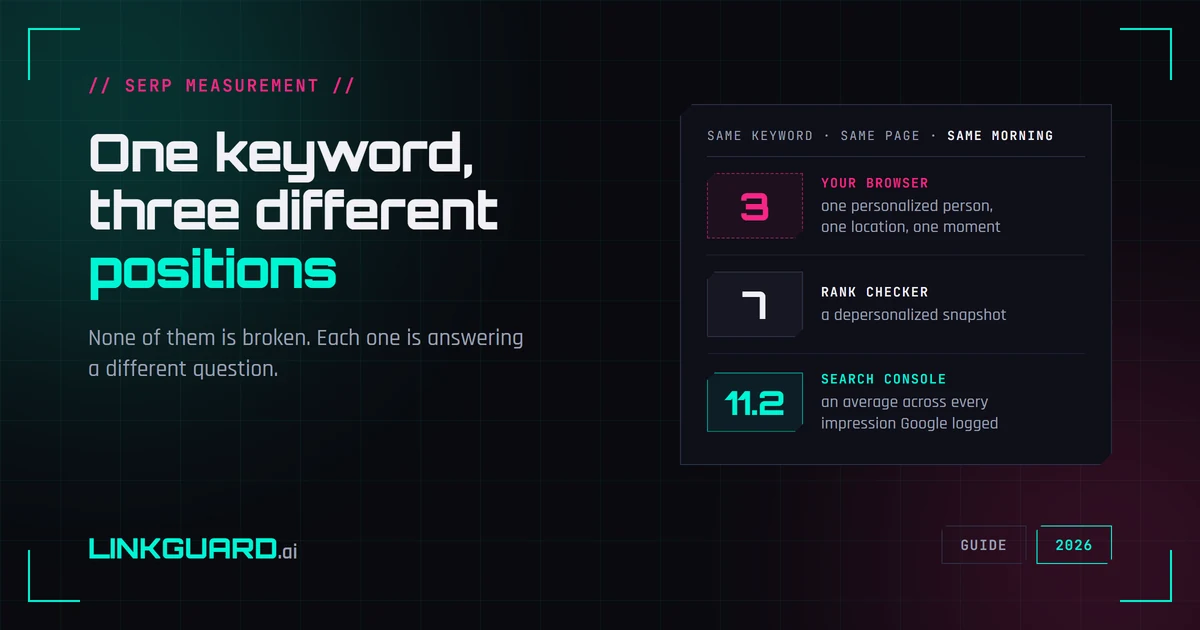
Your browser puts you third. Your rank tracker says seven. Search Console says 11.2. Same keyword, same page, same morning — and none of the three is broken. They answer different questions, and Google documents most of the difference itself. What each number measures, two things I checked live this week that contradict the standard advice, and the one figure worth putting in a client report.